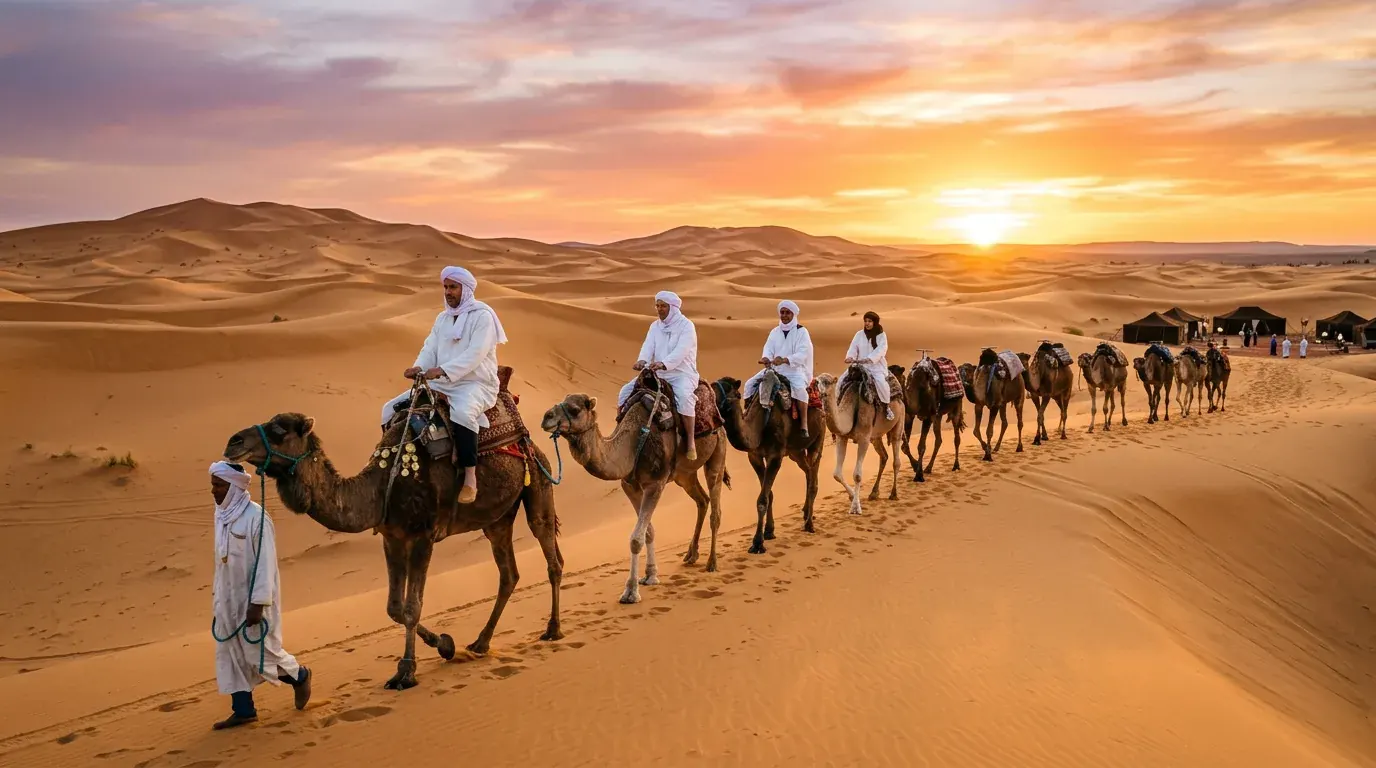
A 10-day family loop out of Marrakech — the red city, the Sahara and the Atlantic at Essaouira — built around children's energy levels, attention spans and the small print of travelling with kids: pool riads, drives that never overstay their welcome, and the camel ride no child ever forgets.
Itineraries · Updated June 2026 · 7 min read
Why is this the ideal family route?
This 10-day circuit out of Marrakech ties together the three things that make Morocco magic for children — the medina's full-volume assault on the senses, a camel trek and a sky full of desert stars, and the wind-scoured ramparts and beach at Essaouira — while keeping the driving days short enough that nobody melts down in the back seat. No single transfer runs past five hours. Every base has a riad or hotel with a pool, which in the warmer months is not a luxury but a survival tool. Drive it yourself in a private car or hand it to a guided operator.
The sweet spot is roughly ages 6 to 14. Under-fives are welcome but get less from the camel trek and the medina footwork; teenagers, by contrast, tend to lock onto the history and the photography. Aim for spring (March–May) or autumn (September–November); steer clear of July and August inland, when the city pushes past 38°C and small tempers fray fast.
Day-by-day: the Morocco family itinerary
The loop opens and closes in Marrakech — it has the best international flight links and far and away the widest choice of riads with pools. If your flights land elsewhere, shuffle the start point to suit.
- Day 1: Land in Marrakech. Transfer to the riad; an afternoon in the pool; an easy first evening watching the Jemaa el-Fna come alive.
- Day 2: Marrakech — Jardin Majorelle at the 9am opening, before the crowds; a slow medina wander; a hammam for the older kids and adults.
- Day 3: Marrakech to Aït Ben Haddou over the Tizi n'Tichka (3h45). Scramble up the UNESCO kasbah; night in a kasbah guesthouse.
- Day 4: Aït Ben Haddou to the Dadès Gorge (2.5 hrs). Walk the trail beneath the 'monkey fingers' rock folds; overnight in the valley.
- Day 5: Dadès to Merzouga via the Todra Gorge (3 hrs). Stroll into the Todra's towering walls, then push on to Merzouga by late afternoon.
- Day 6: A full Sahara day — camels at 16:00 out into Erg Chebbi, sunset on the crests, dinner at a comfortable camp and a night beneath the stars.
- Day 7: Sunrise on the dunes, back by camel, then the drive to Ouarzazate (5 hrs). Overnight in Ouarzazate.
- Day 8: The Atlas Film Studios in Ouarzazate (the sets are a runaway hit with kids), then back over the Tizi n'Tichka to Marrakech (4 hrs). Night in Marrakech.
- Day 9: Marrakech to Essaouira (2h45). Ramparts walk, the harbour fish market, an afternoon on the beach; overnight in Essaouira.
- Day 10: A last Essaouira morning, then the return to Marrakech (2h45) for an afternoon flight home.
The Sahara with children: what to expect
The desert stretch (days 5–7) is the part most children rank first and the memory that outlasts all the rest. The camel ride into Erg Chebbi runs 20–40 minutes from the road's edge to camp — well within reach of a child of about five. Comfortable camps at Merzouga come with real beds and ensuite bathrooms, and for families the gap between a budget camp and a good one is enormous: kids need a working toilet and a proper bed far more than they need to rough it on thin mats and shared facilities.
The thing families consistently underestimate is the cold. Desert nights run 10–15°C in spring and autumn and drop to 2–5°C in winter. Decent camps hand out blankets, but tuck a warm layer into every child's bag whatever the season says. Dawn is the trip's second great moment — hauling everyone up a dune crest before sunrise to watch the light spill across Erg Chebbi is one of those Moroccan experiences that lands at any age.
Practical tips for family travel in Morocco
Private transport is not optional for a family itinerary — it puts you in charge of the stops, the pace and the moment a child needs to eat, sleep or simply get out of the car. A good driver for this route (10 days, private vehicle for four or five) typically runs US$180–280 a day with fuel and tolls in but beds out. Ask specifically for a driver who is easy with children and knows the road; plenty have run the Marrakech–Sahara loop hundreds of times over.
The food tends to suit children well — mild tagines, couscous, flatbreads, fresh juices and pastries please most palates. Stick to bottled water and properly cooked dishes, the younger the child the more so. Riads almost always make families welcome; phone ahead to check the pool depth and ask about interconnecting rooms or a family suite. Many Marrakech riads keep family rooms with a double and two singles under one roof — exactly right for a party of four.
- Book riads with pools — important in spring and autumn, essential in summer.
- A private vehicle for every transfer — non-negotiable with younger children.
- Pack warm layers for the Sahara whatever the forecast — desert nights bite.
- Bring snacks the kids already know for the driving days — the Atlas roads are gorgeous but remote.
- The Atlas Film Studios at Ouarzazate is the surprise children's favourite, every time.
- Carry SPF 50+ — the Saharan glare and the Atlas altitude are both fierce.
How much does a Morocco family trip cost?
A private 10-day family trip (two adults, two children) generally lands at US$4,000–7,500 all-in, international flights aside, depending on the standard of riad, the camp you choose and the calibre of driver. Roughly: the private driver at US$200–280 a day (US$2,000–2,800 over ten days); accommodation at US$120–300 a night (US$1,200–3,000 in total); meals at US$60–120 a day for the family (US$600–1,200); and the desert camp at US$150–350 per person for the night.
Travel in the shoulder weeks — April or October proper, rather than the spring peak or the October half-term — and riad and camp rates ease back 15–25%. Bundling the driver, the riads and the desert camp into one package through a trusted Marrakech operator keeps the coordination simple and frequently undercuts the cost of booking every piece separately.