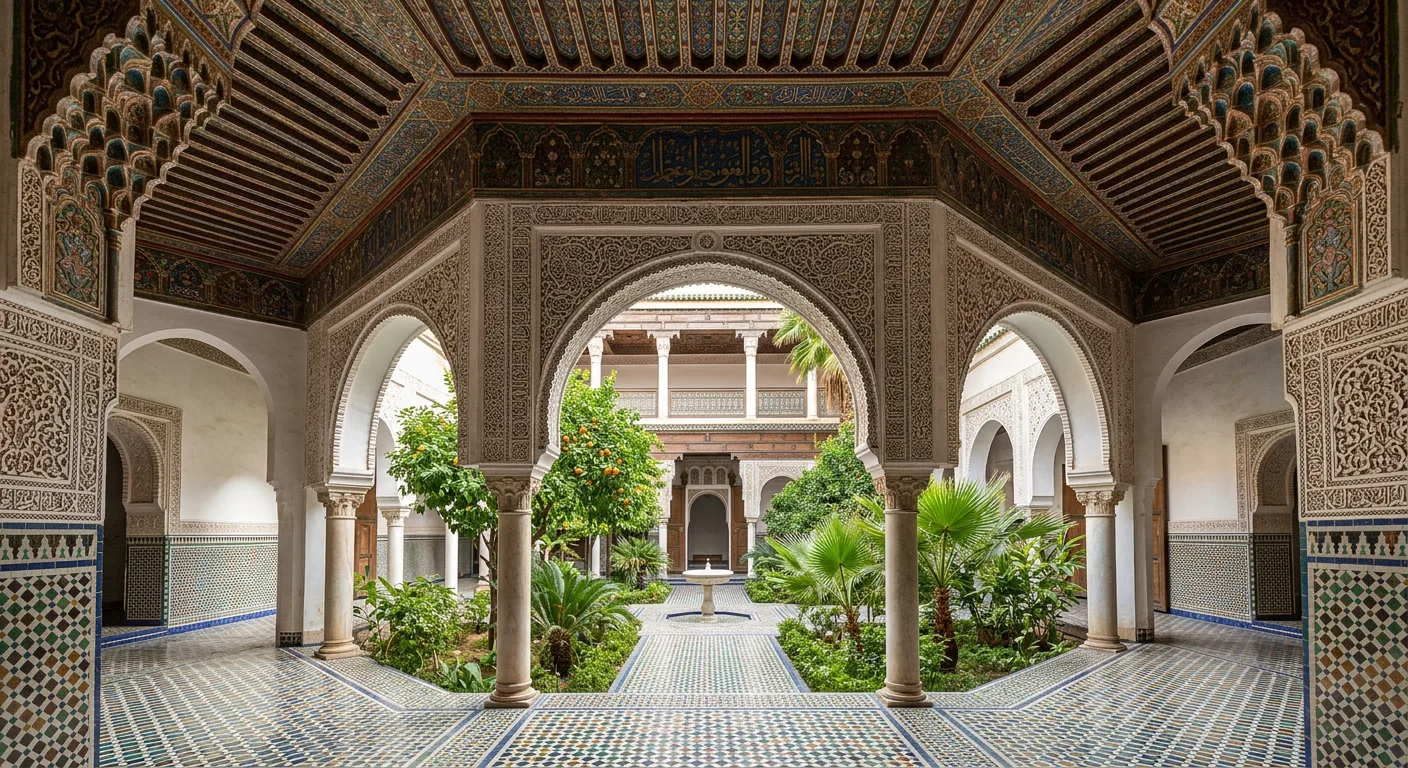
The Bahia Palace is one of the Marrakech medina's great set-pieces — a late-19th-century palace whose name means roughly 'brilliance' or 'the beautiful'. Spread across roughly eight hectares of courtyards, riad gardens and private apartments near the Mellah, it was built for the grand viziers Si Moussa and, on a far grander scale, his son Bou Ahmed (Ba Ahmed). There is little furniture to see today; the palace is celebrated instead for its painted cedar ceilings, carved stucco, zellige tilework and the rhythm of its open courts and shaded riads. This guide covers what to see, when to go to dodge the crowds, how long to allow, and how to combine the visit with the Mellah, the Saadian Tombs and the El Badi Palace. Ticket prices and opening hours change, so always check current information before you travel.
The palace's largest open court is its showpiece — a wide marble-paved expanse framed by colonnaded galleries, with zellige tilework running along the lower walls and carved-plaster and painted-wood detailing above. It was designed for ceremony and to impress visitors arriving at Bou Ahmed's residence, and it remains the natural place to take in the scale of the complex before exploring the rooms around it.
02Highlight
The painted cedar ceilings
Bahia is famous for its ceilings of carved and painted cedar, worked in dense floral and geometric patterns in the zouak tradition. Several rooms keep their original polychrome woodwork, with reds, greens, blues and gold catching the light from the courtyards. Look up often: the ceilings are some of the finest surviving examples of this craft in Marrakech and reward a slow, neck-craning visit.
03Craft
Carved stucco and zellige tilework
The surfaces throughout the palace are a catalogue of Moroccan decorative craft — finely carved gypsum stucco (gebs) framing doorways and upper walls, intricate cut-tile zellige mosaics on the dados, and cedar doors and screens. The work was carried out by skilled maalems (master craftsmen), and moving between rooms is largely an exercise in admiring how these three crafts are layered together.
04Garden
The riad gardens and inner courts
Several planted riad gardens punctuate the palace, with citrus and fruit trees, cypress and shrubs arranged around central paths and fountains in the classic Islamic garden layout. These shaded green courts were designed to cool and calm the interior of the residence, and they offer the quietest, most atmospheric corners of the complex away from the busiest rooms.
05History
The harem and private apartments
Beyond the public courts lie the more intimate private quarters, including the apartments associated with the household and harem of Bou Ahmed, who is said to have kept a large family and entourage here. The rooms are smaller and more domestic in scale, with their own decorated ceilings and tiled walls, and they hint at the daily life of a powerful vizier's residence even though they stand empty today.
06Tip
An empty palace: why there's no furniture
Visitors sometimes expect furnished rooms and are surprised to find the palace largely bare. Bahia is presented unfurnished, which keeps the focus squarely on the architecture and decoration — the ceilings, stucco and tilework — rather than on period rooms. Going in with that expectation makes for a better visit; treat it as an architecture and craft experience rather than a furnished house museum.
07Tip
Go early to beat the crowds
Bahia is one of the medina's most visited monuments and tour groups arrive steadily through the day, so the courtyards and narrow doorways can become congested. The calmest visits are usually right at opening, before the coach and group tours build up. Arriving early also gives you the painted ceilings and tiled courts in gentler light and lets you photograph the spaces without crowds.
08Tip
Photography in the courts and rooms
The palace is highly photogenic — symmetrical courtyards, tiled archways and the painted ceilings all reward a camera. Light is best earlier in the day before the sun is high and harsh in the open courts. Be patient and considerate with the narrow doorways where everyone wants the same framed shot, and check any current rules on tripods or professional shoots at the entrance.
09Planning
How long to allow
Most visitors spend roughly forty-five minutes to an hour and a half exploring Bahia, depending on how much they linger over the ceilings and gardens. The route winds through a sequence of courts and rooms rather than a single hall, so allow enough time to wander without rushing. If it is quiet you can move quickly, but at busy times the crowds themselves will slow you down.
10Planning
Combining with the Mellah, Saadian Tombs and El Badi
Bahia sits at the southern edge of the medina near the Mellah (the historic Jewish quarter), and within easy walking distance of the El Badi Palace and the Saadian Tombs. Many visitors string these together into a single half-day of medina history, often finishing at the nearby Kasbah area. Doing them in one loop makes sense geographically; check each site's current hours so you can sequence them without backtracking.
Frequently asked
Who built the Bahia Palace and what does the name mean?
The palace was begun in the late 19th century for the grand vizier Si Moussa and then greatly enlarged by his son, the powerful vizier Bou Ahmed (Ba Ahmed). 'Bahia' is usually translated as 'brilliance' or 'the beautiful'. It was conceived as a grand residence for the vizier's household rather than as a royal palace, which is part of why its decoration is so lavish.
How long should I spend at the Bahia Palace?
Plan for roughly forty-five minutes to about ninety minutes. The visit leads you through a sequence of courtyards, riad gardens and decorated rooms rather than one large hall, so the time depends on how much you pause over the painted cedar ceilings, stucco and tilework — and on how busy it is, since crowds at the narrow doorways naturally slow you down.
Is there much to see if the palace is unfurnished?
Yes. Bahia is presented largely without furniture, which keeps the focus on the architecture and decorative craft: the painted cedar ceilings, carved stucco, zellige tilework, the grand courtyard and the shaded riad gardens. Go in expecting an architecture-and-craft visit rather than furnished period rooms and you will get the most out of it.
What can I combine with a visit to the Bahia Palace?
Because it sits near the Mellah at the southern edge of the medina, Bahia pairs naturally with the nearby El Badi Palace and the Saadian Tombs, which are within walking distance. Many visitors do all three plus a wander through the Mellah and Kasbah area as a single half-day of medina history. Always check current opening hours and ticket prices for each site before you set out.
See it with a local
Turn this into a private Marrakech trip.
We'll build a private, guided plan around the experiences you care about — with a driver, hand-picked riads and a written quote in 24 hours.