The Ben Youssef Madrasa is one of the Marrakech medina's most spectacular monuments — a former Quranic school (madrasa) tucked into the streets near the Marrakech Museum and the Almoravid Koubba. The college is generally traced back to a 14th-century Marinid foundation, but it was rebuilt and greatly expanded under the Saadian dynasty in the 16th century, which is the architecture visitors largely see today. In its heyday it ranked among the largest Islamic colleges in North Africa, housing many students in small cells arranged around a serene central courtyard with a reflecting pool. It is celebrated above all for its craftsmanship — exquisitely carved cedar, sculpted stucco and zellige tilework. Closed for an extended restoration in recent years, it has since been restored and reopened to visitors, and because it is now a historic monument rather than an active place of worship, non-Muslims may enter. This guide covers the courtyard and pool, the prayer hall and mihrab, the student cells upstairs, the craftsmanship, the surrounding sights, how long to allow, photography and etiquette. Ticket prices and opening hours change, so always check current information before you travel.
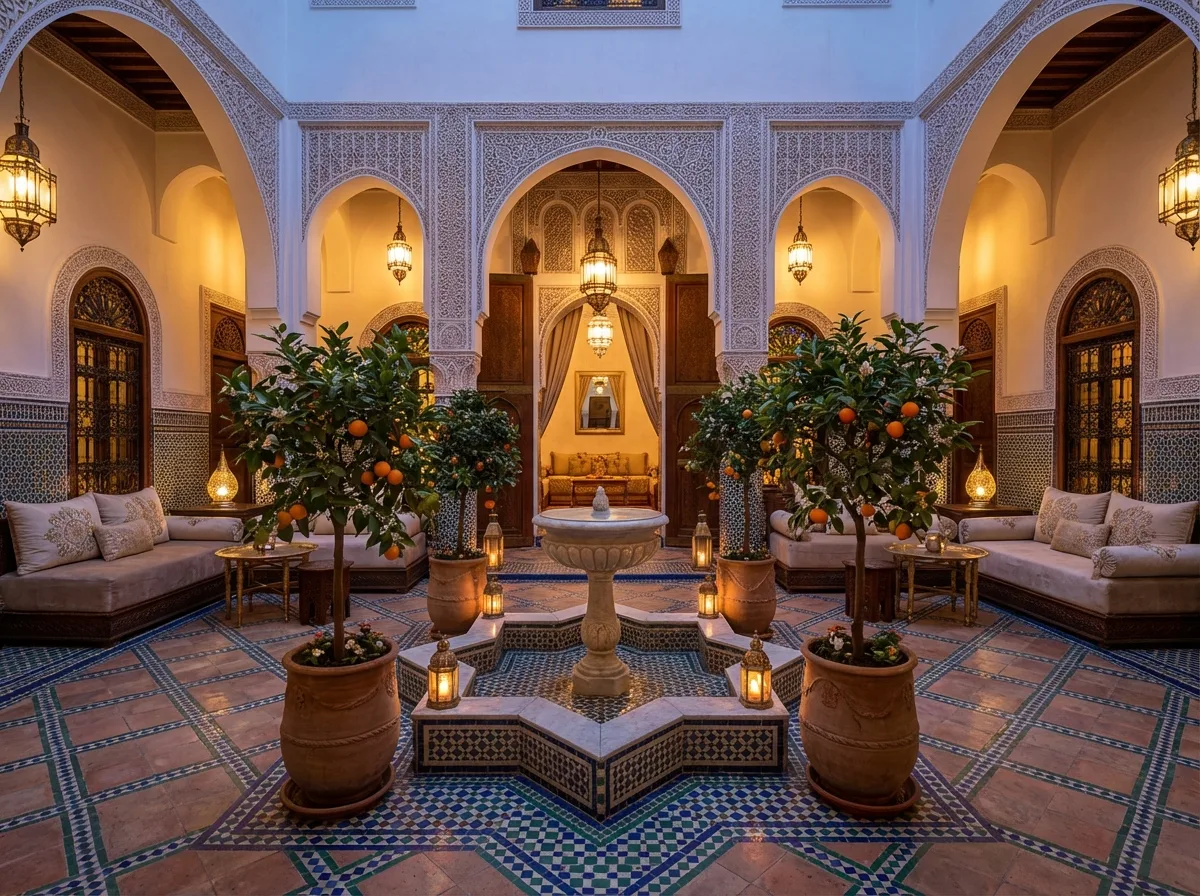
The heart of the madrasa is its serene central courtyard, paved in marble and zellige and centred on a long rectangular reflecting pool. Galleries and richly decorated walls rise on every side, their surfaces layered with carved stucco, tilework and cedar. The pool mirrors the architecture and the sky, and the whole court was designed as a calm, contemplative space at the centre of student life — it remains the natural place to begin and to take in the scale of the building.
02Highlight
The prayer hall and mihrab
Beyond the courtyard lies the prayer hall, the most richly worked interior in the complex, focused on a finely decorated mihrab — the niche indicating the direction of Mecca. Carved stucco, tilework and a worked ceiling frame the space, and the mihrab itself is among the building's decorative high points. As a former teaching college attached to the nearby Ben Youssef Mosque, the hall anchored the religious life of the students who lived and studied here.
03History
The student cells upstairs
Around and above the courtyard run the small student cells (sometimes counted at around a hundred and thirty), reached by stairways to the upper floors. These plain, compact rooms — some looking onto the courtyard, others onto small internal light-wells — housed the many students who boarded at the college. Climbing up to wander the corridors and look into the cells gives a vivid sense of daily life here and a series of changing views down over the courtyard and pool.
04Craft
The carved cedar, stucco and zellije
The madrasa is, above all, a showcase of Moroccan decorative craft. Cedar is carved and worked across the upper walls, lintels and ceilings; gypsum stucco (gebs) is sculpted into dense floral, geometric and calligraphic patterns; and zellige mosaic tilework runs along the dados and around the courtyard. The work was carried out by skilled maalems (master craftsmen), and much of a visit is simply an exercise in looking closely at how these three crafts are layered together.
05Story
A Marinid foundation, a Saadian rebuild
The college is generally traced back to a 14th-century Marinid foundation, but the building visitors see was largely rebuilt and greatly enlarged under the Saadian dynasty in the 16th century. This makes it part of the same Saadian flowering of Marrakech architecture associated with monuments such as the Saadian Tombs. Knowing this layered history adds to the visit: you are walking through a much-expanded Saadian masterpiece built on older foundations.
06Tip
Recently restored and reopened
The madrasa was closed for an extended restoration in recent years and has since reopened to visitors. The conservation work means the carved cedar, stucco and tilework can be appreciated in good condition. Because it is now preserved as a historic monument rather than functioning as an active place of worship or teaching, non-Muslim visitors are able to enter — unlike Marrakech's working mosques. Check current opening arrangements before you go, as access details can change.
07Planning
Setting near the Marrakech Museum and Almoravid Koubba
The madrasa sits in the northern part of the medina, immediately beside the Marrakech Museum (housed in the Dar Menebhi palace) and the small Almoravid Koubba, one of the city's oldest surviving structures. The three are clustered around the same square, which makes them an easy and logical group to visit together. Many people pair the madrasa with the museum and koubba, then wander on through the surrounding souks.
08Tip
Go early to enjoy the courtyard
The madrasa is one of the medina's most visited monuments, and the courtyard — where everyone gathers to photograph the pool and decorated walls — can become busy once tour groups arrive. The calmest visits are usually soon after opening, before the groups build up. Arriving early gives you a better chance to take in the reflecting pool and craftsmanship in peace, and softer light for photographs in the open court.
09Tip
Photography in the courtyard and cells
The reflecting pool, decorated walls and the views down from the upper cells are all highly photogenic, and the symmetry of the courtyard rewards a patient eye. Light is best earlier in the day before the sun is high and harsh in the open court; interiors such as the prayer hall are dimmer, so a steady hand helps. Be considerate where others want the same framed shot, and check any current rules on tripods or professional shoots at the entrance.
10Tip
Dress and etiquette
Although the madrasa is now a historic monument rather than an active religious building, it is a former Quranic college and respectful, modest dress is appropriate, in keeping with visiting any heritage site in the medina. Move quietly through the cells and prayer hall, keep to any marked routes, and be patient with the crowds in the courtyard. Treating the space with care makes for a calmer visit for everyone.
11Planning
How long to allow
Most visitors spend roughly thirty to forty-five minutes exploring the madrasa — taking in the courtyard and pool, the prayer hall and a wander through the upstairs cells. The building is compact but rewards lingering over the craftsmanship, and at busy times the crowds in the courtyard can slow you down. Allow a little extra in high season, or go early, so the visit fits comfortably alongside the neighbouring museum and koubba.
Frequently asked
What is the Ben Youssef Madrasa?
It is a former Quranic college (madrasa) in the Marrakech medina, near the Marrakech Museum and the Almoravid Koubba. It is generally traced back to a 14th-century Marinid foundation but was rebuilt and greatly expanded by the Saadian dynasty in the 16th century. In its heyday it was one of the largest Islamic colleges in North Africa, housing many students in small cells around a central courtyard with a reflecting pool, and it is celebrated for its carved cedar, stucco and zellige tilework.
Can non-Muslims visit the Ben Youssef Madrasa?
Yes. Because the madrasa is now preserved and presented as a historic monument rather than functioning as an active place of worship or teaching, non-Muslim visitors are able to enter — unlike Marrakech's working mosques. It was closed for an extended restoration in recent years and has since been restored and reopened to visitors. Always check current opening arrangements before you travel, as access details and hours can change.
How long should I spend at the Ben Youssef Madrasa?
Plan for roughly thirty to forty-five minutes. That allows time to take in the central courtyard and reflecting pool, the prayer hall and mihrab, and a wander up to the student cells on the upper floors. The building is compact but rewards a slow look at the carved cedar, stucco and tilework, and at busy times the crowds in the courtyard can add to how long the visit takes.
What can I combine with a visit to the Ben Youssef Madrasa?
The madrasa sits beside the Marrakech Museum (in the Dar Menebhi palace) and the small Almoravid Koubba, which cluster around the same square, so the three make a natural group to visit together. From there you can wander on through the surrounding souks of the northern medina. Always check current opening hours and ticket prices for each site before you set out so you can sequence them efficiently.
See it with a local
Turn this into a private Marrakech trip.
We'll build a private, guided plan around the experiences you care about — with a driver, hand-picked riads and a written quote in 24 hours.