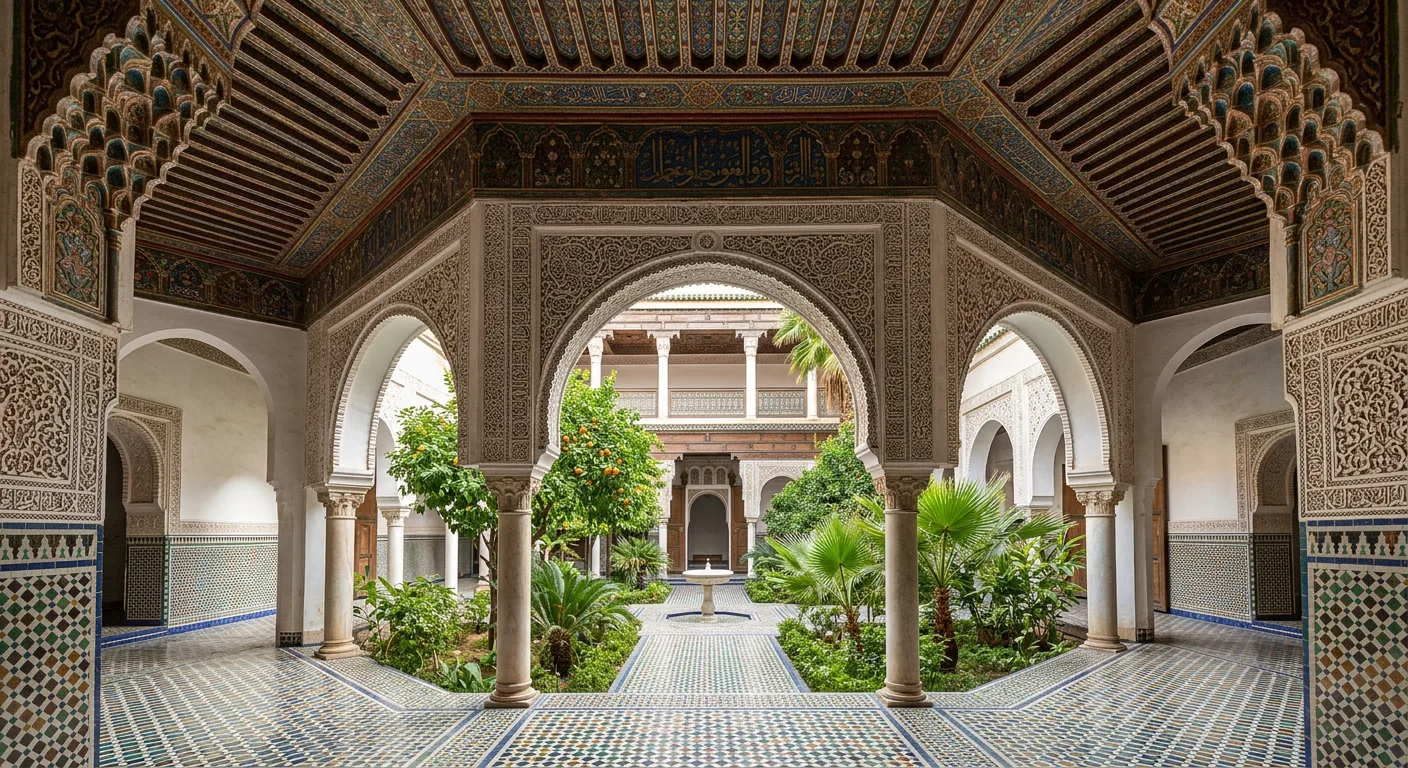
El Badi Palace — 'the Incomparable' — is the great red-walled ruin at the heart of the Kasbah quarter, and one of Marrakech's most atmospheric monuments. It was built in the late 16th century by the Saadian sultan Ahmad al-Mansur, whose treasury was famously swollen by the ransom and gold that followed the Battle of the Three Kings (1578) and by the trans-Saharan gold trade. In its heyday the palace was lavished with gold, onyx, Italian Carrara marble and a vast central reflecting pool flanked by sunken gardens — a stage for receiving ambassadors and impressing rivals. A century or so later, Sultan Moulay Ismail stripped it of its riches to furnish his new capital at Meknes, leaving the towering ramparts, sunken orange groves and empty pavilions you walk through today. This guide covers the courtyard and ruins, the ramparts and their rooftop views, the storks nesting on the walls, the original Koutoubia minbar displayed on site, the history, how long to allow and how to combine the visit with the Bahia Palace, Saadian Tombs and Mellah. Ticket prices and opening hours change, so always check current information before you travel.
The heart of El Badi is its enormous rectangular courtyard, organised around a large central reflecting pool with smaller basins and four sunken garden parterres set below the level of the paving. Even stripped of its decoration, the sheer scale is striking — this was a ceremonial court built to overawe visitors arriving at the Saadian sultan's residence. Standing in the middle of the empty expanse, framed by the high pisé walls, gives the clearest sense of the palace's original ambition.
02Garden
The sunken orange groves
Set into the courtyard floor are sunken garden beds planted with orange trees, a survival of the classic Islamic garden layout where greenery sits below the walkways so that strolling visitors look out across the treetops. The groves soften the ruins and scent the air in season, and they are one of the details that make El Badi feel less like a bare archaeological site and more like a palace whose gardens outlasted its gold.
03Highlight
The towering red ramparts
El Badi is enclosed by massive rammed-earth (pisé) ramparts that glow a deep ochre-red in the Marrakech light. These thick walls are what remain most intact, and they give the ruin its fortress-like silhouette. Walking along their base you get a real sense of how the palace was sealed off from the surrounding Kasbah, a private royal world behind enormous earthen curtains.
04Highlight
Climbing for rooftop views
A ramp and stairways lead up onto the ramparts and terraces, where you are rewarded with sweeping views back over the courtyard and pool, across the rooftops of the Kasbah, and out toward the Atlas Mountains on a clear day. The elevated walkways are among the best vantage points in this part of the medina and put the layout of the whole palace into perspective in a way the ground-level court cannot.
05Nature
The storks on the walls
White storks famously nest along the top of El Badi's ramparts, building large stick nests on the highest points of the walls. Watching them clatter their bills and come and go is one of the small pleasures of a visit, and they have become an emblem of the ruin. From the upper terraces you can often see the nests close to eye level — bring a little patience and a camera.
06History
The original Koutoubia minbar
Displayed within the palace complex is the celebrated minbar (mosque pulpit) originally made for the Koutoubia Mosque — a masterpiece of medieval Moroccan and Andalusian craftsmanship in carved wood and intricate marquetry, commissioned in the 12th century. Removed from the Koutoubia and conserved here, it is one of the finest surviving pieces of its kind and a highlight in its own right. Check on arrival whether the dedicated display space is open, as access can vary.
07History
Reading the ruins: what once stood here
Part of the pleasure of El Badi is imagining the lost splendour. Contemporary accounts describe pavilions sheathed in gold, onyx and Italian marble, with the famous Koubba el-Khamsiniya pavilion among them. After Moulay Ismail stripped the palace in the late 17th century to build Meknes, only foundations, walls and basins were left. Standing among the empty pavilions, the contrast between 'the Incomparable' of legend and the bare ruin in front of you is the whole story of the place.
08History
Underground passages and store rooms
Around the edges of the courtyard you can explore vaulted underground rooms and passageways that once served as stores, stables and service spaces beneath the palace. These cool, dim chambers are an atmospheric counterpoint to the open court above and a reminder that a palace of this scale needed a whole working infrastructure hidden from the ceremonial spaces.
09Tip
Photography at El Badi
The ruin is wonderfully photogenic: red walls against blue sky, the long reflecting pool, the storks on the ramparts and the framed views from the terraces. Early or late light warms the pisé walls and keeps the harsh midday glare off the open court. Take time to climb the ramparts for the elevated compositions over the pool, and watch the storks for a few minutes — they make for the most characterful shots.
10Planning
How long to allow
Most visitors spend roughly forty-five minutes to about an hour and a half at El Badi, depending on how much they explore the ramparts, underground rooms and the minbar display. There is a lot of open ground to cover and several levels to climb, so allow enough time to wander rather than rushing the court. On a hot day, factor in that much of the site is unshaded.
11Planning
Combining with the Bahia, Saadian Tombs and Mellah
El Badi sits in the Kasbah quarter at the southern end of the medina, within easy walking distance of the Saadian Tombs, the Bahia Palace and the Mellah (the historic Jewish quarter). Many visitors string these together into a single half-day of Marrakech history. Doing them in one loop makes geographic sense; check each site's current hours so you can sequence them without backtracking, and note that the Saadian Tombs and El Badi are very close neighbours.
Frequently asked
Who built El Badi Palace and what does the name mean?
El Badi was built in the late 16th century by the Saadian sultan Ahmad al-Mansur, whose wealth was famously boosted by the ransom and gold following the Battle of the Three Kings (1578) and by the trans-Saharan gold trade. The name is usually translated as 'the Incomparable'. It was conceived as a grand ceremonial palace for receiving ambassadors and displaying Saadian power.
Why is El Badi a ruin today?
Although it was once lavished with gold, onyx and Italian Carrara marble, the palace was stripped of its riches by Sultan Moulay Ismail around the late 17th century, who reused the materials to build his new capital at Meknes. What remains is the great red-walled shell: the huge courtyard, the central reflecting pool, the sunken orange groves, the ramparts and the underground rooms.
Can you climb the ramparts, and what about the storks?
Yes. Ramps and stairways lead up onto the ramparts and terraces, which give sweeping views over the courtyard, the Kasbah rooftops and, on a clear day, the Atlas Mountains. White storks nest along the tops of the walls, and the upper walkways often bring you close to their large stick nests — one of the most memorable features of a visit.
What can I combine with a visit to El Badi Palace?
El Badi sits in the Kasbah quarter at the southern edge of the medina, so it pairs naturally with the nearby Saadian Tombs, the Bahia Palace and a wander through the Mellah. Many visitors do all of these as a single half-day of Marrakech history. Always check current opening hours and ticket prices for each site before you set out, as they change.
See it with a local
Turn this into a private Marrakech trip.
We'll build a private, guided plan around the experiences you care about — with a driver, hand-picked riads and a written quote in 24 hours.