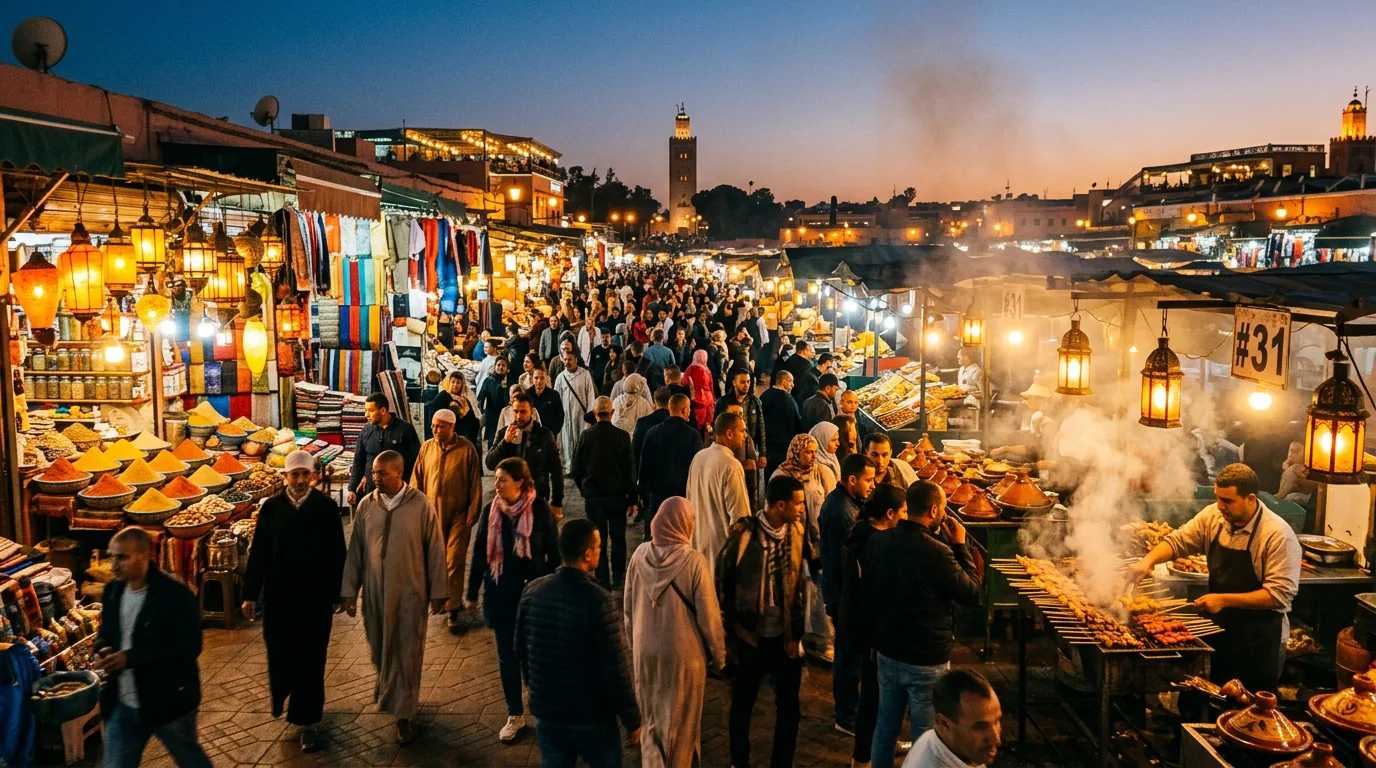
Jemaa el-Fna is the great open square at the heart of the Marrakech medina and the city's living theatre — recognised by UNESCO in 2001 as a Masterpiece of the Oral and Intangible Heritage of Humanity for the storytelling, music and performance traditions that have unfolded here for centuries. By day it is a loose, sun-baked expanse of orange-juice carts, henna artists, costumed water-sellers, storytellers and musicians, with snake charmers and Barbary-ape handlers among the crowds. As dusk falls the square transforms: rows of grill stalls roll out and the open space becomes a vast open-air food market wreathed in smoke and steam, while Gnaoua musicians, drummers and performers draw rings of onlookers — for many visitors this nightly metamorphosis is the highlight of Marrakech. This guide covers the square by day and by night, the food stalls and how to use them, the famous juice carts, the rooftop cafés that overlook it all, and — handled honestly — the animal-welfare and tipping issues you should know about before you go. It is a place to enjoy with your wits about you: agree any price or tip first, watch your belongings in the crowds, and treat it as the spectacle it is. Stalls, performers and the square's rhythm vary by season and time of day, so take this as a guide to the spirit of the place rather than a fixed schedule.
In daylight the square is broad and open, an easy place to get your bearings at the edge of the souks beside the Koutoubia minaret. Fresh orange-juice carts line up in rows, henna artists set out their stools, costumed water-sellers (guerrab) jingle their brass cups, and storytellers, musicians and performers gather small crowds through the day. It is quieter and less intense than after dark, which makes the morning and afternoon a good time to walk through, take in the scale of the space and watch the rhythm of the medina without the evening crush.
02Highlight
The nightly transformation into a food market
The square's most famous moment comes at dusk, when food vendors wheel out rows of stalls, fire up the grills and turn the open space into a huge open-air food market under clouds of smoke and bare bulbs. Tables and benches fill with diners, touts call out their menus, and the whole square takes on a carnival energy. For many travellers this nightly metamorphosis — the same space utterly changed within an hour or two — is the single most memorable thing they do in Marrakech.
03Food
Eating at the food stalls
The grill stalls serve Moroccan street food — brochettes and grilled meats, salads and breads, harira soup, and local specialities such as snail soup (babbouche) and offal dishes for the adventurous. A reliable approach is to point and pick what looks good, favour busy stalls with a steady turnover of locals (a sign of fresh, fast-moving food), and agree the price before you sit and eat so there are no surprises on the bill. Vendors are lively and persistent in drawing you in; choose calmly, confirm what each dish costs, and you can eat very well here.
04Food
The famous orange-juice carts
The lines of orange-juice carts are an icon of the square, pressing fresh juice to order from morning until late. They are a refreshing pause as you explore, and a glass of cold juice is one of the simplest pleasures of Jemaa el-Fna. As with everything in the square, confirm the price before you order, keep an eye on your change, and you can enjoy the ritual without any awkwardness.
05Culture
Storytellers, musicians and Gnaoua performers
The performance traditions of Jemaa el-Fna are exactly what earned it UNESCO recognition: storytellers (hlaykia) reciting tales in Arabic, musicians, drummers and the trance-rhythm groups of Gnaoua players who gather audiences especially in the evening. Rings of onlookers form and dissolve around them through the night. If you stop to watch, stand in the circle and join the crowd; performers depend on contributions, so be ready to give a small tip if you linger or take photos, and agree or offer it openly rather than being pressed afterwards.
06Culture
Henna artists
Henna artists work from stools around the square, offering decorative designs on hands and arms. Two cautions are worth knowing. First, agree the price and the design before any henna is applied, as costs are not displayed and you may otherwise be pressured for more once it is done. Second, be wary of so-called 'black' henna: natural henna is reddish-brown, while very dark or black paste can contain PPD dye that may irritate or harm the skin. If you want henna, settle the price first and ask for natural henna.
07Tip
Animal welfare: snake charmers and Barbary-ape handlers
Among the daytime crowds you will see snake charmers with cobras and handlers with chained Barbary apes (macaques), who make their living from paid photos with tourists. The honest advice is to politely decline: paying for photos sustains the keeping of these wild animals in conditions that raise serious welfare concerns, and macaques in particular are a threatened species. If a handler drapes a snake on you or places a monkey on your shoulder uninvited, a firm, calm 'no thank you' and walking on is the right response — and avoid taking photos, since that is what you would be expected to pay for.
08Tip
Agree every price and tip first
The golden rule of Jemaa el-Fna is to settle the cost before you accept anything. For henna, photos, performances and food, agree the price or tip up front and in clear terms, because anything offered as a 'gift' or done before a price is named can become a demand for money afterwards. This is not about distrust so much as how the square works: a clear figure agreed at the start turns a potential hassle into a fair exchange and lets you enjoy the spectacle.
09Tip
Watch your belongings in the crowds
The square is crowded, especially after dark when the food market and performances pull in the biggest throngs, and dense crowds are where pickpocketing is most likely anywhere in the world. Keep valuables secure and out of back pockets, hold bags closed and in front of you, and stay aware of your surroundings when you stop to watch a performer or queue at a stall. A little ordinary care lets you relax into the atmosphere.
10Planning
Rooftop cafés overlooking the square
Several cafés and restaurants ring Jemaa el-Fna with rooftop terraces that look straight out over it, and they are the classic way to take in the scene from above — a mint tea or a meal while the square fills and the lights come on at sunset. The view is the draw, and the terraces are popular at dusk, so arriving a little before the light fades gives you the best of the transformation. Prices reflect the location, but the perspective over the whole square is worth it for many visitors.
11Planning
Best time to visit and how to plan it
The single best time to experience Jemaa el-Fna is the evening, when the food market sets up and the performers are out in force — ideally arriving around sunset so you catch the square changing character. A good plan is to watch the sunset from a rooftop terrace, then come down into the food market for dinner and a wander among the music and storytelling. The square sits beside the souks and the Koutoubia Mosque, so it links naturally with a day in the medina, finishing here as night falls.
Frequently asked
What is Jemaa el-Fna and why is it famous?
Jemaa el-Fna is the main square at the heart of the Marrakech medina and the city's best-known gathering place. It was recognised by UNESCO in 2001 as a Masterpiece of the Oral and Intangible Heritage of Humanity for its living traditions of storytelling, music and performance. By day it hosts juice carts, henna artists, costumed water-sellers, musicians and storytellers; by night it transforms into a vast open-air food market with grills, performers and Gnaoua musicians, which for many visitors is the highlight of Marrakech.
When is the best time to visit Jemaa el-Fna?
The evening is the classic time to visit. Around sunset the food stalls roll out and the square becomes an open-air food market, while storytellers, drummers and Gnaoua musicians draw crowds. A popular plan is to watch the sunset from a rooftop café overlooking the square, then come down into the food market for dinner. Daytime is quieter and a good time to take in the scale of the space, but the evening transformation is what most people come for.
Is it safe to eat at the food stalls?
Many visitors eat happily at the stalls. Sensible precautions help: favour busy stalls with a quick turnover of customers, since fast-moving food tends to be fresher; point and pick what looks good; and agree the price before you sit down and eat so the bill is clear. The vendors are persistent in drawing you in, so choose calmly and confirm what each dish costs up front.
Should I pay for photos with the snakes and monkeys?
The honest answer is no — it is best to politely decline. The chained Barbary apes (macaques) and the snakes are kept for paid tourist photos, which raises serious animal-welfare concerns, and macaques are a threatened species. If a handler drapes a snake on you or puts a monkey on your shoulder uninvited, give a calm, firm 'no thank you' and walk on, and avoid taking photos, since photos are what you would be expected to pay for. More generally, agree any price or tip first for henna, photos and performances, and keep an eye on your belongings in the crowds.
See it with a local
Turn this into a private Marrakech trip.
We'll build a private, guided plan around the experiences you care about — with a driver, hand-picked riads and a written quote in 24 hours.