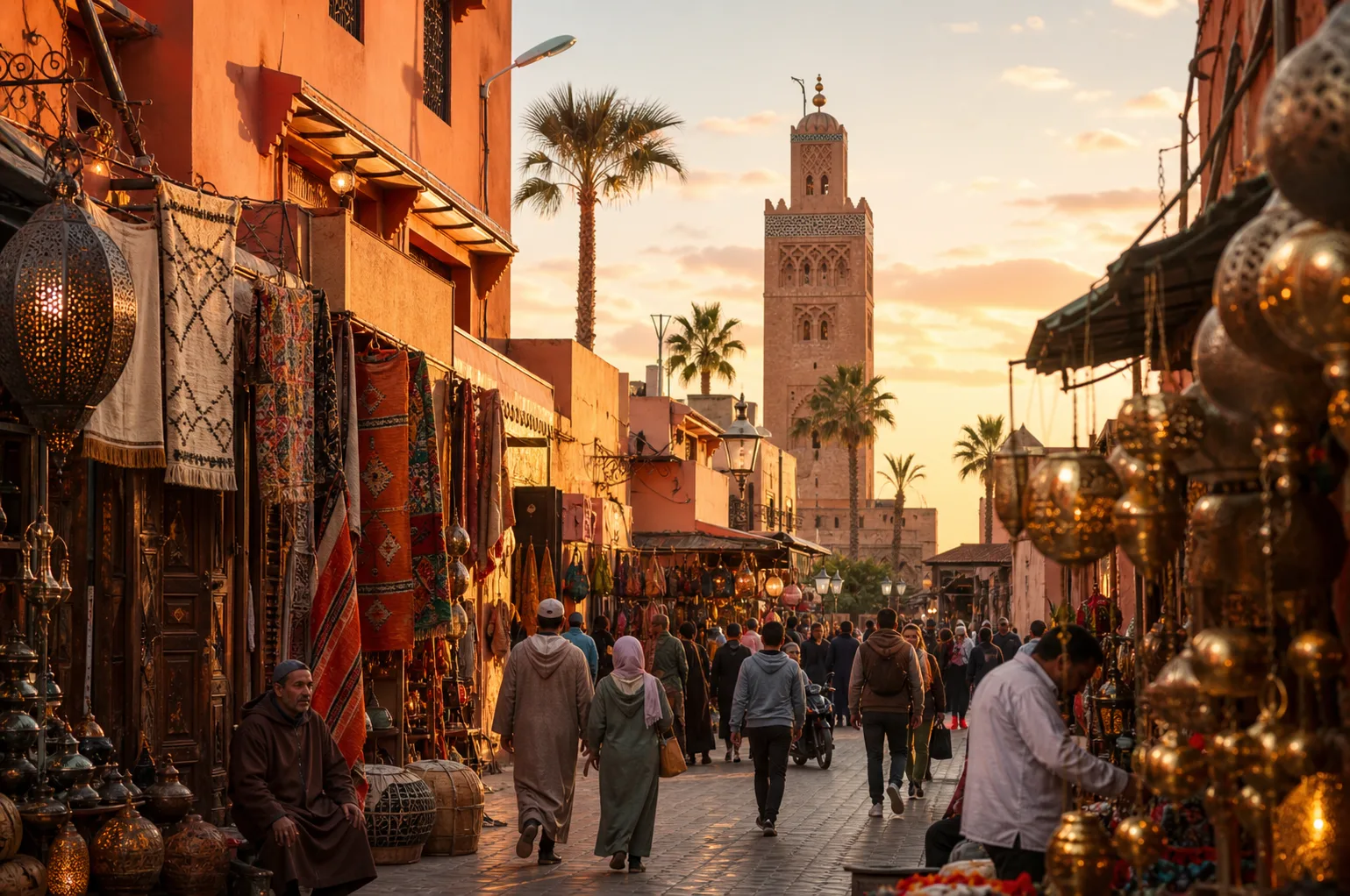
The Koutoubia Mosque is Marrakech's largest mosque and its single most recognisable landmark, rising just south-west of the great square of Jemaa el-Fna. A 12th-century building from the Almohad era, it is crowned by a minaret of around 77 metres that is widely regarded as a masterpiece of Almohad architecture — and as the model and sibling of the Giralda in Seville and the Hassan Tower in Rabat. The name 'Koutoubia' comes from the kutubiyyin, the booksellers whose souk once clustered nearby. Note that, as a working mosque, the interior is reserved for Muslim worshippers and non-Muslims cannot enter; however, the minaret, the surrounding rose gardens and the open esplanade are free to all and are beautifully floodlit after dark. This guide covers viewing the minaret, the gardens, the ruins of the earlier mosque, the night illumination, photography, the building's role as an orientation landmark and how to combine it with Jemaa el-Fna. Details such as garden access and lighting can change, so check current information before you travel.
The minaret is the heart of the monument and one of the defining images of Morocco. Standing roughly 77 metres tall and built of warm sandstone, it dates from the Almohad period in the 12th century and shows the classic features of that dynasty's architecture — a tall square shaft decorated with interlacing arch motifs and a band of tilework near the top, finished with a lantern and copper or brass orbs. It is admired as the prototype for a family of great Almohad towers across the western Islamic world.
02History
Sibling of the Giralda and the Hassan Tower
Koutoubia's minaret is the architectural model and elder sibling of two other famous Almohad towers: the Giralda in Seville, Spain, and the unfinished Hassan Tower in Rabat. All three share the same square plan, proportions and decorative vocabulary, reflecting the reach of the Almohad dynasty that ruled across Morocco and southern Spain. Knowing this connection turns the minaret from a single landmark into the keystone of a wider story of medieval architecture spanning the Strait of Gibraltar.
03Highlight
The copper orbs at the summit
At the very top of the minaret sits a small lantern crowned by a finial of graduated metal spheres, traditionally described as copper or brass orbs. Local legend has accumulated around them over the centuries, but their immediate appeal is visual — they catch the light at the highest point of the tower and complete its silhouette against the sky. They are best appreciated from a little distance, where you can take in the full vertical sweep of the minaret.
04Story
Why it is called 'Koutoubia'
The name derives from the Arabic kutubiyyin, the booksellers, recalling the market of manuscript and book traders that once stood beside the mosque. In an age when books were copied by hand, this was a centre of learning and trade as much as of worship. The name is a reminder that the mosque sat at the commercial and intellectual heart of medieval Marrakech, not far from the great square that still anchors the city today.
05History
The ruins of the earlier mosque
Beside the standing mosque are the excavated foundations of an earlier Almohad mosque, whose outline and column bases can be seen in the open ground near the present building. The first mosque is generally said to have been slightly misaligned and was rebuilt, leaving the remains visible today. Pausing at these low ruins gives a sense of the layered history of the site and of how the great mosque you see now came to take its final form.
06Garden
The rose gardens and esplanade
Wrapping around the mosque are planted gardens with rose beds, palms, olive trees and clipped hedges, threaded with paths and benches. While the mosque interior is closed to non-Muslims, these gardens and the broad esplanade are open to everyone and free to enter, making them one of the most pleasant green spaces in the city centre. They are a fine place to rest in the shade, admire the minaret and watch the daily life of Marrakech pass by.
07Tip
Visiting as a non-Muslim
As a working place of worship, the Koutoubia Mosque is reserved for Muslims and non-Muslims are not permitted inside the prayer hall. This is normal for active mosques in Morocco and is not specific to Koutoubia. The good news is that everything most visitors come to see — the minaret, the gardens, the esplanade and the ruins — is fully accessible from the outside and free of charge, so there is no need to enter the building to enjoy the landmark.
08Highlight
Floodlit by night
After dark the minaret is illuminated, glowing warmly above the gardens and the surrounding streets. The night-time view is one of the most atmospheric sights in Marrakech, especially when combined with the lit-up bustle of nearby Jemaa el-Fna. Many visitors return in the evening specifically to see the tower floodlit; the open esplanade gives clear lines of sight, and the cooler air makes a slow walk around the gardens particularly enjoyable.
09Tip
Photographing the minaret
The minaret photographs beautifully, but the best results need a little distance to fit the full tower into the frame. The gardens, the esplanade and the open approach from Jemaa el-Fna all offer good vantage points. Soft early-morning and late-afternoon light warms the sandstone, while the floodlit tower against a dark sky makes a striking night shot. Be respectful when worshippers are arriving or leaving, and avoid pointing the camera into the prayer hall.
10Tip
An orientation landmark for the city
Because it is the tallest historic structure in central Marrakech and visible from much of the medina and the surrounding avenues, the Koutoubia minaret doubles as a natural compass. If you lose your bearings in the maze of medina lanes, finding the tower helps you navigate back towards Jemaa el-Fna and the city centre. Travellers have used it this way for centuries, and it remains the easiest fixed point to steer by on foot.
11Planning
Combining with Jemaa el-Fna
The mosque stands just a short walk south-west of Jemaa el-Fna, so the two are almost always visited together. A common rhythm is to admire the minaret and stroll the gardens, then walk over to the great square as it comes alive towards evening with food stalls, musicians and performers. Doing both in one outing — minaret and gardens first, then the square at dusk — makes for one of the classic introductions to Marrakech.
Frequently asked
Can non-Muslims go inside the Koutoubia Mosque?
No. The Koutoubia is a working mosque, and like other active mosques in Morocco its prayer hall is reserved for Muslim worshippers, so non-Muslims cannot enter the interior. However, the minaret, the surrounding rose gardens, the open esplanade and the ruins of the earlier mosque are all open to everyone and free of charge, so visitors can still enjoy the landmark fully from the outside.
How tall is the Koutoubia minaret and why is it famous?
The minaret stands roughly 77 metres tall and dates from the 12th-century Almohad era. It is celebrated as a masterpiece of Almohad architecture and as the model and sibling of the Giralda in Seville and the Hassan Tower in Rabat, which share its square plan and decorative style. Topped by a lantern and copper or brass orbs, it is the most recognisable landmark in Marrakech.
Where does the name 'Koutoubia' come from?
The name comes from the Arabic kutubiyyin, meaning the booksellers, after the market of manuscript and book traders that once stood beside the mosque. In medieval Marrakech this made the area a hub of learning and commerce as well as worship, which is why the mosque carries the booksellers' name to this day.
Is the Koutoubia worth seeing at night?
Yes. The minaret is floodlit after dark and glows above the gardens and surrounding streets, making it one of the most atmospheric sights in the city. Because the mosque is only a short walk from Jemaa el-Fna, many visitors pair an evening look at the illuminated tower with the lively night-time scene on the square. Lighting and garden access can change, so check current information locally.
See it with a local
Turn this into a private Marrakech trip.
We'll build a private, guided plan around the experiences you care about — with a driver, hand-picked riads and a written quote in 24 hours.