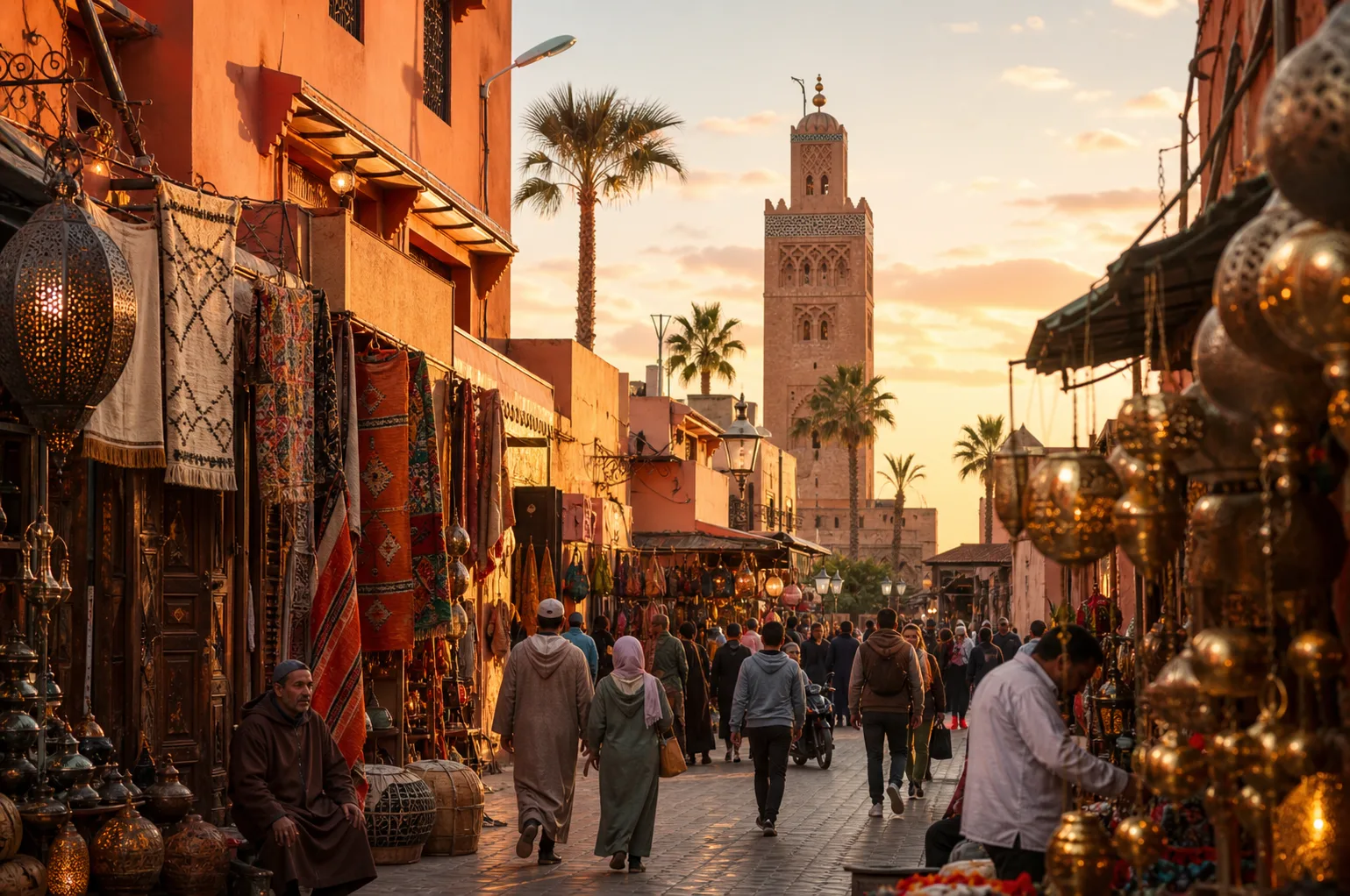
The calèche — the open, green horse-drawn carriage — is a Marrakech institution and one of the city's most recognisable sights. Classic carriages wait at official ranks around the medina, most famously near Jemaa el-Fna and close to the Koutoubia, as well as by some of the larger hotels, ready to take passengers on a leisurely loop of the city. Typical routes trace the ochre ramparts and historic gates, pass the gardens on the western side towards the Menara and Agdal area, and some longer outings head out to the Palmeraie. A calèche ride is more about the unhurried experience and the views than about reaching a destination quickly: you sit back, the city rolls past at walking pace, and you see the walls, gates and palm-lined avenues in a way you cannot from a taxi. Importantly, Marrakech operates an official fixed-price tariff system for calèches, with posted zones and rates, but you should always agree and confirm the fare and the duration with the driver before you set off so there are no surprises. Two things shape a good ride: timing it for the cooler golden hour or early evening rather than the harsh midday heat, and choosing a carriage whose horse is visibly well cared for. This guide covers the experience, the routes, how fares work, the best time to go, animal-welfare considerations and who the ride suits. Routes, official tariffs and arrangements change over time, so confirm the current details before you ride.
The open green horse-drawn carriages are a long-standing fixture of Marrakech and part of the city's character. You will see them lined up at their stands and clip-clopping along the avenues around the medina, and riding in one is a classic, almost old-fashioned way to take in the city. The carriages are open-sided, so you get unobstructed views and a breeze, and the slow pace lets you watch street life unfold as you pass.
02Highlight
Official ranks near Jemaa el-Fna and the Koutoubia
Calèches wait at recognised stands rather than roaming for fares, with the best-known ranks around Jemaa el-Fna and near the Koutoubia, and others by some of the larger hotels. Using an official rank is the sensible way to find a carriage. It is the same area where many visits to the medina begin, so a ride slots naturally into a day around the main square, the mosque and the surrounding old city.
03Route
Looping the ochre ramparts and gates
A favourite route follows Marrakech's famous ochre-red ramparts and passes the historic city gates that punctuate the walls. From the carriage you get a steady, ground-level view of the long stretches of pisé wall and the monumental babs, with the colour shifting warmly as the light lowers. Circling the walls this way gives a sense of the medina's scale and shape that is hard to appreciate on foot in the heat.
04Route
Past the western gardens towards Menara and Agdal
Some routes head out along the broad, palm-lined avenues on the western side of the city, in the direction of the Menara and Agdal gardens area. These wide, tree-shaded boulevards are pleasant from an open carriage and a contrast to the tight lanes of the souks. Exactly how far a given ride goes towards the gardens depends on the route and time you agree, so confirm the loop with the driver beforehand.
05Route
Longer outings to the Palmeraie
Beyond the city loops, some calèche outings run out towards the Palmeraie, the palm grove on the edge of Marrakech. This is a longer trip through more open, greener surroundings and naturally costs more and takes more time than a short ramparts loop. If a Palmeraie route interests you, agree the destination, the duration and the fare clearly before leaving, as this is well beyond the standard short city circuit.
06Fares
How the fixed-price tariff works
Marrakech runs an official fixed-price system for calèches, with posted tariffs and zones intended to standardise what a ride should cost. In practice this means there is an agreed framework rather than a free-for-all, but you should still confirm the fare and what it covers before you set off. Ask whether the price is per carriage or per person and whether it is for a set loop or by time, and settle this clearly at the rank to avoid any misunderstanding later.
07Fares
Confirm the fare and duration before you set off
The single most useful habit is to agree the route, the duration and the total price with the driver before the carriage moves. Even with official tariffs in place, being explicit up front — where you will go, roughly how long it will take and exactly what you will pay — prevents disputes at the end. If the answer is vague, it is fine to clarify or to walk to the next carriage. Because rates and arrangements change, check the current posted tariff rather than relying on a figure you read elsewhere.
08Tip
Best at golden hour and early evening
A calèche ride is at its best in the cooler part of the day, particularly the golden hour and early evening when the light warms the ramparts and the temperature drops. Midday in the hotter months is uncomfortable for passengers and, more importantly, hard on the horses. Aiming for late afternoon into evening gives you the most pleasant ride and the most photogenic light along the walls and avenues.
09Welfare
Choosing a well-cared-for horse
Animal welfare matters, and you can vote with your custom. Look for a horse that appears healthy and well looked after — a good body weight rather than visibly thin, no obvious sores or wounds, and tack that is not causing harm. Choose carriages at official ranks, avoid riding in the harsh midday heat, and do not overload the carriage. Picking a visibly well-kept horse and driver is a simple way to support better treatment.
10Welfare
Welfare rules and reporting mistreatment
The city has welfare rules around the working horses, and as a passenger you can play a part in upholding them. If you see a horse that looks mistreated, injured or in distress, you can decline that carriage and, where possible, report concerns to the relevant authorities or animal-welfare organisations active in Marrakech. Being a considerate passenger — keeping the load reasonable and avoiding the hottest hours — also helps reduce strain on the animals.
11Planning
Who the ride suits
A calèche ride suits families with children, who tend to enjoy the novelty, and anyone wanting a rest from walking the medina while still seeing the city. It is a gentle, low-effort way to cover ground around the walls, gardens and avenues, and it works well as a relaxed interlude between busier sights. For travellers who find the heat and crowds tiring, sitting back in an open carriage for a loop of the ramparts is an easy and scenic break.
Frequently asked
Where do I find a calèche in Marrakech?
Calèches wait at official ranks rather than cruising for passengers, with the best-known stands around Jemaa el-Fna and near the Koutoubia, plus others by some larger hotels. Using one of these recognised ranks is the straightforward way to pick up a carriage. From there, typical rides loop the ochre ramparts and gates, head towards the western gardens around the Menara and Agdal, or on longer outings run out to the Palmeraie.
How much does a calèche ride cost?
Marrakech operates an official fixed-price tariff system for calèches, with posted rates and zones, so there is an agreed framework for what a ride should cost. Even so, you should confirm the fare and the duration with the driver before you set off, and check whether the price is per carriage or per person and for a set loop or by time. Because tariffs and arrangements change, rely on the current posted rate and a clear agreement at the rank rather than any older figure.
When is the best time to take a calèche ride?
Aim for the cooler part of the day — the golden hour and early evening are ideal, when the light warms the ramparts and avenues and the temperature is comfortable. This is also far kinder to the horses than the harsh midday heat of the hotter months, which is hard on the animals and unpleasant for passengers. Late afternoon into evening gives both the most enjoyable ride and the most photogenic conditions.
What should I keep in mind about the horses' welfare?
Choose a carriage whose horse looks healthy and well cared for — a reasonable body weight, no obvious sores and tack that is not causing harm — and use official ranks. Avoid riding in the midday heat, keep the load reasonable rather than overcrowding the carriage, and if you see a horse that appears mistreated or in distress you can decline it and report concerns to the relevant authorities or welfare organisations. The city has welfare rules, and considerate passengers help uphold them.
See it with a local
Turn this into a private Marrakech trip.
We'll build a private, guided plan around the experiences you care about — with a driver, hand-picked riads and a written quote in 24 hours.