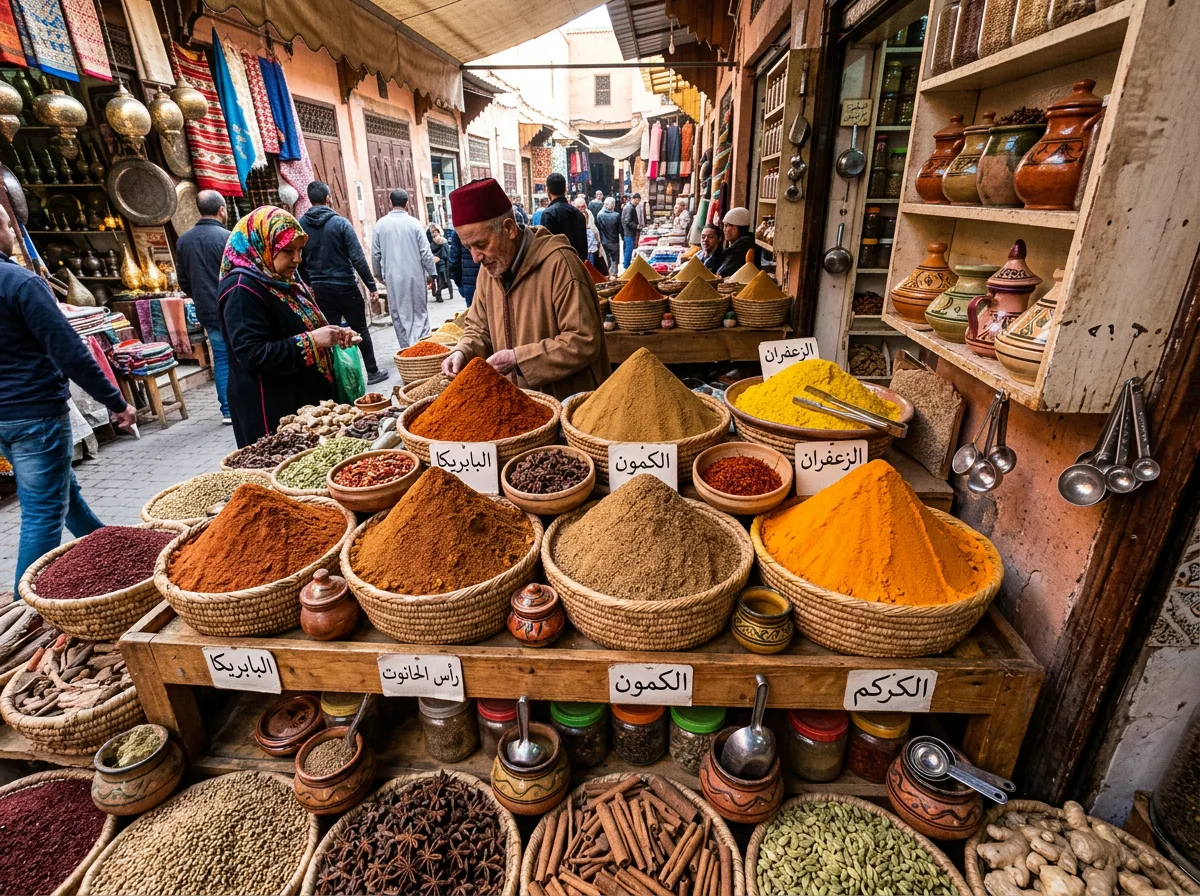
Two of the medina's most atmospheric quarters sit within easy walking distance of one another in the south-east of old Marrakech. The Mellah is the city's historic Jewish quarter, established in 1558 and one of the oldest mellahs in Morocco, laid out close to the royal kasbah and what is now the Bahia Palace. Its narrow lanes still hold the restored Lazama (Slat al-Azama) Synagogue with its quiet courtyard, the vast Miâara Jewish cemetery, and the memory of the goldsmiths, jewellers and spice traders who once worked here. A short walk north, deeper in the souks, lies the Rahba Kedima — the old 'place of spices', widely known today as the Place des Épices. Around this open square, herbalists and apothecaries sell mounds of spices, dried herbs, traditional remedies, argan products and curiosities, while café terraces look down over the bustle. This guide covers the Mellah's history and synagogue, the spice square and its herbalists, the apothecary and argan stalls, gentle haggling, respectful visiting, photography, and how to combine it all with the Bahia Palace and the souks. Opening hours, entry arrangements and prices change, so always check current information before you travel.
The Mellah was established in 1558, making it one of the oldest Jewish quarters in Morocco. It was laid out in the south-east of the medina, close to the royal kasbah and the area now occupied by the Bahia Palace, and for centuries it was home to a substantial Jewish community whose traders, goldsmiths and craftspeople were woven into the life of the city. Today its dense lanes, balconied houses and small workshops still carry that history, and wandering them is the best way to sense the quarter's distinct character within the wider medina.
02Highlight
The Lazama (Slat al-Azama) Synagogue
Tucked into the Mellah's lanes, the Lazama Synagogue — also written Slat al-Azama — is a restored historic synagogue arranged around a calm tiled courtyard, with the prayer hall opening off it. It is the best-known surviving synagogue in the quarter and gives visitors a tangible link to the community that lived here for centuries. It is generally kept as a place that can be visited respectfully; check current opening arrangements and any entry contribution before you go, as access details can change.
03History
The Miâara Jewish cemetery
On the edge of the Mellah lies the Miâara, the large historic Jewish cemetery, its whitewashed graves spread across a walled enclosure. It is one of the most significant Jewish heritage sites in the city and a powerful, quiet counterpoint to the busy lanes nearby. Visiting is a contemplative experience rather than a sightseeing 'highlight'; dress modestly, move quietly, and check current access arrangements, which can vary.
04Craft
The old goldsmith and jewellery trades
The Mellah was historically associated with the goldsmith and jewellery trades, and the surrounding lanes still hold workshops and stalls selling silver, gold and ornaments. The quarter's old jewellery souk area is a reminder of the specialist crafts once concentrated here. Browsing is part of the pleasure, whether or not you buy — and as everywhere in the medina, prices for jewellery are not fixed, so expect to discuss them.
05Highlight
The Rahba Kedima — the spice square (Place des Épices)
A short walk north of the Mellah, deep in the souks, the Rahba Kedima is the old 'place of spices' — widely known today as the Place des Épices. This open square is ringed by herbalists and traders whose stalls overflow with cones of spices, dried herbs, dyes and curiosities, with café terraces above offering a fine view over the activity. It is one of the most photogenic and characterful corners of the medina and the natural heart of a spice-quarter visit.
06Highlight
The herbalists and apothecary stalls
The traders around the square include herbalists and traditional apothecaries selling spices for cooking alongside dried herbs, natural remedies, cosmetics and curiosities. Stallholders will often invite you to look, smell and ask questions, and many enjoy explaining what the different spices and preparations are used for. Browsing here is a sensory experience as much as a shopping one; take your time over the colours and scents before deciding whether to buy.
07Shopping
Argan oil and natural products
Among the apothecary and herbalist stalls you will find argan oil and argan-based products, a Moroccan speciality pressed from the nuts of the argan tree, sold for both cooking and cosmetic use. Quality and presentation vary from stall to stall, so it is worth asking questions and comparing before buying. As with spices, prices are not displayed and are reached through discussion, so treat any first figure as a starting point.
08Tip
Gentle haggling and how to buy well
Prices in the spice square and the Mellah's stalls are rarely fixed, and good-natured haggling is part of how trade works here. Browse a few stalls first to get a feel for what things cost, decide what an item is worth to you, and bargain politely and with a smile — it is meant to be friendly, not adversarial. If you cannot agree a price you are happy with, a courteous 'no thank you' and walking on is perfectly normal and accepted.
09Tip
Visiting respectfully
The Mellah is a living quarter with religious heritage sites, so dress modestly and behave considerately, especially around the synagogue and cemetery. Keep your voice down in places of worship and remembrance, follow any guidance from custodians, and treat the community's heritage with care. The same courtesy applies in the busy souks: be patient in the crowds, and ask before photographing people or the inside of private stalls.
10Tip
Photography in the souks and square
The spice square is wonderfully photogenic — the cones of coloured spices, the stacked baskets and the café-terrace views all reward a camera, and the light is gentler earlier and later in the day. Stallholders may expect a small purchase or a polite request before you photograph their goods or themselves, so ask first and be respectful. Around the synagogue and cemetery, be especially discreet and follow any rules on photography at the entrance.
11Planning
Combining with the Bahia Palace and the souks
The Mellah sits right beside the Bahia Palace at the southern edge of the medina, and the spice square lies between it and the main souks, so the three link together naturally on foot. A logical half-day strings the Bahia Palace, a wander through the Mellah and synagogue, and the Rahba Kedima spice square with the surrounding souks into one loop, often extended to the nearby El Badi Palace and Saadian Tombs. Check each site's current hours so you can sequence them without backtracking.
Frequently asked
What is the Mellah of Marrakech?
The Mellah is Marrakech's historic Jewish quarter, established in 1558 and one of the oldest mellahs in Morocco. It lies in the south-east of the medina, close to the royal kasbah and the present-day Bahia Palace. For centuries it was home to a substantial Jewish community of traders, goldsmiths and craftspeople, and it still holds heritage sites including the restored Lazama (Slat al-Azama) Synagogue and the large Miâara Jewish cemetery.
Can I visit the Lazama Synagogue?
The Lazama Synagogue, also written Slat al-Azama, is a restored historic synagogue in the Mellah, arranged around a quiet tiled courtyard. It is generally kept as a place that visitors can see respectfully. Dress modestly, behave considerately, and follow any guidance from custodians. Because opening arrangements and any entry contribution can change, it is best to check current information before you go.
What is the spice square (Place des Épices) and where is it?
It is the Rahba Kedima, the old 'place of spices' in the souks, widely known today as the Place des Épices. The open square is ringed by herbalists and apothecary stalls selling spices, dried herbs, traditional remedies, argan products and curiosities, with café terraces overlooking it. It lies a short walk north of the Mellah, between the Jewish quarter and the main souks, which makes the two easy to combine on foot.
Is haggling expected in the spice square and the Mellah?
Yes. Prices at the spice and apothecary stalls and the Mellah's shops are generally not fixed, and friendly haggling is part of how trade works. Browse a few stalls first to gauge prices, decide what an item is worth to you, and bargain politely. It is meant to be good-natured, and walking away with a courteous 'no thank you' if you cannot agree a price is completely normal and accepted.
See it with a local
Turn this into a private Marrakech trip.
We'll build a private, guided plan around the experiences you care about — with a driver, hand-picked riads and a written quote in 24 hours.