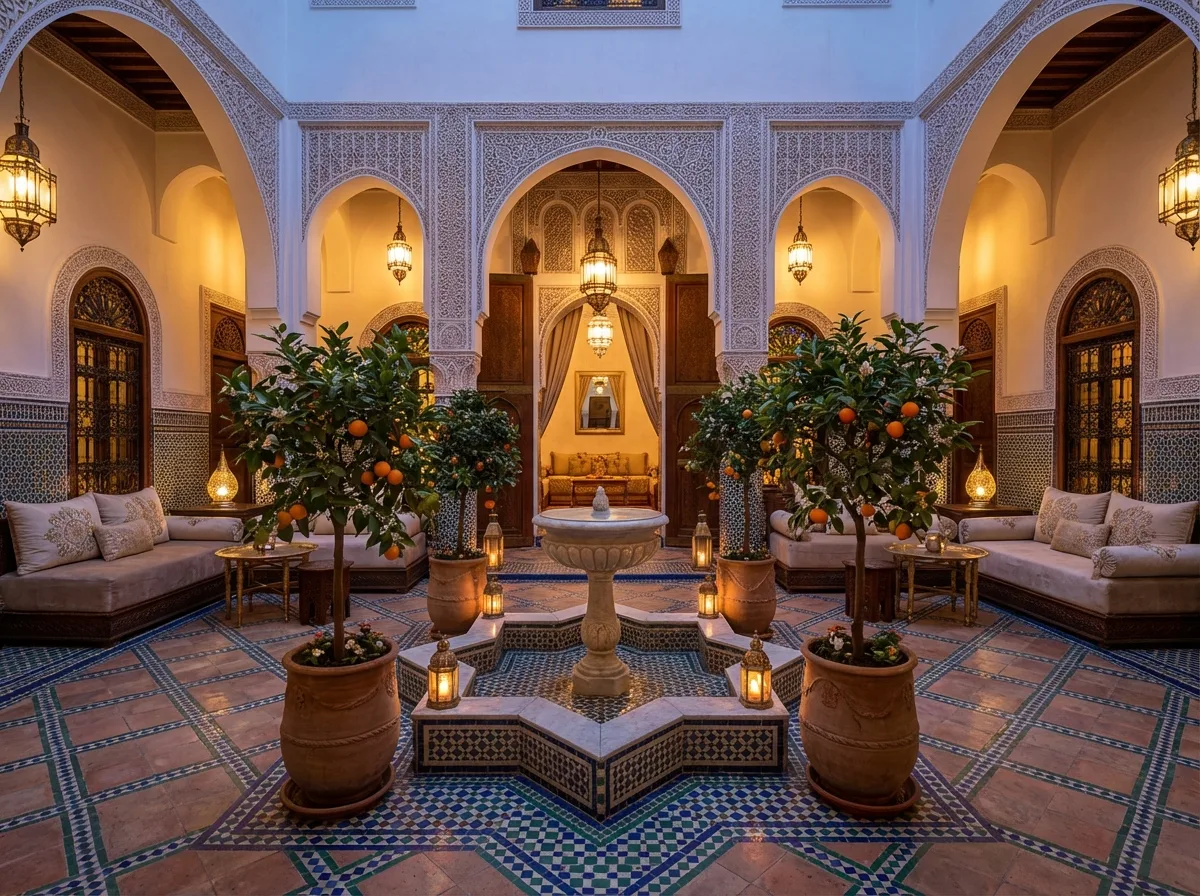
Two of the medina's quietest treasures sit side by side on the same square in the northern medina, beside the Ben Youssef Madrasa. The first is the Marrakech Museum (Musée de Marrakech), housed in the restored Dar Menebhi — a grand late-19th-century riad-palace built for a Moroccan minister, arranged around a vast central atrium famously canopied by a huge metal-and-glass chandelier and lantern, with its own hammam and rooms displaying Moroccan art, calligraphy, textiles and ceramics. The second is the Almoravid Koubba (Koubba Ba'adiyn, or Koubba Almoravide), a small domed ablution pavilion that is the only surviving Almoravid-era structure in Marrakech, dating from the early 12th century. Modest in size, it is prized by historians far beyond its scale: its carved interior dome, interlacing and lobed arches, and the pinecone, palm and acanthus motifs are regarded as prototypes of the Moroccan-Andalusian ornament that flowered in the centuries after. Together with the neighbouring madrasa, the museum and koubba form a compact cluster you can visit in a single, unhurried circuit. This guide covers the Dar Menebhi palace and its atrium, the museum collection, the koubba's historical importance, the medina cluster, how long to allow, photography and combining tickets. Opening hours and ticket prices change, so always check current information before you travel.
The Marrakech Museum is housed in Dar Menebhi, a grand riad-palace built in the late 19th century for Mehdi Menebhi, a minister of the era, and later restored to open as a museum. Its showpiece is a vast central atrium — a former courtyard now roofed over and dominated by an enormous metal-and-glass chandelier-lantern that hangs at its centre. Around the court run richly decorated walls layered with carved stucco, zellige tilework and painted cedar, so the building is as much an exhibit as the works it displays.
02Highlight
The museum collection
The rooms and galleries opening off the courtyard present changing displays of Moroccan art and craft — typically calligraphy, textiles, ceramics and historic decorative arts, alongside contemporary works at times. The collection is shown within the palace's domestic spaces, so you move from reception rooms to side chambers as you go. Because displays are rotated and curated over time, it is worth treating the exact contents as something to confirm on arrival rather than assuming a fixed permanent layout.
03History
The palace hammam
Tucked within Dar Menebhi is the palace's own hammam (traditional bathhouse), part of the original domestic complex of a grand Marrakech residence. Its vaulted, star-pierced chambers — where steam and daylight once filtered through the roof — give a tangible sense of how a wealthy household lived around the turn of the 20th century. It is a small but evocative space that many visitors find a highlight, and a reminder that the building itself is a piece of social history.
04Highlight
The Almoravid Koubba next door
A short step from the museum stands the Almoravid Koubba (Koubba Ba'adiyn), a small domed pavilion set a little below today's street level. It once served as an ablution structure linked to the religious life of the medina, providing water for ritual washing before prayer. Compact and easy to overlook, it nonetheless rewards a close look: the interest here is entirely in the carved detail of its dome and arches rather than its size.
05Story
Why the koubba matters to historians
The koubba is widely described as the only surviving Almoravid-era structure in Marrakech, dating from the early 12th century — making it one of the oldest monuments in the city. Its significance is out of all proportion to its size: scholars regard its interlacing and lobed arches, its ribbed and carved interior dome, and its pinecone, palm and acanthus motifs as early prototypes of the Moroccan-Andalusian decorative vocabulary that later monuments would refine. Standing inside, you are looking at where much later ornament effectively begins.
06Craft
The carved dome and merlon battlements
Look up inside the koubba to see its carved interior dome, worked with interlacing arches and floral and vegetal motifs, and out to its crown of stepped, stair-like merlon battlements. These details — the lobed arch forms, the pinecone and acanthus carving, the merlons — are exactly the elements historians trace forward into later Almohad, Marinid and Saadian architecture across Morocco and Andalusia. A few quiet minutes spent reading the carving is what gives the visit its meaning.
07Planning
A cluster with the Ben Youssef Madrasa
The museum and the koubba sit on the same square as the Ben Youssef Madrasa, the medina's celebrated former Quranic college, so the three monuments form a natural and very compact group. Most visitors take them together in a single circuit, then wander on into the surrounding souks of the northern medina. Visiting as a cluster is the efficient way to see them, and it lets you compare the Almoravid-era koubba with the much later Saadian and 19th-century work nearby.
08Planning
How long to allow
Allow roughly forty-five minutes to an hour for the Marrakech Museum, taking in the atrium, the surrounding rooms and the hammam, and around fifteen minutes for the small koubba, which is quick to see but worth a proper look. Visiting both alongside the Ben Youssef Madrasa makes a comfortable half-morning or half-afternoon in the northern medina. Times stretch in high season when the square is busy, so leave a little margin if you are sequencing several sites.
09Tip
Photography in the atrium and koubba
The museum's covered atrium, with its great hanging lantern and decorated walls, is the most photogenic spot, though the interior light is soft and even rather than bright — a steady hand helps. The koubba's carved dome is striking but dim inside, so it can be a challenge to capture well. Check any current rules on photography, flash and tripods at each entrance, as conditions can differ between the two sites and from one season to the next.
10Tip
Combining tickets and entry
The Marrakech Museum and the Almoravid Koubba have at times been presented together under shared management, with combined or linked entry arrangements, while the neighbouring Ben Youssef Madrasa is normally ticketed separately. Because these arrangements, prices and opening hours change, do not assume a fixed combined ticket — check the current situation at the ticket desk or in advance. Confirming on the day is the surest way to plan the most efficient way around the cluster.
11Tip
Dress and etiquette in the medina
Both sites are historic monuments rather than active places of worship, so non-Muslim visitors are welcome, but modest, respectful dress is appropriate in keeping with visiting any heritage site in the medina. Move quietly through the galleries, the hammam and the small koubba, keep to any marked routes, and be patient when the square outside is crowded. Treating the spaces with care makes for a calmer visit and is in keeping with their age and significance.
Frequently asked
What is the Marrakech Museum?
The Marrakech Museum (Musée de Marrakech) is housed in Dar Menebhi, a grand riad-palace built in the late 19th century for a Moroccan minister and later restored to open as a museum. Its centrepiece is a vast central atrium dominated by a huge metal-and-glass chandelier-lantern, surrounded by walls of carved stucco, zellige and cedar. The palace also includes a hammam, and its rooms display Moroccan art, calligraphy, textiles, ceramics and at times contemporary works. Displays are rotated, and opening hours and ticket prices change, so check current information before you visit.
Why is the Almoravid Koubba important?
The Almoravid Koubba (Koubba Ba'adiyn) is a small domed ablution pavilion that is widely described as the only surviving Almoravid-era structure in Marrakech, dating from the early 12th century — one of the oldest monuments in the city. Historians prize it because its carved interior dome, interlacing and lobed arches, pinecone, palm and acanthus motifs, and merlon battlements are regarded as prototypes of the Moroccan-Andalusian decorative style refined by later dynasties. Its significance is far greater than its modest size suggests.
Can I visit the Marrakech Museum and Almoravid Koubba together?
Yes. The two sit on the same square in the northern medina, beside the Ben Youssef Madrasa, and have at times been presented together with combined or linked entry, while the madrasa is normally ticketed separately. They form a natural, compact cluster that most visitors see in a single circuit before wandering into the surrounding souks. Because ticketing arrangements, prices and hours change, confirm the current situation at the ticket desk or in advance rather than assuming a fixed combined ticket.
How long should I spend at these sites?
Allow roughly forty-five minutes to an hour for the Marrakech Museum, taking in the atrium, the rooms and the hammam, and around fifteen minutes for the small Almoravid Koubba, which is quick to see but rewards a close look at its carving. Visiting both together with the neighbouring Ben Youssef Madrasa makes a comfortable half-morning or half-afternoon in the northern medina. Leave a little extra time in high season, when the square and the madrasa can be busy.
See it with a local
Turn this into a private Marrakech trip.
We'll build a private, guided plan around the experiences you care about — with a driver, hand-picked riads and a written quote in 24 hours.