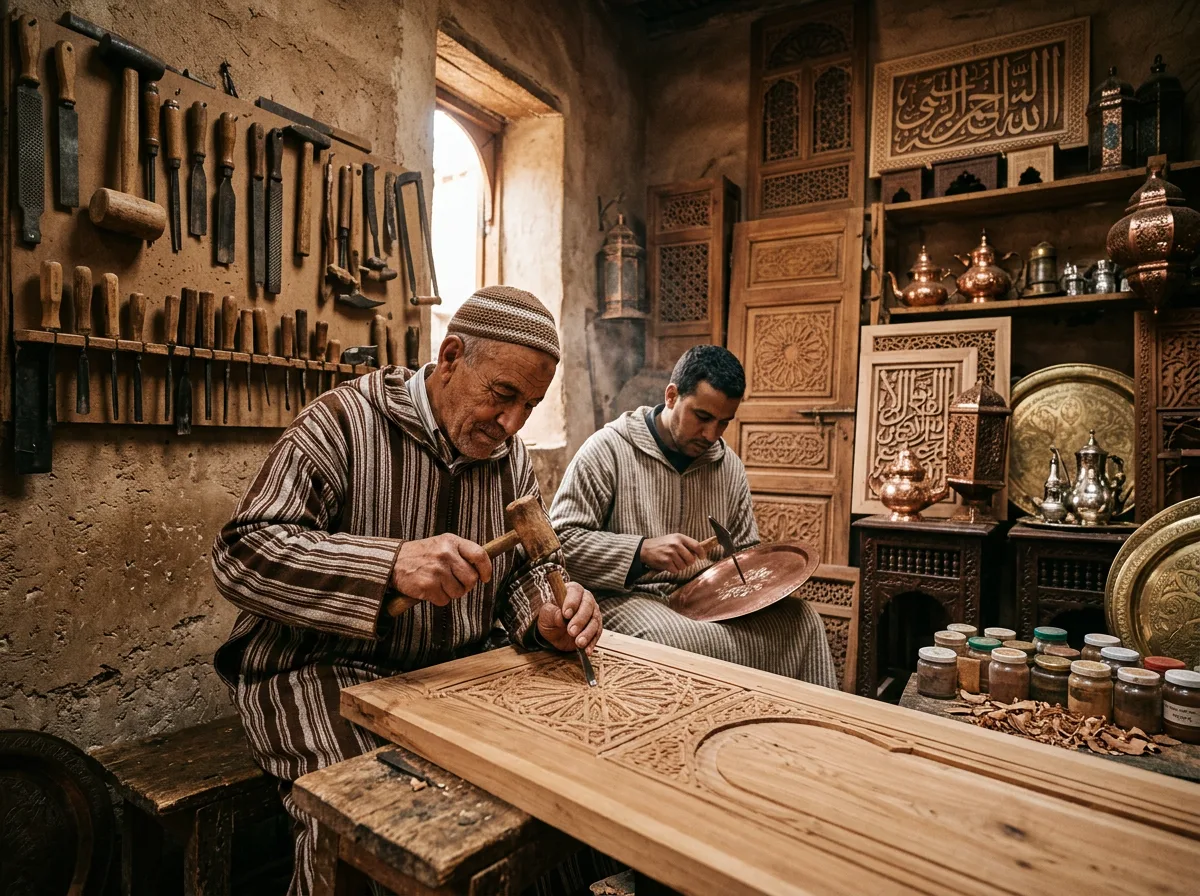
Tucked into a traditional house in the southern medina, on the route between the Bahia Palace and Dar Si Said, the Tiskiwin Museum (Musée Tiskiwin) is one of Marrakech's quietest and most thoughtful sights. Often called the Bert Flint museum, after the Dutch anthropologist whose collection it holds, it is devoted to the material culture of the Sahara and southern Morocco — textiles and carpets, jewellery, leatherwork, basketry, musical instruments and everyday artefacts. The rooms are arranged to evoke a journey from Marrakech to Timbuktu along the old trans-Saharan caravan route, so that as you move through the house you follow, room by room, the goods, crafts and traditions that once travelled between Morocco and the lands south of the Sahara. It is a small, atmospheric place set in a traditional riad-style house, a deliberate contrast to the grand palaces nearby, and is especially loved by anyone drawn to Berber, Amazigh and Saharan culture. This guide covers the collection and the Marrakech-to-Timbuktu concept, Bert Flint's role, the riad setting, who the museum suits, how long to allow, photography, and combining it with the Bahia Palace and Dar Si Said. Opening hours and admission can change, so always check current information before you go.
The collection and the Marrakech-to-Timbuktu concept
The defining idea of the museum is a journey from Marrakech to Timbuktu, the old trans-Saharan caravan route that once linked Morocco with the lands south of the Sahara. Rather than grouping objects by type alone, the displays are arranged to follow that route, so that moving through the rooms traces the crafts, materials and traditions exchanged along the way. It turns a collection of artefacts into a story about connection and trade across the desert, which is what makes the visit distinctive.
02Highlight
Textiles, carpets and clothing
A large part of the collection is given over to textiles — carpets, woven cloth, capes, veils and items of dress from the Berber and Saharan regions of southern Morocco and beyond. These pieces show the patterns, weaves and colours of different communities, and the skill invested in everyday and ceremonial garments alike. For anyone interested in craft and design, the textiles are among the most rewarding parts of the museum, displayed close enough to study the detail.
03Highlight
Jewellery, leatherwork and adornment
Alongside the textiles, the museum is known for its jewellery and personal adornment — silverwork, beads and ornaments — together with leatherwork and other crafted objects. These reflect the artistry of southern Moroccan and Saharan cultures and the way materials were worked, traded and worn. Seen together with the clothing, they help build a fuller picture of how communities along the caravan route expressed identity, status and tradition through what they made and wore.
04Highlight
Musical instruments and everyday artefacts
The collection also gathers musical instruments and a range of everyday artefacts — tools, vessels, basketry and household objects — that round out the portrait of daily life across the Sahara and the Moroccan south. These ordinary things are often as revealing as the finest pieces, showing how people lived, worked and made music. They reinforce the museum's focus on material culture: not just art, but the practical fabric of communities along the route.
05Story
Bert Flint and his collection
The museum grew out of the lifelong work of Bert Flint, a Dutch anthropologist who spent decades studying and collecting the material culture of Morocco and the Sahara. The objects on show reflect his deep interest in the crafts and traditions of southern Morocco and the lands beyond the desert, and his wish to present them as a connected cultural world rather than isolated curiosities. Knowing the collection is the work of one dedicated scholar gives the visit a personal, considered character.
06History
The traditional riad setting
The museum occupies a traditional house in the medina, arranged in the riad style around a courtyard, with rooms opening off the central space. The domestic scale of the building is part of the experience: you view the textiles, jewellery and instruments in intimate rooms rather than large modern galleries, which suits the personal nature of the collection. The setting itself, a restored medina house, adds to the atmosphere and offers a glimpse of traditional Marrakech architecture.
07Tip
A quiet contrast to the big palaces
Compared with the grand, often crowded palaces nearby, the Tiskiwin Museum is calm, small and unhurried. That contrast is one of its pleasures: after the scale and bustle of the Bahia Palace, it offers a thoughtful, low-key pause where you can look closely and take your time. Visitors who appreciate atmosphere and substance over spectacle often rate it among their favourite medina stops, precisely because it is so different from the larger sights.
08Planning
Who the museum suits
Tiskiwin appeals most to travellers interested in Berber and Amazigh culture, Saharan traditions, crafts, textiles and anthropology — anyone who likes to understand the cultures behind the objects. It is less of a marquee monument and more of a focused, specialist museum, so it rewards curiosity and a slower pace. Those wanting big architecture or sweeping courtyards may prefer the palaces, but for culture and craft lovers it is a genuine highlight of the southern medina.
09Planning
How long to allow
The museum is small, so many visitors find around an hour comfortable to move through the rooms and follow the Marrakech-to-Timbuktu journey, though those who linger over the textiles and labels may stay a little longer. Its compact size makes it easy to combine with neighbouring sights rather than treat as a half-day in itself. Allow a little extra margin in busy periods, and check current opening hours before you set out, as they can change.
10Tip
Photography on your visit
As at many small museums, rules on photography can vary and may change, so check any current guidance at the entrance before taking pictures of the displays. Interior light in a traditional house is often soft rather than bright, so a steady hand helps if photography is allowed. Whatever the rules, the intimate rooms reward looking closely with your own eyes, and being mindful of other visitors in the quiet spaces is always appreciated.
11Planning
Combining with the Bahia Palace and Dar Si Said
The museum sits on the route between the Bahia Palace and Dar Si Said in the southern medina, towards the Kasbah and Mellah, which makes it easy to fold into a walking circuit of that quarter. A common plan is to pair it with the Bahia Palace and Dar Si Said for a half-day mixing grand architecture with focused craft and culture. Each site is ticketed separately, so treat them as individual visits and confirm current hours and admission for each.
12Planning
Finding it in the southern medina
Tiskiwin lies in the lanes of the southern medina, in the direction of the Kasbah and Mellah, between the Bahia Palace and Dar Si Said. As with many medina addresses, the entrance is modest and easy to miss, so following signs, a map or local directions for the final approach helps. Most visitors reach it on foot while exploring this part of the old city, and the surrounding lanes are part of the pleasure of getting there.
Frequently asked
What is the Tiskiwin Museum in Marrakech?
The Tiskiwin Museum (Musée Tiskiwin), often called the Bert Flint museum, is a small private museum in a traditional house in the southern Marrakech medina, between the Bahia Palace and Dar Si Said. It holds the collection of the Dutch anthropologist Bert Flint, devoted to the material culture of the Sahara and southern Morocco — textiles, carpets, jewellery, leatherwork, musical instruments and everyday artefacts. The rooms are arranged to evoke a journey from Marrakech to Timbuktu along the old trans-Saharan caravan route. It is a quiet, atmospheric contrast to the bigger palaces. Hours and admission can change, so check current information before you go.
Why is it arranged as a journey to Timbuktu?
The museum is organised around the old trans-Saharan caravan route that once linked Marrakech with Timbuktu and the lands south of the Sahara. Instead of grouping objects only by type, the displays follow that route room by room, so moving through the house traces the crafts, materials and traditions exchanged along the way. The idea reflects the collection's focus on the cultural connections between Morocco and the Sahara, turning a set of artefacts into a story about trade and exchange across the desert.
Who will enjoy the Tiskiwin Museum most?
It suits travellers interested in Berber and Amazigh culture, Saharan traditions, crafts, textiles, jewellery and anthropology — anyone who likes to understand the cultures behind the objects. It is a focused, specialist museum rather than a grand monument, so it rewards curiosity and a slower pace. Visitors looking mainly for sweeping architecture may prefer the nearby palaces, but for culture and craft lovers Tiskiwin is a genuine highlight and a calm contrast to the busier sights of the medina.
Can I combine it with the Bahia Palace and Dar Si Said?
Yes. The Tiskiwin Museum sits on the route between the Bahia Palace and Dar Si Said in the southern medina, so it fits naturally into a single walking circuit of that quarter. A common plan is to pair it with the Bahia Palace and Dar Si Said for a half-day that mixes grand architecture with focused craft and culture. The museum is small, so allow about an hour. Each site is ticketed separately, so confirm current opening hours and admission for each before you visit.
See it with a local
Turn this into a private Marrakech trip.
We'll build a private, guided plan around the experiences you care about — with a driver, hand-picked riads and a written quote in 24 hours.