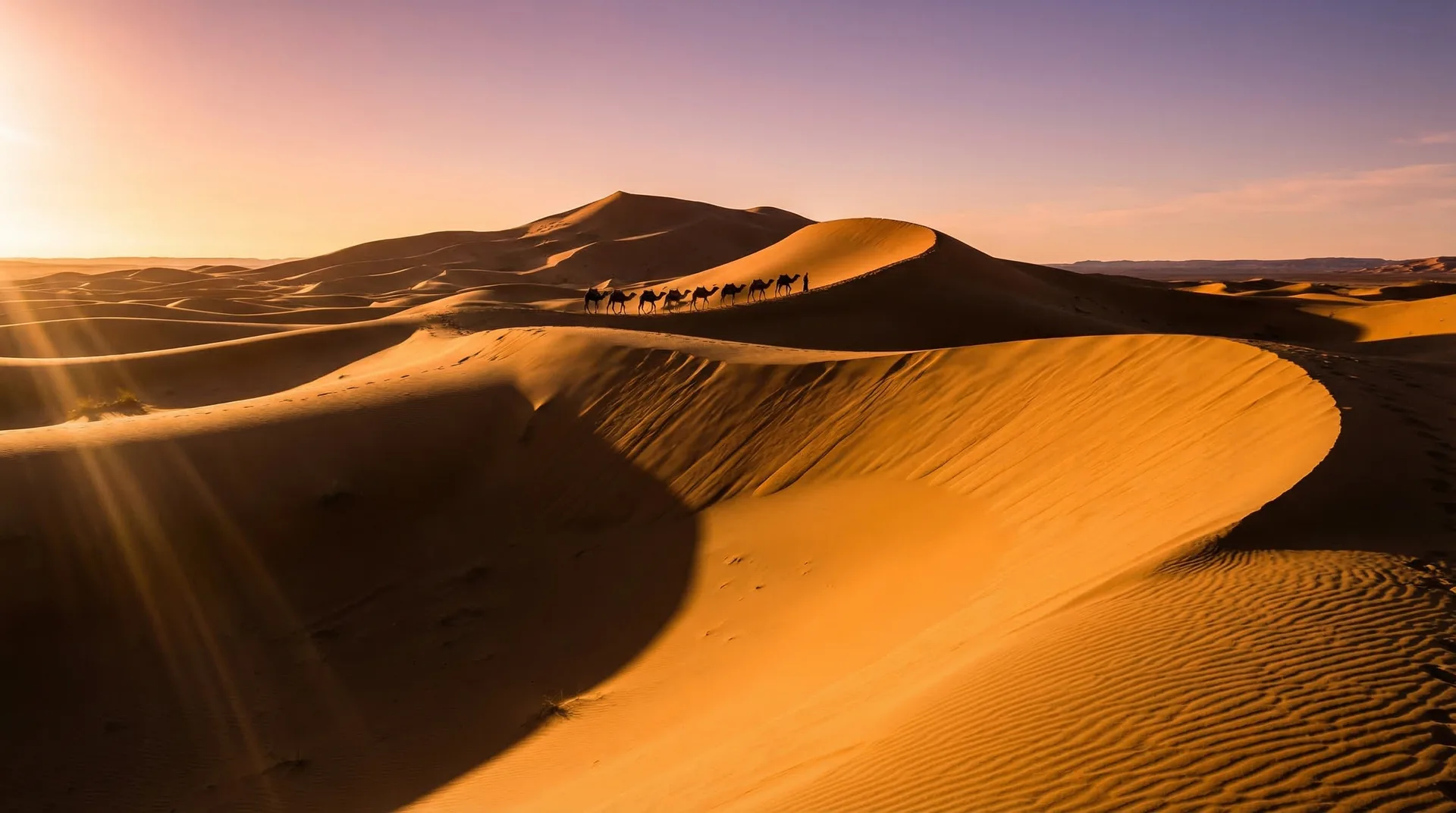
For Sahara trips out of Marrakech, October to April is the golden window — comfortable days, cold clear nights and dunes raked by low golden light. July and August are brutal and best left alone.
In this guide
Why season matters so much in the Sahara
The dunes most Marrakech travellers head for — Erg Chebbi at Merzouga, Erg Chigaga out past M'Hamid — sit in one of the most thermally extreme environments anywhere. In December and January the days at Erg Chebbi hold a pleasant 15–20°C under hard, bright sun, while the nights plunge to 2–5°C, cold enough to want a fleece and a hat by the fire. Come July, those same crests bake at 45–50°C by midday, and even a short walk in open sun turns into an ordeal.
That swing in temperature dictates the whole experience: whether the camel trek is magical or a slog, whether sunrise over the dunes is a joy or simply a relief, whether you want to be outside at all beyond a narrow window at each end of the day.
The best months: October to April
October through April is the Sahara at its most welcoming and most photogenic — and it lines up neatly with the comfortable months for the long drive south from Marrakech. Autumn (October–November) gives warm days of 25–30°C and cool nights; the late-October light on the dunes is pure gold and the summer crowds have long gone. Winter (December–February) is, for many seasoned Morocco hands, the peak: cold nights wrapped in blankets by the fire, skies scrubbed clean for stargazing, and dune shadows at sunrise that are simply extraordinary. Spring (March–April) is every bit as good, with the days warming and a chance of wildflowers in the scrub at the camp edges.
- October–November: warm days, cool nights, superb light, thinning crowds
- December–February: cold nights (2–8°C), the clearest skies, fewest visitors, the best desert atmosphere
- March–April: warming fast, pleasant days, the odd wildflower, still comfortable after dark
The shoulder months: May and September
By May the midday figure is creeping toward 35°C — still workable if you start early and save the activity for late afternoon. Most camps run as normal and the dunes are quieter than the spring rush. September swings the other way: the worst of the summer has broken but it stays hot at 35–40°C around midday, with the second half of the month improving sharply.
Both months are perfectly viable with the expectations adjusted. Keep clear of the middle of the day for anything outdoors; sunrise and sunset are still excellent.
When to avoid: June to August
June to August is when a lot of the better camps either shut up shop or pare their operations right back. Midday at Merzouga sits stubbornly above 42°C, climbing to 48–50°C in July. The camel trek shrinks to a 15-minute dash for the dunes rather than anything meditative, and sitting outdoors in the afternoon without shade and water is genuinely risky. If your dates land in high summer, the Atlantic coast or the cool of the High Atlas are far better uses of the time — and both are easy escapes from Marrakech.
- June: warming fast — fine in early June, uncomfortable by month's end
- July–August: avoid for any outdoor desert activity; some camps close
- If you must go: choose a camp with air-cooled tents and generators, and keep all activity to before 9am and after 5pm
Erg Chebbi vs Erg Chigaga: does season choice differ?
The two dune seas follow much the same seasonal pattern. Erg Chigaga, out beyond M'Hamid, lies a touch lower and can run 1–2°C warmer in summer, and its sheer remoteness makes a summer visit even harder to pull off. In the good season (October–April), that same isolation from any road or village is Chigaga's trump card — darker skies and emptier crests, a real edge if you are out to photograph the night sky.
Frequently asked
What is the best month to visit Merzouga?
October, November, December and March stand out. December has the coldest nights but the most dramatic mood and the clearest skies; October and March split the difference, with mild desert nights for those who would rather not freeze by the fire.
Is the Sahara cold at night?
Yes — markedly so. Between October and February the nights fall to 2–8°C, sometimes lower. The better camps hand out blankets and many lend fleece jackets, but bring a warm layer of your own regardless. The cold is part of the bargain — a night under that desert sky around the fire earns its keep.
Is the Sahara too hot in summer?
In July and August midday routinely tops 45°C, and most experienced operators and travellers steer clear of the dunes then. If your dates are fixed, ask for an air-cooled tent and keep every outdoor moment to before 9am and after 5pm.
Can you see stars in the Moroccan Sahara?
On a clear, moonless night, spectacularly. The best of it falls between December and February on a new moon at a remote camp away from any generator. Erg Chigaga, further from roads and towns than Merzouga, carries marginally less light pollution.
How cold does the Sahara get in December?
Expect daytime highs of 15–20°C at Erg Chebbi in December and nights down at 2–5°C. The wind chill on an exposed dune ridge at 3am can feel a good deal colder than that — dress for it.
Planning a trip?
Let a Marrakech atelier handle the details.
Tell us your dates and style and we'll send a written itinerary and a transparent quote within 24 hours.
Request an itineraryKeep reading
Planning
Sahara Desert Tour Guide: Merzouga, Chigaga & Zagora
Almost every Sahara trip starts here in Marrakech, and three desert gateways compete for your nights: Erg Chebbi at Merzouga for accessibility and grandeur, Erg Chigaga near M'Hamid for remoteness, and Zagora for the shortest run from the city. Here is how to choose, what the camps are like, and when to go.
Planning
The Best Time to Visit Morocco
For a Marrakech city break, spring (March–May) and autumn (September–November) hit the sweet spot — sun-warmed days in the medina, cool enough rooftops at dusk, and perfect conditions for Agafay, the Ourika valley and an Atlas or desert day trip.
Itineraries
Morocco Itinerary: 10 Days
Ten days is the sweet spot for Morocco — long enough to start in our home city of Marrakech and loop through the Sahara and the imperial north unhurried, with the Essaouira coast as an optional finish.