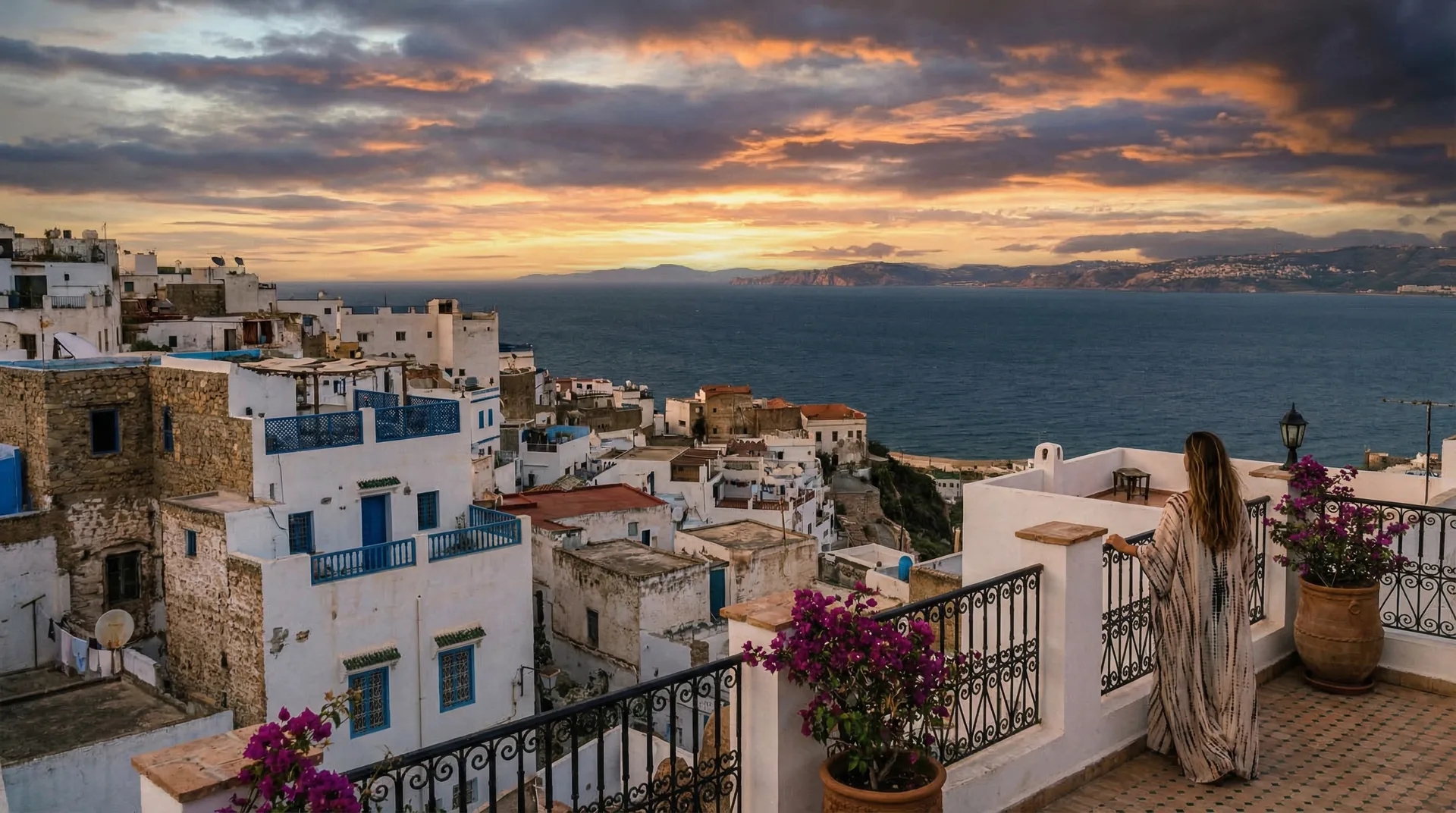
Two weeks is enough to cover Morocco's full sweep and finish in our home city: the imperial cities of the north, the High Atlas, the kasbah road, a night in the Sahara, and a final flourish in Marrakech — all at a genuinely unhurried pace.
In this guide
Why is 14 days the ideal length for Morocco?
Fourteen days lets you combine everything a 7- or 10-day trip forces you to choose between. You can begin in Casablanca, trace the northern imperial cities (Fes, Meknes, Chefchaouen), cross the Middle Atlas, descend the kasbah road to the Sahara, and return over the High Atlas to finish in Marrakech — a full circle, with two or three days in each highlight rather than a rushed overnight.
The driving distances in Morocco are real, and the routes between the north and the south are genuinely beautiful — the cedar forests of Azrou, the Dadès and Todra gorges, the palm-filled Drâa Valley — so the transfers become part of the experience rather than a tax on it. With a private driver-guide from our Marrakech base, each stretch is a narrated journey rather than dead time.
Day-by-day: the grand circuit
This outline assumes arrival in Casablanca (CMN) and departure from Marrakech (RAK) — the classic open-jaw routing we recommend, since it removes all backtracking and ends in the city where most travellers want their final couple of days. Days can be adjusted for flights, pace and personal interests.
- Day 1: Arrive Casablanca — Hassan II Mosque exterior and the corniche; overnight near the port.
- Days 2–3: Fes — the Chouara tanneries, Bou Inania madrasa, the Attarine souk; a private historian guide is essential.
- Day 4: Meknes (Bab Mansour, the royal granaries) and Roman Volubilis at golden hour.
- Days 5–6: Chefchaouen — the blue medina and Rif mountain hikes; two slow nights.
- Day 7: Azrou cedar forest and the Middle Atlas plateau south to Midelt or Ifrane.
- Day 8: Gorge country — the Dadès Gorge and Boumalne; overnight in the valley.
- Day 9: Todra Gorge at dawn, then east to Merzouga.
- Day 10: Erg Chebbi dunes — afternoon camel trek to a luxury camp; dinner under the stars.
- Day 11: Sunrise on the dunes, then the long, rewarding drive west through the Drâa Valley.
- Day 12: Ouarzazate ('the door of the desert') and Aït Ben Haddou kasbah.
- Day 13: Tizi n'Tichka pass (2,260 m) over the High Atlas; arrive Marrakech in the afternoon, settle into a riad.
- Day 14: Marrakech — the souks and Jemaa el-Fna, Bahia Palace and the Saadian Tombs, Jardin Majorelle and a farewell hammam; evening departure from RAK.
How much driving does a 14-day Morocco trip involve?
The circuit covers roughly 2,500–3,000 km in total, spread across 11 or 12 driving days — typically 2–5 hours of moving per day. Days 7 and 11 involve the longest transfers (6–7 hours each); these are the days where an early start and a knowledgeable driver who stops at the right viewpoints make the most difference. The route is almost entirely paved, though some desert pistes near Merzouga benefit from a high-clearance vehicle.
Variants and add-ons
If Essaouira calls, extend the Marrakech leg with two nights on the Atlantic coast (around 3 hours west of the city) — the seafood, the ramparts and the wind make a superb decompression before a long-haul flight. If you want a longer Atlas experience, swap the Midelt overnight for two nights in Imlil, a 90-minute drive from Marrakech, with a guided day on the Toubkal foothills. Honeymooners and families can add a second Sahara night at Erg Chigaga, the wilder, more remote alternative to Erg Chebbi.
Frequently asked
Is 14 days enough to see all of Morocco?
Two weeks covers the essential circuit comfortably — the imperial cities, the Atlas, the Sahara and Marrakech — without feeling rushed. A few destinations (Taroudant, the Souss-Massa, the far south near Dakhla) fall outside a 14-day radius, but most travellers leave Morocco after a fortnight with a full trip rather than a frustrated one.
What is the best 14-day Morocco route?
An open-jaw circuit from Casablanca (or Fes) in the north down to Marrakech, via Chefchaouen, the Middle Atlas, the kasbah road, the Sahara at Merzouga and the High Atlas. It removes all backtracking, follows the natural grain of the landscape, and finishes in Marrakech for your flight home.
What is the best time of year for a 14-day Morocco trip?
March to May and September to November. Spring and autumn give comfortable temperatures in the cities, walkable desert days, and the High Atlas passes free of snow. Summer (July–August) is feasible in the north and on the coast, but the desert and Marrakech at 40°C+ make a full circuit punishing.
Should I fly open-jaw for a two-week Morocco trip?
Yes — fly into Casablanca or Fes and out of Marrakech (or vice versa). The open-jaw eliminates 1–2 full driving days of backtracking, which makes a noticeable difference on a 14-day trip. Prices for open-jaw routings are usually comparable to returns.
Can I do the 14-day circuit by train and bus?
The northern section (Casablanca–Fes–Meknes–Chefchaouen) is well connected by train and CTM bus. South of Fes — the gorges, the Sahara, the kasbah road — public transport is slow and infrequent. A private driver is strongly recommended for the southern half of the circuit.
Planning a trip?
Let a Marrakech atelier handle the details.
Tell us your dates and style and we'll send a written itinerary and a transparent quote within 24 hours.
Request an itineraryKeep reading
Itineraries
Morocco Itinerary: 10 Days
Ten days is the sweet spot for Morocco — long enough to start in our home city of Marrakech and loop through the Sahara and the imperial north unhurried, with the Essaouira coast as an optional finish.
Itineraries
Morocco Itinerary: 7 Days
A week is plenty to pair our home city of Marrakech with the Sahara, or to trace the imperial cities of the north. Here are two proven 7-day Morocco itineraries, both designed to start or finish in Marrakech — and how to choose between them.
Planning
The Best Time to Visit Morocco
For a Marrakech city break, spring (March–May) and autumn (September–November) hit the sweet spot — sun-warmed days in the medina, cool enough rooftops at dusk, and perfect conditions for Agafay, the Ourika valley and an Atlas or desert day trip.