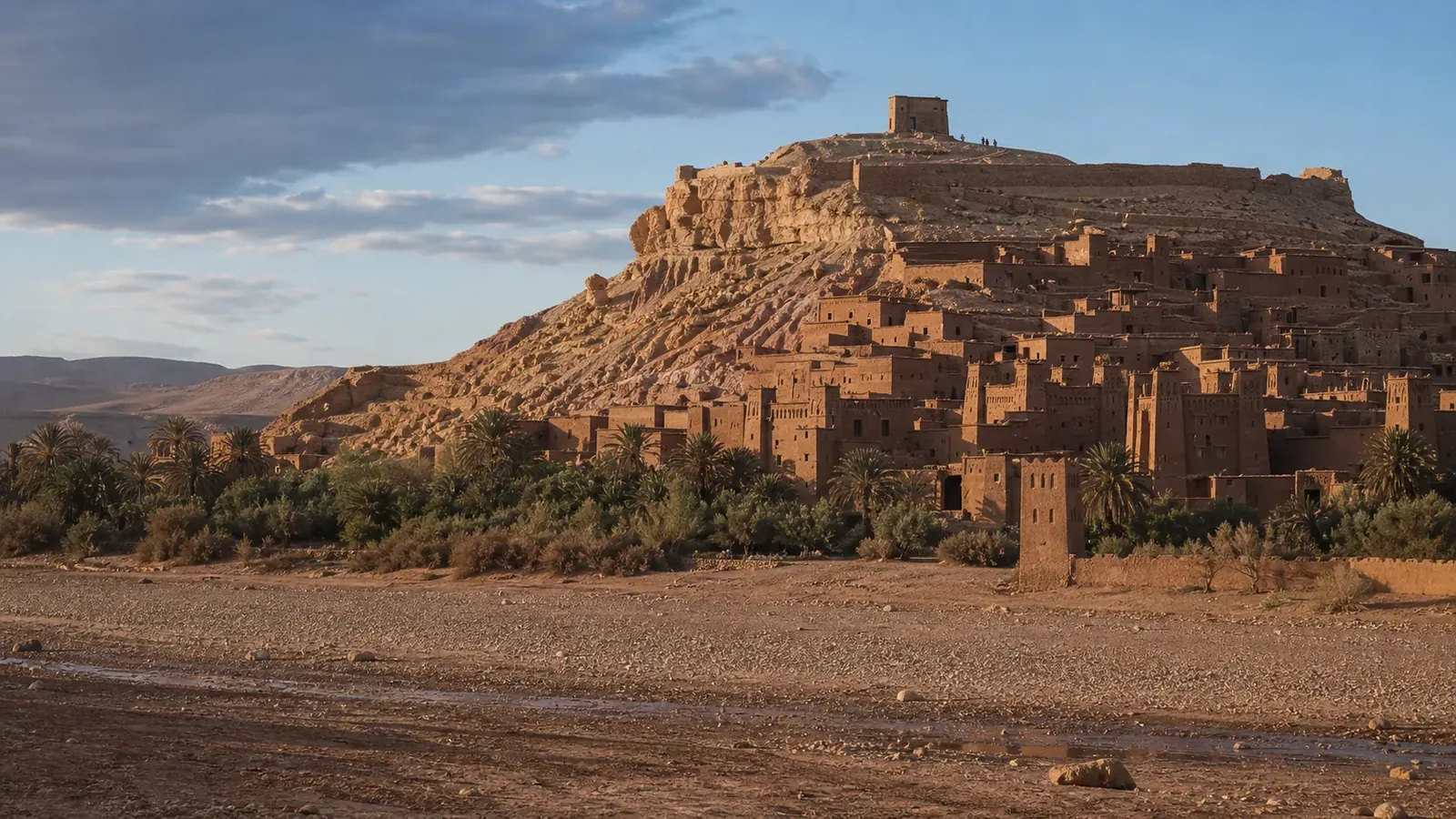
Ouarzazate — 'the door of the desert' — sits where the High Atlas gives way to the Saharan south, about 4 hours from Marrakech over the Tizi n'Tichka pass. It is the classic first stop on Sahara day trips and overnights out of the red city: the gateway to Aït Ben Haddou, Africa's most famous film set, the Drâa Valley and the Atlas Studios.
Planning · Updated June 2026 · 7 min read
What is Aït Ben Haddou and how do you visit it?
Aït Ben Haddou — a UNESCO World Heritage ksar (fortified earth-brick village) 30 km north-west of Ouarzazate — is the most photographed historic site in southern Morocco and the natural lunch-stop on the drive down from Marrakech. The ksar's family towers (ighrem) climb a rocky spur above the Ounila river in a stack of tapering pisé walls, crenellated towers and carved geometric panels that has appeared on screen with remarkable frequency: Gladiator, Lawrence of Arabia, The Mummy, Game of Thrones (seasons 3–4, as Yunkai and later Meereen), The Last Temptation of Christ and many more were shot here.
Cross the river on foot (stepping stones in the dry season, a footbridge when the water is high) and climb through the inhabited lower village into the empty upper ksour. The view from the granary (agadir) at the top — over the river, the palm oasis, the Ounila plain and the Atlas wall behind — is one of Morocco's great panoramas. Entry to the ksar is free; local guides wait at the base of the crossing and are worth taking for context. Allow 2–3 hours for a proper look.
- Aït Ben Haddou ksar — UNESCO World Heritage pisé village; summit-granary panorama; the classic stop on the Marrakech–Sahara road.
- On-screen credits: Gladiator, Game of Thrones, Lawrence of Arabia, The Last Temptation of Christ.
- River crossing — stepping stones in the dry season; footbridge at other times.
- Local guides wait at the base; agree the fee first.
- Adjacent new village — a short restaurant strip plus argan-oil and artisan shops.
What is the Atlas Studios and can you visit it?
Atlas Studios — the largest film studio in Africa and one of the largest anywhere by land area — sits 6 km north of Ouarzazate, an easy add-on if you are basing a Sahara trip out of Marrakech. Founded in 1983 by Mohammed Belghmi, it has hosted Bernardo Bertolucci's The Sheltering Sky, Martin Scorsese's Kundun, Ridley Scott's Gladiator, Oliver Stone's Alexander and, more recently, big international television shoots. The standing sets — a recreation of ancient Egypt, Moroccan medina streets, Roman forums, a Tibetan monastery — are left up between productions and open to guided tours.
Tours run roughly 8:00 to 17:00 daily (closed Friday mornings), with paid entry. The effect is at once slightly surreal and genuinely interesting: stepping from a pharaonic Egyptian set around a corner into a Moroccan village built for television drives home just how many landscapes the Ouarzazate region can convincingly stand in for.
What is the Taourirt Kasbah and what else is there to see in Ouarzazate itself?
The Taourirt Kasbah — once the palace of the Glaoui feudal lords who held the southern Atlas passes in the late 19th and early 20th century — stands in the centre of Ouarzazate. Begun in the 18th century and enlarged by Thami El Glaoui, the Pasha of Marrakech and a controversial figure of the Protectorate era, it is among the best-preserved kasbahs in the country. The interior, partly restored by UNESCO, shows Glaoui-era furnishings, painted woodwork and the administrative rooms of a lord who controlled the caravan routes to the Sahara. There is a small entry fee.
The Fint Oasis — a lush palm grove 6 km south of the city in a dry river valley — makes a striking contrast to the surrounding desert plateau. A 30-minute drive and then a short walk brings you to a world of running irrigation channels, date palms, oleander and Berber garden plots. The sunrise visit (or very early morning in summer) catches the soft light on the pink earth walls of the narrow canyon. Camel rides and walks through the oasis are available from local operators.
- Taourirt Kasbah: 18th-century Glaoui palace; UNESCO-restored interior; small entry fee.
- Fint Oasis — 6 km south; palm grove in a desert canyon; best at sunrise or late afternoon.
- Musée du Cinéma — small cinema museum in the city centre documenting the film industry.
- Drâa Valley road south — the palm-lined valley road to Zagora is one of Morocco's most beautiful drives.
What day trips can you do from Ouarzazate?
The Drâa Valley — Morocco's longest river valley, stretching 200 km south from Ouarzazate towards Zagora — is one of the country's most spectacular landscapes: a continuous palm oasis cutting through black hammada desert, punctuated by hilltop kasbahs and Berber villages. The drive to Zagora (2.5 hours) passes Agdez, the Tamnougalt ksar and the palmery of Tinzouline. Zagora itself is a departure point for shorter Sahara excursions to the dunes of Erg Lihoudi.
The Skoura Oasis — 45 km north-east of Ouarzazate on the road towards the Dadès Valley — contains the finest concentration of kasbahs in Morocco: dozens of Glaoui-era pisé towers rising from a dense date-palm oasis. The most significant is the Amridil Kasbah (small entry fee), still inhabited by its original family and in remarkable condition. A walk through the palmery takes 2–3 hours and can be combined with a visit to the Dadès Gorge (70 km further east).
- Drâa Valley to Zagora — 2.5 hrs south; continuous palm oasis; hilltop kasbahs and the Erg Lihoudi dunes.
- Skoura Oasis — 45 km east; Morocco's finest kasbah concentration; Amridil Kasbah open to visitors.
- Dadès Gorge — 2 hrs east; dramatic red rock canyon; good base for Atlas trekking.
- Todra Gorge — 3 hrs east; 300 m vertical limestone walls; rock climbing and walking.
How do you get to Ouarzazate and where do you stay?
The Tizi n'Tichka pass, Morocco's highest paved road at 2,260 m, links Marrakech to Ouarzazate (200 km) in about 4 hours by private car, and it is the spine of nearly every Sahara trip out of the red city. The drive is spectacular: hairpin switchbacks climbing through the High Atlas past snow-capped peaks in winter and early spring, then dropping through Berber villages and argan forests into the south. Royal Air Maroc flies Marrakech–Ouarzazate (OZZ) when schedules align, but the road is the far more rewarding way in.
Lodging in Ouarzazate runs from simple guesthouses to several genuinely good hotels with pools and kasbah views — handy bases for multi-day desert loops. The Berbère Palace and Dar Ahlam (the latter 30 km east in the Skoura palmery, one of Morocco's finest boutique hotels) hold the top end. Most travellers stay one or two nights, almost always as part of a Marrakech–desert loop that returns to the red city or pushes on toward Fes.