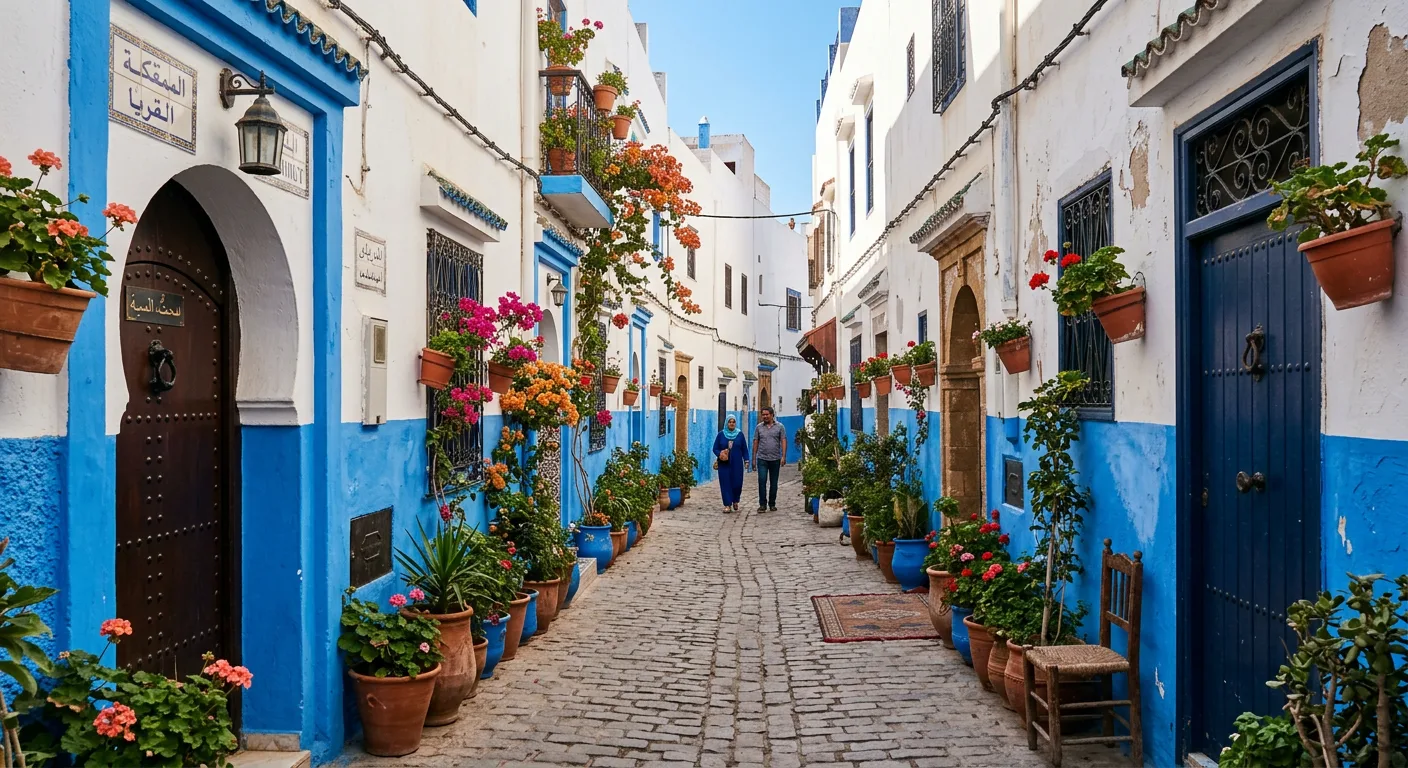
Rabat, Morocco's understated capital, trades the souk frenzy of Marrakech for UNESCO-listed monuments, a blue-and-white royal kasbah, Roman ruins and a calm, lived-in rhythm. It sits on the high-speed line that also feeds Marrakech, so it slots neatly into a wider loop built around the red city.
In this guide
What are the top sights in Rabat's medina and kasbah?
The Kasbah of the Udayas — a 12th-century Almohad fortification perched above the Bou Regreg estuary — is Rabat's most atmospheric quarter. Inside the walls, whitewashed houses with cobalt-blue lower halves line lanes barely wide enough for two people to pass. The Andalusian Garden at its centre is one of Morocco's loveliest green spaces: clipped hedges, orange trees and a hush you will not find in the Marrakech medina. The kasbah gate, Bab Oudaia, is a masterpiece of Almohad carved stucco and one of the finest pieces of medieval Moroccan architecture still standing.
The Hassan Tower — a colossal unfinished minaret begun in 1195 under Sultan Yacoub al-Mansour and meant to be the tallest on earth — rises above the stumps of some 200 columns, the only trace of what would have been the western Islamic world's largest mosque. Note the family link to Marrakech: the same sultan raised the Koutoubia minaret that still dominates the red city's skyline, and Hassan Tower was conceived as its grander sibling. Alongside stands the Mausoleum of Mohammed V, an active royal tomb of white Carrara marble, cedarwood ceilings and a permanent honour guard. Entry is free; dress modestly.
- Kasbah of the Udayas — 12th-century Almohad citadel; blue-and-white lanes; Andalusian Garden; finest estuary viewpoint.
- Hassan Tower and Mausoleum of Mohammed V — unfinished 12th-century minaret, sibling of Marrakech's Koutoubia; royal mausoleum with honour guard.
- Chellah — Roman and Marinid ruins south of the centre; storks nest atop the ancient minaret.
- Mohammed VI Museum of Modern and Contemporary Art — one of Africa's best modern-art collections; free on Sundays.
- Rabat medina — smaller, calmer and far less hawkish than the Marrakech souks; good textiles and pottery.
- Oudayas beach — surf beach right below the kasbah; a magnet for young Rabatis.
What is the Chellah and why is it worth visiting?
The Chellah (Shalla) is Rabat's most singular monument: a walled necropolis 2 km south of the medina that layers the ruins of a Roman town (Sala Colonia, 1st–3rd century AD) over a 14th-century Marinid royal funerary complex. White storks colonise the Marinid minaret every spring, their nests piled metres high on the old stone, and the clatter of their bills above the toppled columns is genuinely arresting. The garden within — wild figs, rose bushes and an eel pool where superstitious offerings are still left — has an atmosphere you will not meet anywhere else in Morocco.
Entry runs about MAD 70. Come in the late afternoon, when the light turns the Roman columns gold and the storks are busiest (February to July). It stays blissfully uncrowded compared with the headline monuments of Marrakech and Fes — exactly the kind of quiet that defines Rabat as a destination.
What is the Mohammed VI Museum of Modern and Contemporary Art?
Opened in 2014, the Mohammed VI Museum of Modern and Contemporary Art (MMVI) is one of the finest art museums in Africa. Its permanent collection traces Moroccan modern art from the colonial era to the present, with strong holdings of Expressionist, Abstract and contemporary Moroccan painters. The rotating temporary programme regularly brings major international shows to the capital. The building itself — a purpose-built six-storey modernist block near parliament — meets international museum standards, with proper climate control, trilingual labelling in Arabic, French and English, and a good bookshop.
Admission is around MAD 60; free on Sundays. It is a 10-minute walk from the medina and rarely busy. For anyone curious about contemporary North African culture beyond the medina-and-souk story that dominates a Marrakech itinerary, it is unmissable.
How do you get to Rabat and how long should you stay?
Rabat sits on the Al Boraq high-speed line, which makes it easy to fold into a Marrakech-based trip. From Casablanca the train covers the 90 km in under an hour, running every 30–60 minutes from Mohammed V Airport straight to Rabat Agdal. From Marrakech, take the standard ONCF service to Casablanca (about 3 hours) and change onto Al Boraq for the final 50 minutes. From Fes the train is roughly 1.5 hours; from Tangier about 2 hours direct on Al Boraq. Rabat has no major international airport of its own — most arrivals route through Casablanca and continue by rail.
Two nights is the comfortable length: a full day for the Hassan Tower, the Kasbah of the Udayas and the Chellah, and a second for the MMVI museum, the medina's textile quarter and the beach. Day-tripping from Casablanca is common but rushed — you tick off the monuments but miss the kasbah at sunset and a slow mint tea in the Andalusian Garden.
- From Casablanca airport: Al Boraq high-speed train, under 1 hour, every 30–60 minutes.
- From Marrakech: ONCF to Casablanca (~3 hrs), then Al Boraq onward (~50 min).
- From Fes: ONCF train, approximately 1.5 hours.
- From Tangier: Al Boraq direct, approximately 2 hours.
- Recommended stay: 2 nights — an easy add-on to a Marrakech and imperial-cities loop.
Where should you eat in Rabat?
Rabat eats well by Moroccan standards — a capital with a large diplomatic and government community supports a broader range of restaurants than its size alone would suggest. The Agdal and Hassan neighbourhoods have solid contemporary Moroccan and international tables. For a medina lunch, the lanes around the Grand Mosque serve honest harira, brochette stalls and unpretentious tagines at local prices. Café Maure, perched above the kasbah garden, is the reliable stop for mint tea with an estuary view.
Frequently asked
Is Rabat worth visiting in Morocco?
Yes — especially if you want a calmer, more lived-in Moroccan city after the intensity of the Marrakech souks. Rabat delivers UNESCO-listed monuments, superb modern art and a daily rhythm that belongs to residents rather than tour groups. Two days slots neatly into a Marrakech-anchored loop via the high-speed train.
What is the Hassan Tower in Rabat?
The Hassan Tower is a vast unfinished minaret begun in 1195 under the Almohad Sultan Yacoub al-Mansour — the same ruler who built the Koutoubia minaret in Marrakech — intended to top 86 m and crown the world's largest mosque of its day. The sultan died in 1199, work stopped, and the mosque was never finished. The 1755 earthquake brought down most of the columns. What survives — the 44 m tower and around 200 column stumps across a huge esplanade — ranks among Morocco's most important medieval monuments.
How do I get to Rabat from Marrakech or Casablanca?
From Marrakech, take the ONCF train to Casablanca (about 3 hours) and change onto the Al Boraq high-speed service for the final 50 minutes to Rabat. From Casablanca it is simplest of all — Al Boraq runs under an hour from Mohammed V Airport straight to Rabat Agdal, every 30–60 minutes. A private driver for the transfer can also be arranged.
What is the Kasbah of the Udayas?
The Kasbah of the Udayas is a 12th-century Almohad fortress on the headland above the Bou Regreg estuary. Inside the walls sits a quarter of whitewashed houses with cobalt-blue lower walls, an Andalusian garden and a small museum. The Bab Oudaia gate, elaborately carved in Almohad stucco, is one of the finest surviving examples of medieval Moroccan architecture. Entry to the kasbah is free; the garden and museum charge a small fee.
What is the best time to visit Rabat?
Spring (March–May) and autumn (September–November) are ideal: mild temperatures, low humidity and lovely light. Summer is warm and dry (25–30°C) but far gentler than inland Marrakech, thanks to the Atlantic; winter is mild with the odd rainy spell. The Chellah storks peak February to July, a further nudge toward a spring visit.
Planning a trip?
Let a Marrakech atelier handle the details.
Tell us your dates and style and we'll send a written itinerary and a transparent quote within 24 hours.
Request an itineraryKeep reading
Planning
Things to Do in Casablanca: The Essential Guide
Casablanca is Morocco's economic capital and largest city — a modern, cosmopolitan metropolis built on Atlantic trade rather than imperial history. Its centrepiece, the Hassan II Mosque, is one of the most extraordinary buildings on earth, and its restaurants, Corniche and Art Deco streetscape reward anyone who lingers. For many it is the gateway into the country before the high-speed line carries them south toward Marrakech.
Planning
Things to Do in Fes: The Essential Guide
Fes el-Bali is the largest living medieval city on earth — a UNESCO-listed medina of some 9,400 lanes, Marinid madrasas, the world's oldest university and the famous Chouara tanneries. Where Marrakech dazzles, Fes immerses: it asks for a good guide, unhurried days and real curiosity. Many travellers pair the two imperial cities on a single Moroccan loop.
Planning
Things to Do in Meknes: The Essential Guide
Meknes — the fourth imperial city and the least visited — pays back the traveller who lingers: a UNESCO medina, the monumental gates and granaries of Sultan Moulay Ismail's 17th-century capital, and the Roman city of Volubilis 33 km north. It pairs naturally with Fes and Rabat on a northern loop that often bookends a Marrakech-anchored Morocco trip.
Itineraries
Morocco Itinerary: 10 Days
Ten days is the sweet spot for Morocco — long enough to start in our home city of Marrakech and loop through the Sahara and the imperial north unhurried, with the Essaouira coast as an optional finish.