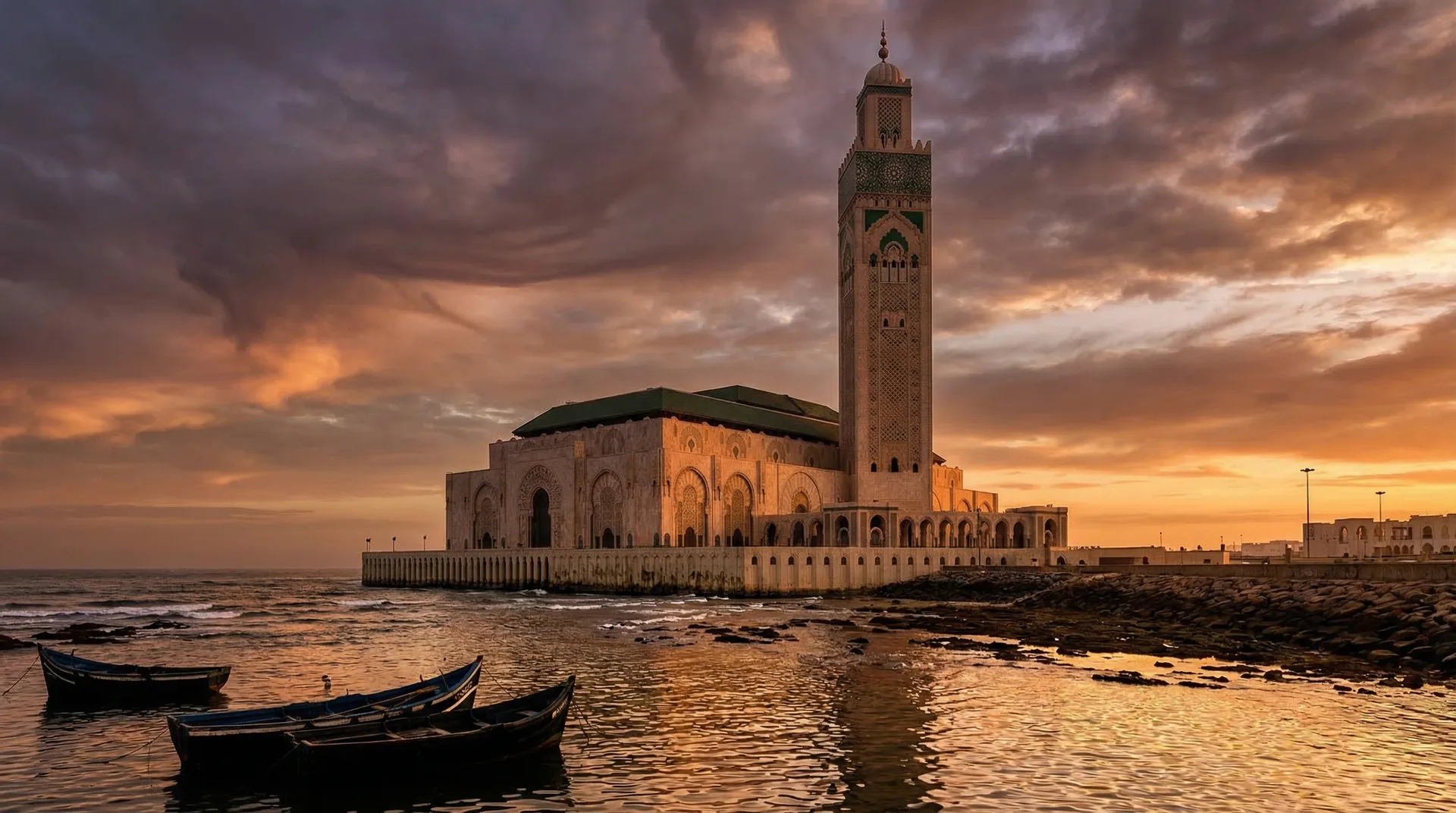
Casablanca is Morocco's economic capital and largest city — a modern, cosmopolitan metropolis built on Atlantic trade rather than imperial history. Its centrepiece, the Hassan II Mosque, is one of the most extraordinary buildings on earth, and its restaurants, Corniche and Art Deco streetscape reward anyone who lingers. For many it is the gateway into the country before the high-speed line carries them south toward Marrakech.
In this guide
What are the must-see sights in Casablanca?
The Hassan II Mosque is the reason most travellers pause in Casablanca rather than transferring straight on to Marrakech or Fes — and it earns the stop on its own. Completed in 1993 on a headland over the Atlantic, it is the third-largest mosque in the world (after Mecca and Medina) and the largest in Morocco open to non-Muslim visitors. Its minaret reaches 210 m — among the tallest anywhere — and at night a laser from the tip points toward Mecca, visible up to 50 km out. Guided interior tours (MAD 170 per adult, roughly US$17, outside prayer times) reveal a prayer hall of staggering craftsmanship: hand-carved cedar ceilings, zellij floors, onyx columns and a retractable roof.
The Corniche d'Ain Diab — the Atlantic seafront boulevard running west from the mosque — is where Casablancans spend their weekends, strung with beach clubs, fish restaurants and café terraces. The Morocco Mall and the financial-district towers signal the modern city's scale, but the Habous quarter (the Nouvelle Médina), laid out by French planners in the 1930s in a deliberately Moroccan idiom, is its most architecturally coherent pedestrian zone: a planned medina with a central souk of patisseries, bookshops and leather goods at gentler prices, and far less hustle, than the Marrakech souks.
- Hassan II Mosque — third-largest mosque in the world; open to non-Muslims on guided tours; minaret 210 m.
- Corniche d'Ain Diab — Atlantic seafront boulevard; beach clubs, fish restaurants, evening promenade.
- Habous quarter — 1930s planned 'new medina'; patisseries, bookshops, calmer crafts shopping.
- Old Medina and Central Market — Casablanca's historic core; smaller and far less intense than the Marrakech medina.
- Villa des Arts — contemporary art space in a 1934 colonial villa; rotating exhibitions.
- Place Mohammed V — central Beaux-Arts square ringed by French Protectorate administrative buildings.
What Art Deco architecture can you see in Casablanca?
Casablanca holds one of the world's largest and best-preserved concentrations of Art Deco architecture, raised during the French Protectorate (1912–1956). The buildings clustered around the Centre-Ville — especially along Boulevard Mohammed V and around Place des Nations Unies — show a hybrid sometimes called Mauresque or Moroccan Art Deco: European Deco massing dressed in Moroccan ornament, with carved plasterwork, zellij tiles, keyhole arches and cedar screens.
A self-guided loop taking in the Central Post Office (a 1918 Mauresque landmark), the former Hôtel Lincoln, the Cathédrale du Sacré-Cœur (now a cultural centre) and the apartment blocks along Rue du Prince Moulay Abdallah runs about 90 minutes and exposes a layer of the city the airport-transit traveller never sees. The association Casa-Mémoire runs guided Art Deco walks in French and Arabic on selected weekends.
What is the food scene like in Casablanca?
Casablanca's restaurant scene is the most sophisticated in Morocco: a large resident business and diplomatic crowd, plus the heaviest diaspora return traffic of any city, sustains everything from street tagine to contemporary Moroccan fine dining. The Corniche has the densest run of good fish restaurants; La Sqala, set within the old city walls near the medina, is a beloved traditional kitchen in a historic fort. Chez El Bab in the Habous quarter leans into pastilla and Fassi cooking.
For the freshest seafood, the Central Market (Marché Central) on Rue Chaouia has a fish hall where the Atlantic catch is laid out each morning, and the attached grills will cook whatever you pick from the stalls next door — one of the best-value fish lunches in the country. Budget roughly MAD 100–180 for a full grilled-fish meal with bread and salad.
How long should you spend in Casablanca and how do you get there?
One night and a full day covers the Hassan II Mosque, the Corniche, the Habous quarter and an Art Deco walk. Two nights buys a slower pace and an evening on the Corniche, which is at its best around sunset. Casablanca does not ask for the medina-deep investment that Fes or Marrakech reward, but it is far more than a place to change planes.
Mohammed V International Airport (CMN), 30 km south-east, is Morocco's main international hub and, for many, the front door to a Marrakech trip. The airport train into Casa Voyageurs (every 30 minutes, about 45 minutes) is the easiest link; taxis to the centre take 30–45 minutes in traffic. Al Boraq high-speed trains run to Rabat (45 minutes) and Tangier (2 hours), while the standard ONCF line carries you south to Marrakech in around 3 hours.
- Airport train: CMN to Casa Voyageurs, about 45 minutes, every 30 minutes.
- To Rabat: Al Boraq, 45 minutes.
- To Marrakech: ONCF train, approximately 3 hours direct.
- To Fes: ONCF, approximately 4 hours via Rabat.
- Recommended stay: 1–2 nights, often as the entry point to a wider Marrakech-based itinerary.
Frequently asked
Is Casablanca worth visiting in Morocco?
Yes, above all for the Hassan II Mosque — one of the most extraordinary buildings on earth and unmissable even for non-religious visitors. The Corniche, Art Deco streets and food scene add to the case. It is not an imperial medina city like Marrakech, but travellers who engage with it rather than just transit through find it genuinely rewarding.
Can non-Muslims visit the Hassan II Mosque?
Yes — it is one of the very few mosques in Morocco open to non-Muslim visitors. Guided tours run outside prayer times (typically 9:00, 10:00, 11:00 and 14:00; not Friday mornings). Admission is approximately MAD 170 (around US$17). Modest dress is required: covered shoulders and knees for all; no shorts.
What is the Habous quarter in Casablanca?
The Habous (or Nouvelle Médina) is a planned neighbourhood laid out by French urban planners in the 1930s in a deliberately Moroccan style — the reverse of colonial planning that usually imposed European layouts. The result is a calm, grid-planned pedestrian quarter with a central souk of patisseries, bookshops and craft shops at far gentler prices, and far less pressure, than the tourist souks of Marrakech. The Royal Palace stands adjacent.
Is Casablanca safe for tourists?
Yes — Casablanca is a large modern city with the usual urban considerations. The Hassan II Mosque, the Corniche and the Habous quarter are all straightforwardly safe by day. Apply the same common sense you would in any big city: mind your belongings in crowds, use arranged transport rather than unmarked taxis after dark, and keep copies of your documents.
How does Casablanca compare to Marrakech as a destination?
They are fundamentally different cities. Marrakech is the classic Moroccan experience — a medieval medina, the legendary Jemaa el-Fna, the souks, riads and the High Atlas on the doorstep. Casablanca is a modern commercial capital defined by outstanding architecture (the Hassan II Mosque above all), a sophisticated food and nightlife scene, and almost no historic medina. Most visitors do best to experience both rather than choose, linking them on the easy 3-hour train.
Planning a trip?
Let a Marrakech atelier handle the details.
Tell us your dates and style and we'll send a written itinerary and a transparent quote within 24 hours.
Request an itineraryKeep reading
Planning
Things to Do in Rabat: The Essential Guide
Rabat, Morocco's understated capital, trades the souk frenzy of Marrakech for UNESCO-listed monuments, a blue-and-white royal kasbah, Roman ruins and a calm, lived-in rhythm. It sits on the high-speed line that also feeds Marrakech, so it slots neatly into a wider loop built around the red city.
Planning
Things to Do in Marrakech: The Essential Guide
Marrakech is glorious sensory overload — a thousand-year-old medina, the cobalt of the Majorelle garden, the ritual of the hammam, candlelit rooftop dinners, and a square that reinvents itself every evening into one of the world's great open-air theatres. This is our insider map to where your hours are best spent, from the souks and the palaces to the day trips that fan out into the Atlas and the desert.
Practical
Getting Around Morocco
Within Marrakech you'll mostly walk the medina and grab petit taxis between districts. For the airport, the day trips and onward cities, the choice is between the train (to Casablanca, Rabat, Fes) and a private driver — and which you want depends on where you're headed.
Itineraries
Morocco Itinerary: 10 Days
Ten days is the sweet spot for Morocco — long enough to start in our home city of Marrakech and loop through the Sahara and the imperial north unhurried, with the Essaouira coast as an optional finish.