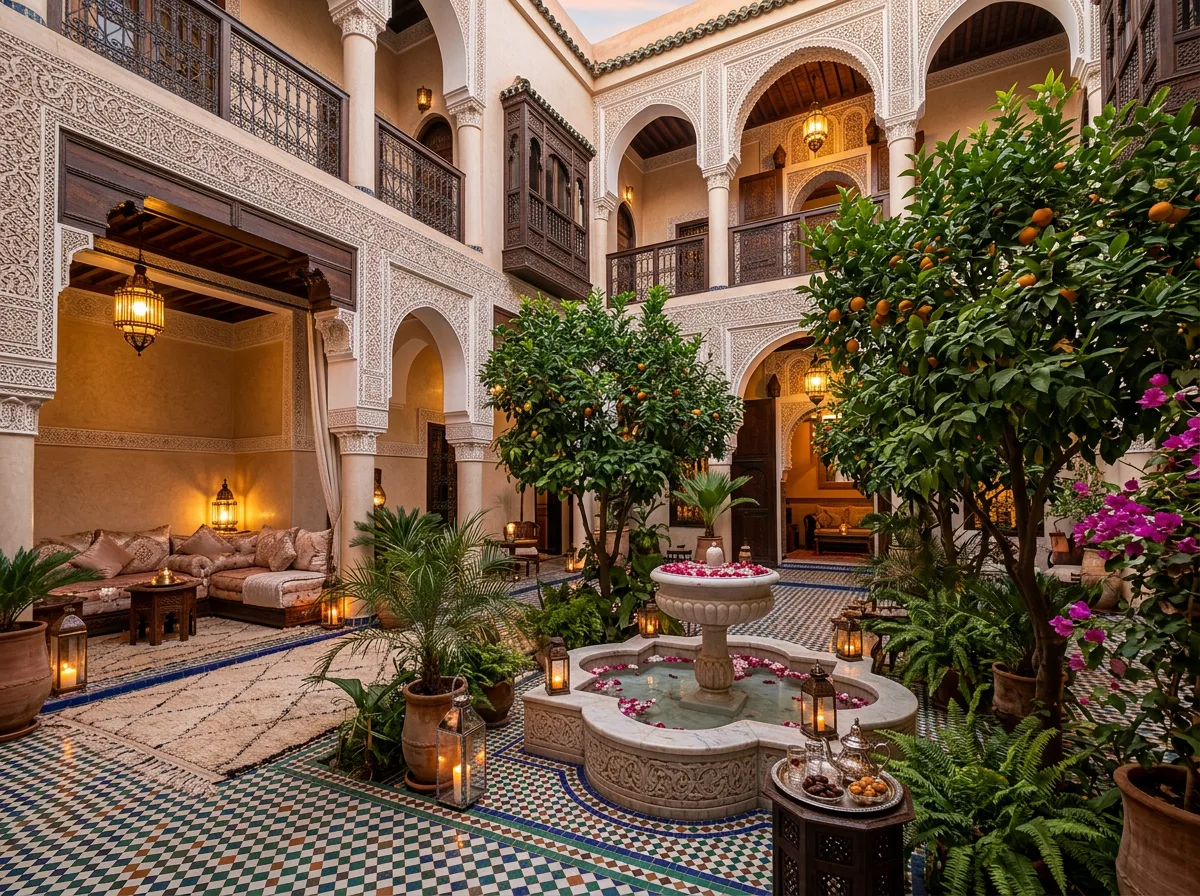
Ask returning visitors what they remember most about Marrakech and a surprising number say the riad rather than any monument. The catch is that the word now stretches over everything from a painstakingly restored seventeenth-century merchant house to a brand-new guesthouse that copied the look and skipped the feeling. Learn to read the difference and you save yourself both money and a flat first night.
What actually makes a riad a riad?
At its core a riad is a townhouse wrapped around an open courtyard — the wast al-dar — usually with a fountain or a small pool at its centre, citrus and olive trees rooted in the floor, and rooms stacked two or three storeys high around the void. The light pours down from the open sky above; the street side gives away nothing but bare plaster. The whole house is built to hide its best face indoors.
None of that inward turn was accidental. These were family homes, and the courtyard moved air, held greenery and gave the household its social centre. The grandest survivors in Marrakech run 200 to 400 years old, dating to when the Saadian and Alaouite sultans made this a royal capital. The craft to look for is the giveaway: hand-cut zellige mosaic, carved plaster (stucco), and painted cedar ceilings worked behind moucharabieh screens, each the product of generations of workshop skill.
Plenty of today's 'riads' are new builds, or guesthouses that took the courtyard plan without the old fabric underneath. Some are genuinely lovely — just understand it is a different night's sleep. If the real, aged article matters to you, ask the house about its history point-blank and trust the evidence: thick walls, original tiling and hand-carved wood, not smooth fresh paint and crates of imported tile.
Which quarter fits which traveller?
Every riad worth booking is inside the medina — but the medina is not one place, and the quarters pull in different directions:
- Mouassine & Bab Doukkala: the most atmospheric ground, thick with traditional riads and anchored by the Mouassine fountain and mosque, a short walk from the dyers' souk and the Saadian Tombs. The lanes are tight and full of character. Pick this if you want to be in the thick of it.
- Riad Laarous & Kennaria: calmer and more lived-in, a touch further from Jemaa el-Fna but with far fewer day-trippers underfoot. Strong value and a local feel — well suited to repeat visitors who have already done the headline sights.
- North medina (around Bab el-Khemis): the furthest from the bustle, yet home to some of the most serious restored riads in the city. A good call for travellers who want quiet and have their own transport sorted.
- Right by Jemaa el-Fna: as central as it gets, five minutes from the square — and the loudest, with motorbikes, traders and music running deep into the night. Check that your riad has a roof terrace you can escape to.
The questions to ask before you book
Looks aside, this is the short list we would put to any riad before paying a deposit:
- Owner-run or agency-run? Houses with the owner on the premises tend to run tighter — better service, sharper local tips, and maintenance that actually gets done.
- How many rooms? Under ten feels intimate; push past fifteen and it starts to behave like a hotel. Couples and small groups chasing privacy should ask about taking the whole house.
- Is there a plunge pool? From June to August, with Marrakech sitting at 38–42°C, that small pool stops being a luxury and becomes the reason you make it to dinner.
- Air conditioning in the rooms? Old riads stay cool by design, but upper floors can heat up in July and August. Confirm AC in the bedroom itself, not just the salon downstairs.
- Does the breakfast look properly Moroccan? One photo of the morning table tells you most of what you need to know. Look for msemen, khobz, argan oil, amlou and fresh-squeezed juice — not a lone croissant and a pot of jam.
- How does the transfer work? Cars can't reach the deep-medina houses, so a good riad meets you at a named landmark or sends a porter with a cart. Pin this down before you arrive.
How to book and not be let down
Going straight to the riad — email or WhatsApp — often beats the booking platforms on price and opens a direct line to the team before you ever land. It also gives you the chance to put the questions above to them and gauge how they answer.
Read reviews through the lens of who wrote them. A solo backpacker and a couple marking an anniversary will score the same house wildly differently. Hunt down the comments on noise, breakfast, how helpful the staff were, and — most telling of all — how the house dealt with something going wrong. That tells you far more than yet another line praising the tiles.
And if you would rather skip the legwork entirely, we keep a vetted shortlist of Marrakech riads across the price range, every one of them stayed in or walked through by our own team. Give us your dates, your group and what matters most, and we'll match the house — then fold the transfers into a wider Morocco trip. Start with our Marrakech destination guide and our private tour options.
Frequently asked
What exactly is a riad, and how is it different from a hotel?
The word comes from the Arabic 'riyadh', a garden, and that is the clue: a riad is a traditional Marrakech townhouse turned inward around a planted courtyard, usually with a fountain, citrus or olive trees, and often a plunge pool. Where a hotel is built to process strangers efficiently, a riad is small — five to fifteen rooms is typical — with shared lounges, a cook who works on site, and staff who learn your name by the second morning. Plain walls on the lane, all the beauty kept inside: that flip is the whole idea.
Which neighbourhood is best for a riad in Marrakech?
Stay inside the medina, full stop — and within it, lean toward the old quarters of Mouassine, Bab Doukkala, Riad Laarous and Kennaria. All four put you within a 10–15 minute walk of Jemaa el-Fna and the main souks, with the real grain of the old city on your doorstep. Hivernage and Guéliz, the French-built new town, have plenty of hotels but no genuine riads, and the feel is completely different. For a first visit, the medina is the only answer.
How do I find a good riad without relying on a famous name?
Favour places run by the owner, where replies read like a person wrote them rather than a hotel chain. Make sure the photos show the actual courtyard and the actual rooms, not just styled close-ups of lanterns. And ask the blunt question outright: is the house let to several unrelated groups at once, or held for your party alone? It changes the whole atmosphere. Reviews that name the host by name are the surest sign a riad is genuinely looked after.
What should a riad breakfast include?
Breakfast in a good riad is one of the quiet pleasures of Marrakech. You want msemen or beghrir (the flaky and the honeycomb pancakes), khobz flatbread, argan oil and amlou (that almond-and-argan paste), local honey, juice squeezed that morning, and mint tea or coffee. If all that arrives is toast and a croissant, the kitchen is coasting. Any riad worth its rate serves the full Moroccan table.
Is it safe to stay in the medina in Marrakech?
Yes, thoroughly. The old city carries a strong tourist-police presence, CCTV on the main arteries and a register of licensed guides. The lanes can scramble your sense of direction on the first night, but your riad will send someone to collect you the moment you message that you are lost nearby — just WhatsApp them. Book your airport or train transfer through the riad too; they will put a driver they trust on it.
How far in advance should I book a riad in Marrakech?
The well-reviewed small houses — five to eight rooms — sell out months ahead for the busy stretches (March to May, October to November) and over Christmas and New Year. Travel in the shoulder or quiet seasons and two to four weeks is usually plenty. If you want to take over an entire small riad — couples and families often do, for the privacy — count on booking six months out for peak dates.
Houses we actually know
We'll put you in a riad that suits you, not just one with a free room.
Every house we point you toward has been walked by our own team. We know which riads are genuinely quiet, which kitchens are worth the table, and which hosts quietly go further than they need to. Tell us what you're after and we'll line it up.
Request an itinerary