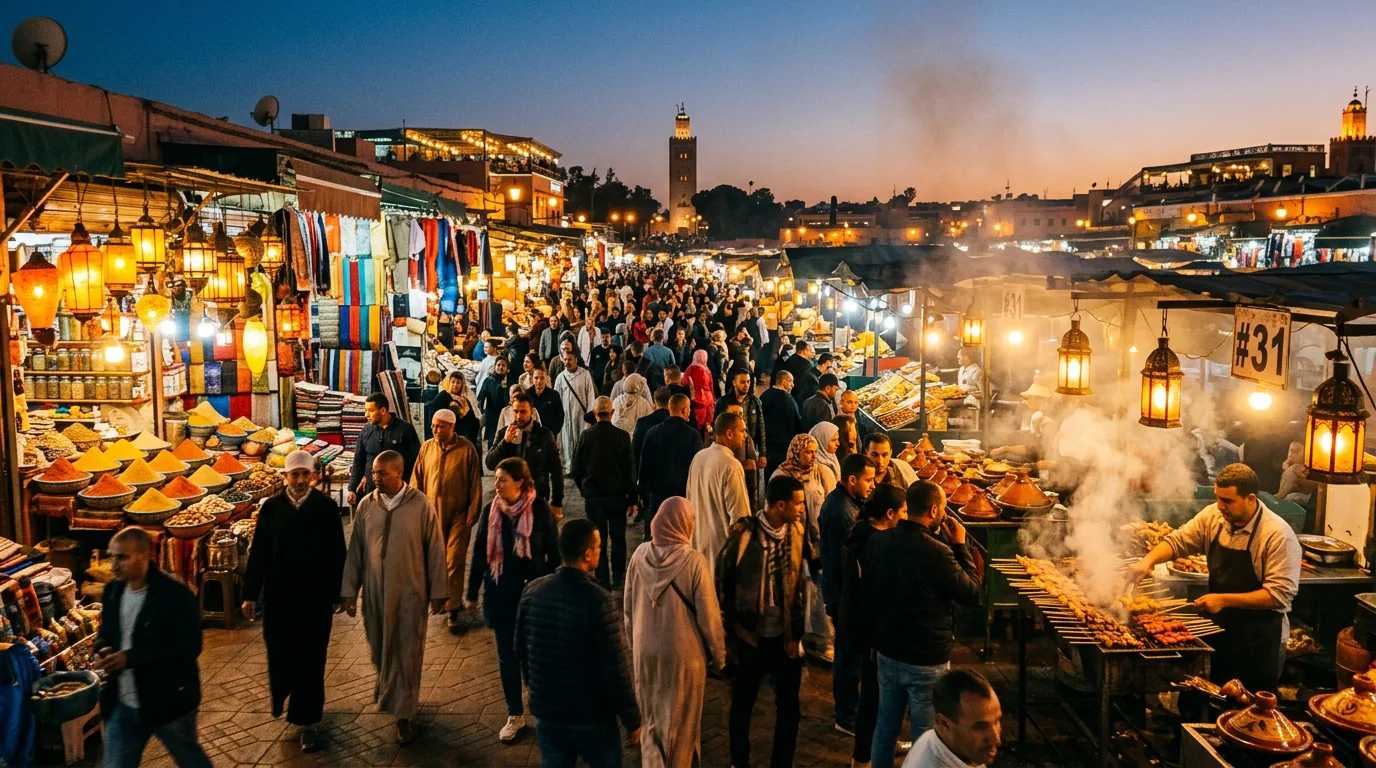
Marrakech does not reward hurry. It rewards handing over your schedule — at least for the first morning. Three days is enough to move through the medina at a human pace, take in the garden quarter, slip out toward the mountains for a day, and still leave without the sense that you merely ticked a list. Here is the shape we give it for our guests.
Day one: the medina on foot
Start in Jemaa el-Fna before 9 am, while the square still belongs to the orange- juice carts and locals cutting across to work. Head north into the souks with a licensed guide for the first two hours — the tanners' quarter near Bab Debbagh, the dyers' lane, the spice and carpet trade circling Rahba Kedima. Break late-morning on a rooftop café looking down over the square.
After lunch, give an hour to the Ben Youssef Madrasa — the city's finest piece of Saadian-era school architecture, beautifully restored and well worth the ticket. Let the late afternoon go loose in Mouassine, map pocketed. For dinner, choose a neighbourhood place over the grand spectacle terraces on the square; your riad host will steer you to one that fits your pace.
Come back to Jemaa el-Fna once it is dark. The square turns into a vast open-air kitchen and theatre. Walk it rather than sit in it — you take in far more on the move.
Day two: the garden quarter and the palaces
Book Majorelle Garden for 8 am — slots sell out and the light is at its best early. Yves Saint Laurent and Pierre Bergé pulled the garden back from ruin in 1980; the cobalt Villa Bou Saf Saf at its heart and the Berber Museum within easily fill 90 minutes. Right beside it, the Musée Yves Saint Laurent Marrakech (the YSL Museum) is a striking building and worth the time if fashion history pulls at you — it shares the same entrance plaza. Allow two hours for the garden quarter all told.
In the afternoon, cross to the southern medina for the Saadian Tombs and El Badi Palace. The tombs are a quick 20 minutes, but the carving in the Chamber of Twelve Columns is extraordinary. El Badi is a shell now, yet the scale of what was once the most opulent palace in the Islamic world reads clearly in the footprint — and storks nest along the ramparts. For the evening, slide out to Gueliz, the modern quarter, for a change of tempo and the city's better contemporary tables.
Day three: a day out to the Atlas or Agafay
Roll out by 8 am in a private vehicle; where you point it depends on the group. The Ourika Valley (60 km, paved to around 1,800 m, the Setti Fatma waterfalls at the top) makes a relaxed day with a riverside lunch. Imlil (90 km, 1,740 m at the trailhead) is for walkers — a three-hour loop above the village through stone hamlets and walnut terraces gives a real taste of the Berber highlands with no technical climbing. The Agafay stone desert, by contrast, is barely 40 minutes out for a half-day of camel walks and a sunset dinner.
We steer first-timers toward Ourika and send returning visitors deeper into Imlil. Either gets you back to Marrakech by late afternoon, with time to fold in the Agafay Desert on the way home if you take the Imlil road. Our Atlas day tours lay out the options.
Where to sleep
A medina riad — the traditional courtyard house — is the only thing we recommend for a first stay. The range is broad: a well-run mid-range riad runs US$80–140 a night for a double, while a boutique one with a plunge pool, resident staff and serious design lands at US$180–350. Anywhere inside Bab Doukkala, Mouassine or the Mellah keeps every sight within a fifteen-minute walk. We help every guest with riad selection through our concierge.
Pacing — and what to leave out
The classic mistake is cramming in monuments. Two or three sights a day, loosened up with unstructured time in the souks, beats five sights with no room to breathe every time. If the clock is tight, drop the Bahia Palace — handsome, but rarely the thing people remember. And ignore any "free" guide who falls in beside you offering to orient you; that whole informal trade runs on commissions from the carpet and argan shops it steers you into.
A few practicalities: keep small dirham notes on you for the souks, book Majorelle and the YSL Museum online ahead of time, and skip the main-square restaurants at dinner — those menus exist for tourists and the food seldom lives up to the view. Marrakech's best meals sit in neighbourhood rooms where the menu is short and shifts by the day.
Frequently asked
Is three days in Marrakech enough?
Three full days covers the essentials at a humane pace — the souks and Jemaa el-Fna, the Majorelle and YSL garden quarter, the southern palaces, and one day out toward the Atlas or Agafay. What you trade away is depth: three days tends to leave people wanting more, which is exactly why so many of our guests stretch it to five.
Where is the best place to stay in Marrakech?
On a first visit, a riad inside the medina walls puts everything within walking reach. The northern medina around Mouassine, or the Bab Doukkala quarter, hits the sweet spot of atmosphere, relative calm and quick access to the souks. Hivernage and Gueliz suit anyone who would rather have a modern hotel and a pool.
When is the best time of year for Marrakech?
October to early December and mid-February to April bring mild days (20–26 °C), bearable crowds and dependable sun. July and August push regularly above 38 °C and make sightseeing on foot genuinely hard. December and January can turn cool and wet, though the medina's winter mood — woodsmoke, quiet derbs — has its own pull.
Do you need a guide for the Marrakech medina?
For your first morning in the souks, a licensed guide earns its keep — the tangle of derbs is properly disorienting, and a good one opens up craft quarters and tucked-away fondouks you would never stumble on alone. By day two you will have the main arteries mapped in your head and can roam more freely. We arrange licensed guides for every guest.
How do you get from Marrakech Menara Airport to your riad?
The budget routes are the official grands taxis and the Airport Express (bus line 19). For Marrakech Tours guests we lay on a private chauffeured transfer — the driver meets you at arrivals, takes the bags, and drops you as close to the riad door as the medina's lanes will physically allow, then walks you the last stretch if a porter is needed.
Can you do a day trip from Marrakech into the Atlas or desert?
Easily. The Ourika Valley sits about 60 km out and works as a relaxed four-to-five-hour run. The Imlil trailhead for Toubkal is a 90-minute drive for those who want to walk. The Agafay stone desert is barely 40 minutes from the city for a sunset and dinner. Aït Ben Haddou and Ouarzazate are a full day of roughly 350 km round trip — ambitious but ever-popular. We pitch the pace to your group.
Want to go deeper?
We build trips around the Marrakech most visitors walk straight past.
Every Marrakech Tours guest gets a private driver, a licensed local guide and a concierge line open around the clock. No group coaches, no commission shops, no script to follow.
Request an itinerary