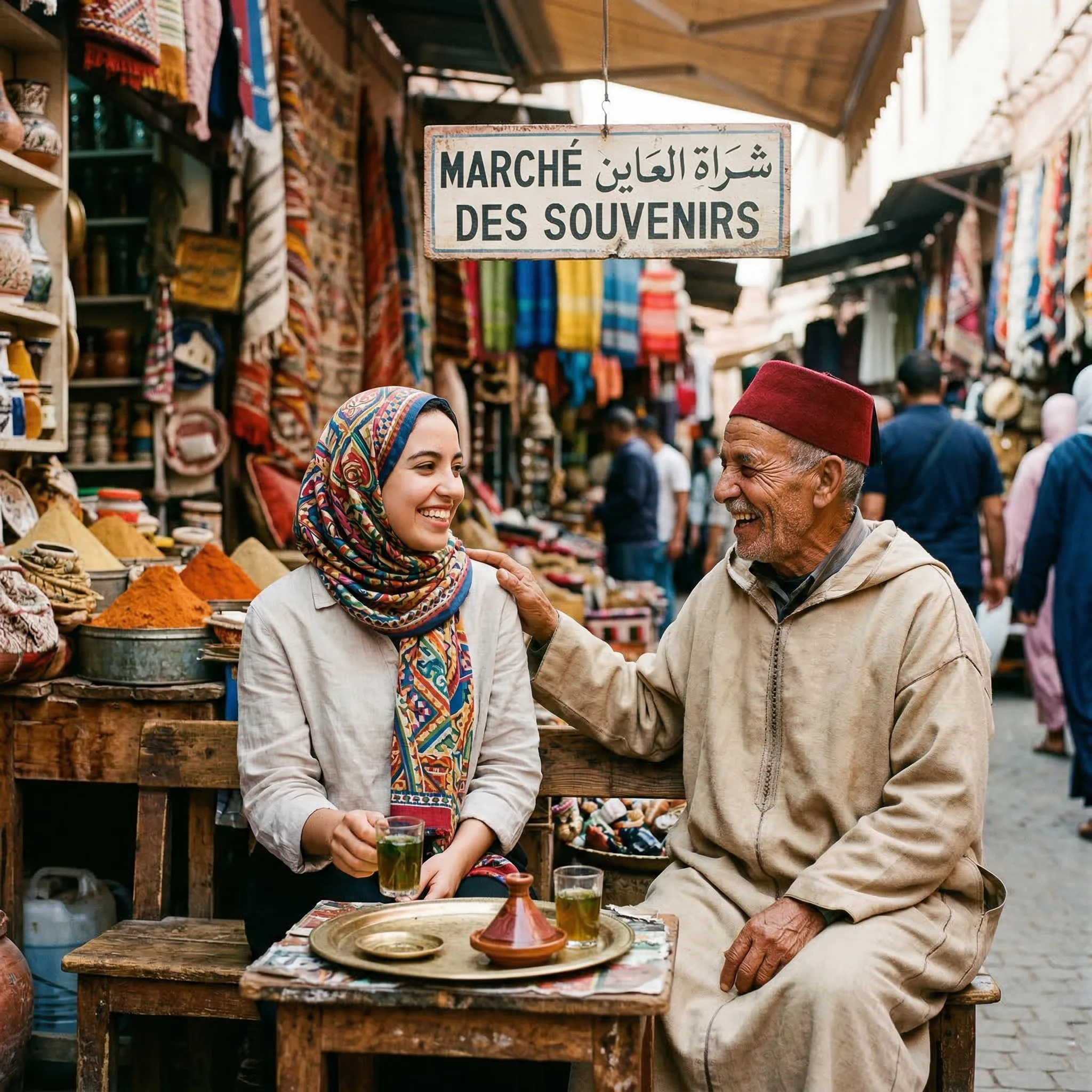
Before any conversation in Marrakech, before any haggle over a rug, before any meal — there is tea. Atay in Darija: green gunpowder leaf, a fistful of fresh spearmint, more sugar than most visitors expect, sent in a long arc from teapot to small glass and handed over with both hands. It isn't really a drink. It's a way of saying welcome.
Where did the ritual come from?
Chinese gunpowder green tea arrived through British merchants in the mid-18th century, as Britain pushed to open North African trade. The Sultan took to it over coffee, and within a generation it had displaced older infusions across the country, gathering up the ceremonial weight that earlier hospitality customs had carried. The mint was the Moroccan stamp on it — spearmint, nana, which grows thick in the river valleys and Atlas foothills, with Meknès still regarded as the mint capital. Bitter leaf, cooling mint, sweetening sugar: the trio settled fast and has scarcely changed since. Today a Marrakech riad and a roadside stall pour from the same recipe.
How is the tea actually brewed?
The method is careful and unhurried by design. A splash of boiling water goes first over the loose gunpowder leaf in the berrad — the slim steel teapot — then is swirled and tipped away to rinse off bitterness and wake the leaves. Fresh boiling water follows, then a tightly packed fistful of spearmint stems. The sugar comes next, and the amount is startling — four or five teaspoons to a pot — before the whole thing returns to the flame for a short simmer. The host pours a test glass, tastes, adjusts, and pours again from 30 to 40 centimetres up: that fall aerates the tea and raises the prized collar of foam. The first three glasses all come from one pot, each a touch different as the mint keeps steeping.
What does 'Berber whisky' mean?
The nickname is warm and knowing. Where traditional households pour no alcohol, mint tea shoulders the social role a generous whisky plays elsewhere — offered to guests, easing conversation, marking respect. Say 'Berber whisky' to a host in a Marrakech shop and you'll nearly always get a grin of recognition. The phrase has run through English travel writing since at least the 1960s, and a version of it lives in Darija too. It's no slight — it's a small point of pride, a nod that this ritual is Morocco's own currency of welcome.
What's the etiquette for guests?
A handful of things are worth knowing. Take the first glass with both hands or your right hand — never the left alone. Don't gulp it; the tea is scalding and the talk is the point. Three glasses is the rhythm — declining the first is impolite, but a warm 'baraka' after the third bows out gracefully. Praising the tea is welcome but unnecessary; the host already knows. Crucially, in a Marrakech souk, accepting a glass does not commit you to buying anything, whatever the patter suggests — it's a real gesture of welcome, and you can leave warmly once you've finished. In a home, stay for all three rounds; an early exit cuts the hospitality short.
How does the tea change across Morocco?
Quite a lot, region to region — which makes a road trip out of Marrakech a tea education in itself. Down in the Saharan south on the Zagora road — Tata, Guelmim — the Tuareg way shows: three separate rounds, each sweeter and more concentrated, carrying the saying of life, love and death that has long since soaked into mainstream Moroccan culture. In the Rif towns around Chefchaouen, a little wormwood (chiba) lends the mint a bitter, herbal warmth. Along the Atlantic, some households slip orange blossom water into the pot. In aristocratic Fès the ceremony reaches its most formal — tray, glasses and pour all matters of pride. And here in Marrakech you'll find tea just as fine poured into a plastic cup at a stall by Jemaa el-Fna for a few dirhams.
Can you recreate it at home?
With a bit of care, yes. Chinese gunpowder green tea and fresh spearmint are the two you can't fake. The pour from height is technique, not theatre — rehearse over a sink first. Sugar is to taste, but go too sparing and you lose the way sweetness offsets the gunpowder's bite. A proper Moroccan teapot — narrow spout, weighty steel — is the right vessel, and many of our guests carry one home from the Marrakech souk as the most useful souvenir of the whole trip.
Frequently asked
Why is Moroccan mint tea called 'Berber whisky'?
It's a fond local wink. Morocco is largely Muslim and traditional homes don't serve alcohol, yet mint tea is poured with all the ceremony and generosity a Scot might pour a dram. You'll hear the phrase from shopkeepers in the Marrakech souk as readily as from guidebooks; it goes back at least to the mid-20th century and Moroccans use it about themselves.
What kind of mint goes into the tea?
Spearmint — nana in Darija — is the classic: bright, cool, faintly sweet. In the Marrakech summer some families toss in a sprig of wormwood (chiba) for a bitter, herbal edge. Out in the Saharan south, desert herbs stand in when fresh mint runs short. The one leaf you'll never see is peppermint, which Moroccans find far too sharp.
How many glasses is it polite to accept?
Three is the customary count — one for life, one for love, one for death, from the Tuareg saying that long ago entered Moroccan tea culture. Turning down the first glass reads as rude; taking all three is warm and gracious. After the third, a soft 'baraka' (enough, thank you) is understood everywhere from a riad salon to a souk stall.
Can you ask for tea without sugar in Marrakech?
You can — 'bla sukkar, afak' — and most hosts will try, even if traditionalists look mildly puzzled. To many Moroccans, mint tea without sugar is a handshake with no hand. The graceful middle ground is 'shwiya sukkar' (a little sugar), which earns you a gentler, less syrupy glass.
Is there a set time of day for tea?
None at all — tea suits any hour. It greets an arrival, seals a souk bargain, revives you after a walk through the medina, and closes a meal. In a negotiation it often signals a deal is near; in a home it's the very first thing pressed on a guest. The ritual is about welcome, not the clock.
Experience it properly
Tea in a riad courtyard — your first morning in Marrakech.
Every Marrakech Tours itinerary opens with a welcome glass of atay in your riad. We can also set up a private ceremony with a Marrakech tea master who walks you through the history and the pour, glass by glass.