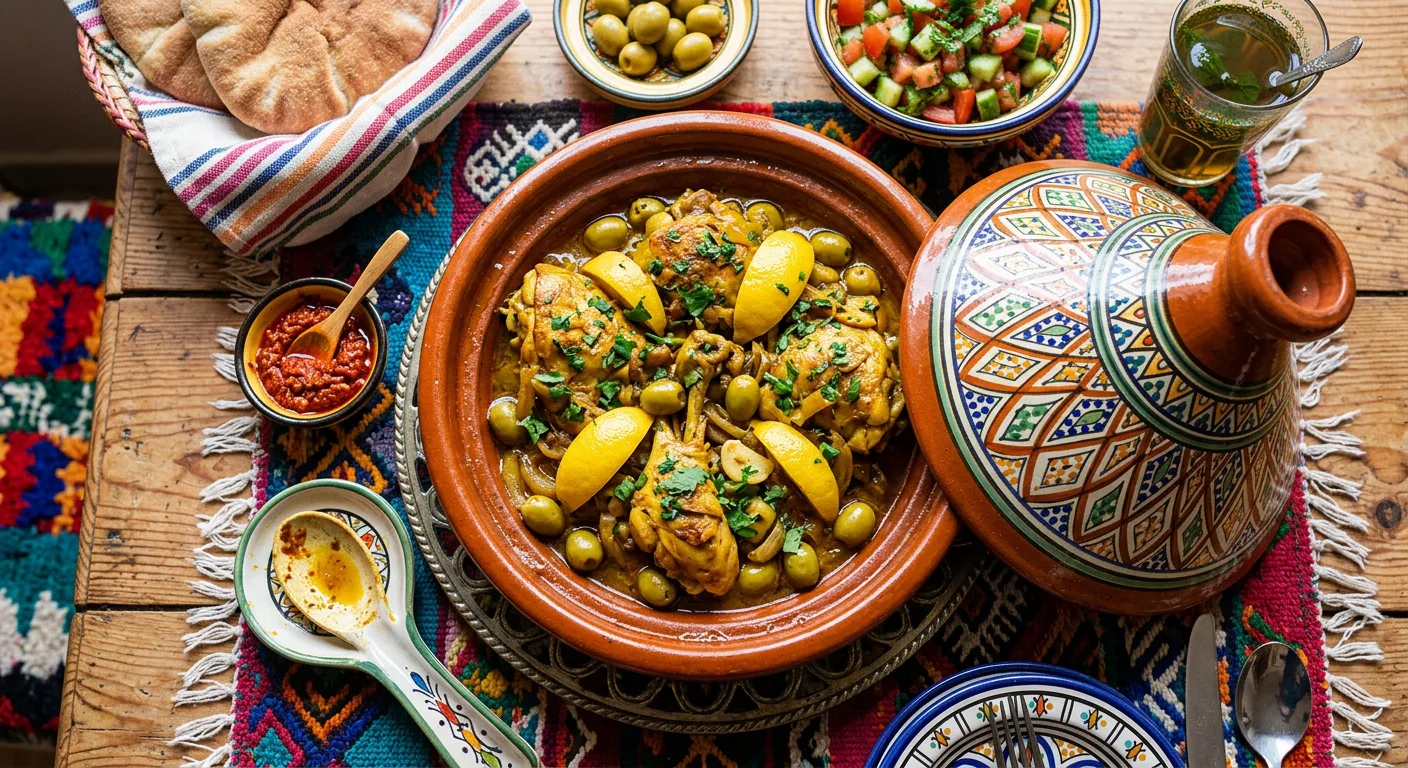
Within an hour of landing in Marrakech, a tagine appears in front of nearly every traveller. The clay pot, the pointed lid, the rising steam of saffron and preserved lemon — it is the photo on every menu around Jemaa el-Fna. It earns its fame; it really is delicious. But stopping there is like flying to Japan and only eating ramen. Here is the rest of the table.
The tagine, properly understood
Tagine names both the vessel and the meal cooked inside it. The conical lid traps the steam and feeds it back as condensation, a slow braise that coaxes tenderness out of the toughest cuts. In Marrakech you'll meet the classics again and again: lamb with prunes and almonds (mrouzia), chicken with preserved lemon and cracked olives, and kefta — spiced minced beef baked with eggs. The lemon-and-olive chicken is the gentlest and the one most visitors fall for first.
The finest tagines are rarely in the polished restaurants. Have your guide steer you to a backstreet fondouk in the medina where the pots have been ticking over coals since dawn, or let us set up a cooking experience inside a Marrakech riad.
Pastilla — the medina showpiece
If tagine is Marrakech's daily bread, pastilla is its banquet dish. Sheets of tissue-thin warqa pastry wrap slow-braised pigeon (or chicken) with egg, saffron and coriander, and the whole golden parcel arrives dusted with icing sugar and cinnamon — sweet and savoury folded into one bite. It was born in Fes, where the best versions still live, but the grand riads of Marrakech turn out a superb one for a special dinner. Essaouira's seafood pastilla, a coastal twist, is worth chasing down too.
Couscous — the Friday ritual
Couscous is what families across Marrakech gather around on Friday, once the midday prayer ends. In its own culture it isn't really restaurant food — it's domestic, made by the women of the house, shared from one dish. The semolina is steamed three times over a vegetable broth, heaped into a dome, then crowned with slow-cooked turnip, courgette, carrot and cabbage and a choice of lamb, chicken or vegetables alone. Medina restaurants serve it Friday and Saturday; if you're in town then, order it.
Street food worth stopping for
At dusk, Jemaa el-Fna becomes the most theatrical dinner in Morocco. After 18:00 the square hazes with charcoal smoke and the calling of stallholders waving you to a bench. The babbouche carts (stalls 14 and 32 have stood for decades) ladle a cumin-spiked snail broth you fish through with a pin — strange, moreish and cheap. Round it out with grilled merguez in a crusty baguette, msemen brushed with argan honey, and a glass of orange juice pressed at the cart for a few dirhams.
Beyond the city, the regional bites are worth planning a day trip around. In Essaouira — a three-hour run from Marrakech — sardines are split and grilled over charcoal right at the port. And across the medinas of the interior, bissara (thick fava bean soup with cumin and a slick of olive oil) is the breakfast of choice, eaten standing with bread dipped straight into the bowl.
Vegetarian and vegan eating in Marrakech
Marrakech kitchens look after non-meat eaters well, though strict veganism still needs spelling out. The little salad starters — zaalouk (smoked aubergine and tomato), taktouka (roasted pepper and tomato), carrot with cumin, beetroot with chermoula — are plant-based and tend to land on the table unasked. A plain vegetable tagine with olives and preserved lemon is on every menu. Vegans should single out smen (aged butter), which sneaks into couscous and some breads, and check that the starters haven't been bound with egg.
Cooking classes in a riad kitchen
A half-day class is among the most rewarding things you can do in Marrakech. Our preferred version opens with a walk through the souk to gather what you'll cook — watching a spice merchant blend ras el hanout by hand is worth the morning on its own — then moves into a riad kitchen to learn three dishes. You sit down and eat the result over mint tea, quietly proud of yourself. It's built into our cultural tours and can be booked on its own if you're staying independently.
What to drink
Morocco is a Muslim country, so alcohol is sold in licensed restaurants and hotels but not everywhere. The everyday pour is atay — mint tea sent from a height to raise a head of foam, three glasses one after another (life, love and death, as the old saying runs). Fresh orange juice from the square, almond milk and avocado smoothies are the usual alternatives. Tap water is treated but uneven across the medina; we keep guests on bottled water throughout.
Frequently asked
Is Moroccan food spicy?
Marrakech cooking is fragrant rather than fiery. The big flavours are ras el hanout, cumin, cinnamon, saffron and preserved lemon — warmth, not heat. Harissa shows up as a side condiment in some kitchens, but it is rarely built into the dish itself the way it is in Thai or Indian cooking. Guests who dislike chilli almost never struggle here.
What's the difference between a tagine and couscous?
Both are slow and aromatic, but they're built differently. A tagine is a braise — meat and vegetables cooked gently in the conical clay pot until they collapse into tenderness. Couscous is steamed semolina mounded under a separately simmered stew. In Marrakech, tagine is everyday food while couscous is the Friday family meal, so most restaurants only serve it Friday and Saturday.
What should vegetarians and vegans order in Marrakech?
Marrakech tables are kind to non-meat eaters. Zaalouk (smoky aubergine and tomato), taktouka (roasted pepper salad), bissara (cumin-laced fava bean soup) and a plain vegetable tagine are everywhere and genuinely good. Vegans should flag smen — the aged butter — which slips into couscous and some breads, so ask before you order.
What street food should I try around Jemaa el-Fna?
As the sun drops, Jemaa el-Fna turns into the best open-air kitchen in North Africa. Try grilled merguez tucked into a baguette, babbouche (cumin snail broth) sipped from a cup, sheep's head for the brave, juice pressed to order at the orange carts, and msemen drizzled with honey. Come after 18:00, when the smoke rises and every stall is firing.
Can I take a cooking class in Marrakech?
Yes — and it's one of the best half-days a Marrakech trip can hold. A good class starts with a souk walk to gather ingredients, then moves into a riad or family kitchen to cook two or three dishes you then sit down and eat. We fold this into several of our Marrakech culture itineraries.
Is tap water safe to drink in Marrakech?
Marrakech tap water is treated, but quality varies by neighbourhood, so we steer guests toward bottled water for drinking and brushing teeth. Riads and restaurants cook with the tap without any problem. Skip ice at street stalls; ice in established medina restaurants is fine.
Eat well in Marrakech
We'll run a culinary thread through your trip.
From a dusk walk through the Jemaa el-Fna food stalls to a private class in a medina riad kitchen, Marrakech Tours threads the best eating into every itinerary — dietary needs arranged well ahead of arrival.
Enquire about a culinary itinerary