Plaza Uta el-Hammam & the Kasbah
The café-shaded main square spreads below the red-ochre Kasbah of 1471, whose Andalusian garden, small ethnographic museum and rooftop terrace open the whole blue medina out at your feet.
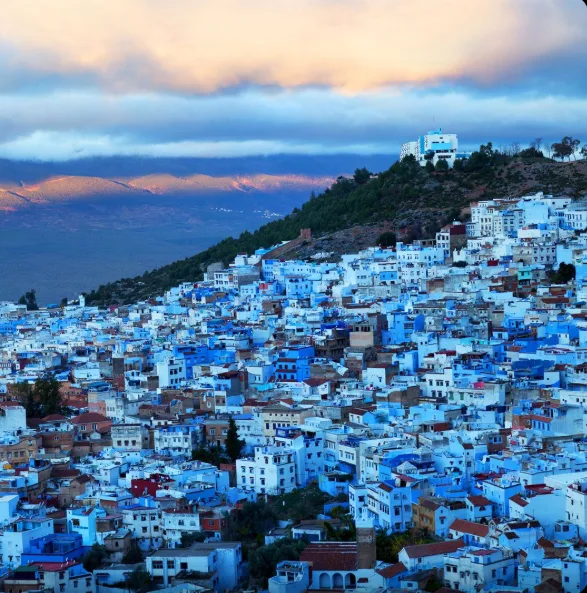
Rif mountains · Chefchaouen Province, Tangier-Tétouan-Al Hoceïma
Morocco's blue pearl — a cobalt-washed 15th-century medina high in the Rif, a world away from the red city's heat.
Best time
April–June and September–October (mild 18–26 °C, low rain)
Recommended
1–2 nights
Airport
Tangier Ibn Battouta (TNG) — 113 km, ~2h drive
Region
Rif mountains · Chefchaouen Province, Tangier-Tétouan-Al Hoceïma
Why Chefchaouen
Chefchaouen (Arabic: شفشاون, also spelled Chaouen) is the blue town that fills everyone's camera roll, but it lies a long way from Marrakech — perched in the western Rif at around 564 m, roughly 113 km south of Tangier and 200 km north of Fes. From the red city it belongs to a northern loop rather than a day trip, reached after Fes or by flying up to Tangier first. Moulay Ali ben Rashid founded it in 1471 as a Berber-Andalusi bastion against Portuguese Ceuta, and it later sheltered Muslim and Jewish exiles driven from Spain after 1492. The signature blue is most often pinned on the Jewish community that arrived in the 1930s; whatever its true origin, the town's 43,000 residents keep it fresh with a twice-yearly coat of lime. Off-limits to non-Muslims until Spanish troops entered in 1920, it remains one of the gentlest, most unhurried medinas in the country — the perfect counterweight to Marrakech's intensity.
What to see
The café-shaded main square spreads below the red-ochre Kasbah of 1471, whose Andalusian garden, small ethnographic museum and rooftop terrace open the whole blue medina out at your feet.
At the top edge of the medina, the cold mountain spring where local women still gather to wash clothes — the source of the stream that once powered the town's mills.
A 30–40 minute climb to the 1920s Bouzaafar mosque east of the walls, timed so the entire blue town glows beneath you as the sun slips behind the Rif.
A 30 km drive into Talassemtane National Park for a 2–3 hour walk up the Oued Farda to the cascades, or on further to the natural rock arch of the Pont de Dieu.
Itineraries
Every itinerary below is privately operated, fully customisable, and includes a deep stop in Chefchaouen. Click any tour for the day-by-day plan, the map, dates and pricing.
Two unhurried Rif days out of Tangier — the blue medina at golden hour, a sunrise climb to the Spanish mosque, and a forest walk toward the Akchour cascades.
Before you go
Concierge
Tell us your dates, group size and pace. We'll send back a written proposal within 24 hours — private guides, transfers, riads, the lot.
Request a proposalFAQ
Give it two nights. Arrive around midday, shoot the lanes at golden hour, sleep over, climb to the Spanish Mosque for sunrise, then either hike Akchour or drive on after lunch. The town shines at dawn and dusk, once the day-trippers have cleared out.
No — it's simply too far. From Marrakech it belongs on a northern loop, reached after Fes or via Tangier, never in a single day. Even from Tangier (113 km, about two hours each way) a day trip means arriving with the tour buses and leaving before the medina looks its best, so an overnight wins every time.
The favourite explanation credits the Jewish community that settled here in the 1930s, who painted the walls blue for the sky and the heavens. Others point to the original Andalusian settlers, or claim the colour repels mosquitoes. Either way, residents now keep it up because the blue has simply become the town's identity.
Yes — it's one of the most easygoing towns in Morocco. You won't find alcohol sold inside the medina, but a handful of hotels and restaurants beyond the walls, the Hotel Parador among them, do serve it.
Closest destinations
These destinations are closest to Chefchaouen — easily combined on a private itinerary.
13 kmFar north in the Rif — Akchour's emerald waterfalls and God's Bridge, a day's hike beyond Chefchaouen.
Explore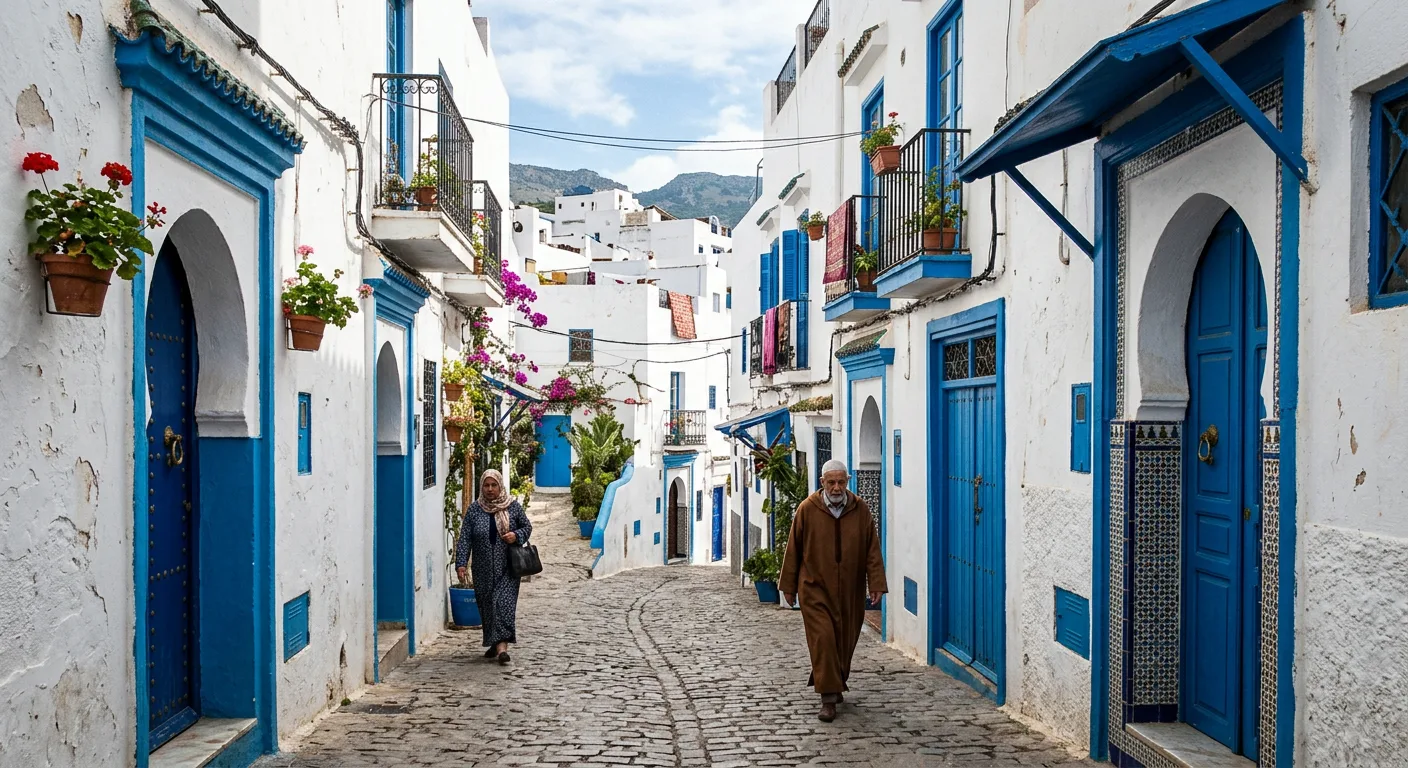 47 km
47 kmFar north of the Red City — Tetouan's UNESCO Andalusian medina, a whitewashed Rif counterpoint to Marrakech's ochre.
Explore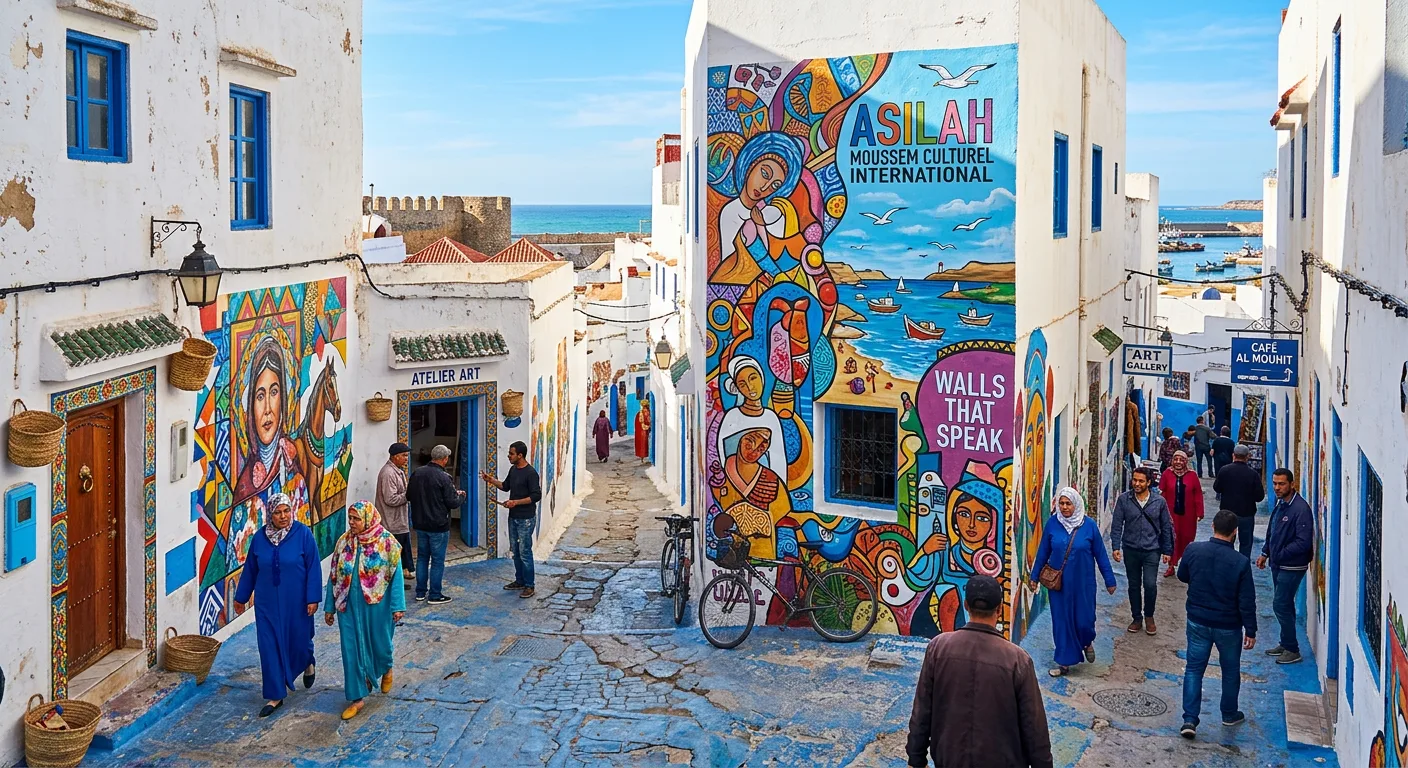 77 km
77 kmA whitewashed Atlantic art town near Tangier — Portuguese ramparts, painted murals and a calm, walkable medina, far up north from Marrakech.
ExploreRead more
Stories, guides and practical tips to help you plan your time in Chefchaouen and beyond.