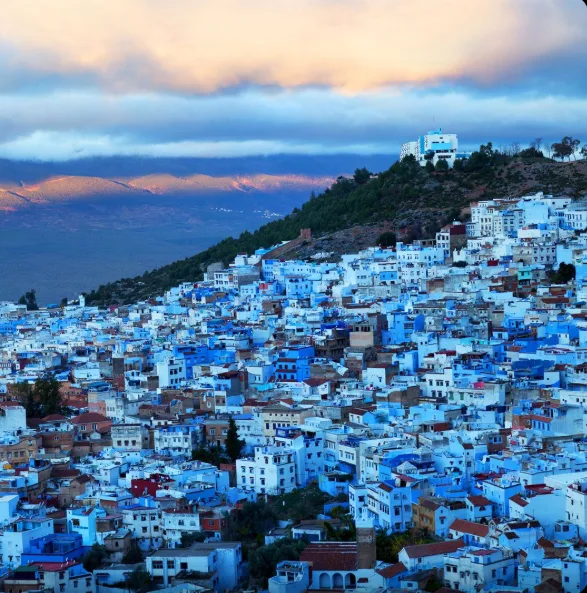
Chefchaouen perches at 600 metres in the Rif Mountains of the far north — four hours from Fès, an hour from Tetouan, and a long way from Marrakech, which is precisely why so few visitors who come for the red city ever make it up here. It is the most photographed town in Morocco and one of the least understood. Arrive expecting a stage set built for the camera and you find something better: a real mountain town with its own culture, a cooler climate, extraordinary goat cheese, and lanes that are every bit as blue as the pictures promised.
Why is Chefchaouen painted blue?
At least three origin stories circle the medina's blue, and the truth is probably braided from all of them. The one with the firmest historical footing is Sephardic: Jewish refugees driven out of Spain in 1492 brought a habit of painting thresholds and shared walls in tekhelet, a blue tied in their tradition to heaven and protection. The mosquito theory — that the colour keeps the insects off — likely helped the practice spread further.
Down the generations the Muslim population made the blue their own, and today the town guards it as a badge of identity, with the municipality keeping the palette in line and nudging anyone who repaints in the wrong shade. Walk the lanes and you notice it is never one blue: cobalt here, periwinkle there, an almost violet wall around the next corner, depending on the pigment and how many mountain winters it has weathered. That unevenness is half the beauty.
What is there to do once the photos are done?
The medina is small — you could cross it in forty minutes — but it pays you back for going slowly. Begin at Plaza Uta el-Hammam, the main square, where the fifteenth-century Kasbah and its hexagonal minaret hold down the northern end. The little museum inside lays out the town's Andalusian roots through ceramics, old weapons and textiles, and earns about half an hour.
From the square, head east to Ras el-Maa, the mountain spring where women still rinse wool in the cold rush of water. This is a working corner of the town rather than a sight, and the ten-minute walk to it leads through steadily more local lanes as the tour groups fall away. The waterfall is modest; the setting — blue walls stacked against the green hillside — is the draw.
The Spanish mosque on the hill above town, a twenty-minute climb from Plaza Uta el-Hammam, hands you the best panorama of blue rooftops against the Rif. Non-Muslims cannot go inside, but the terrace outside is open, and sunrise from up here — the town still half-asleep, the light dragging low across the roofs — ranks among the finest moments Morocco has to give.
The morning market by the grand mosque carries the produce of the Rif: fresh goat cheese (jben) in rush baskets, dried figs, wild thyme and oregano, hand-spun wool — and cannabis resin, sold openly across the northern Rif but legally murky for foreigners, so use your own judgement.
Day trip or overnight: which is better?
A day trip from Fès works on paper — four hours each way, three or four in town — but it lands you in Chefchaouen at its most crowded, roughly 11am to 4pm. The lanes are lovely at that hour, no question, but you are framing them shoulder to shoulder with everyone else doing the same.
A single night flips the whole experience. By 6pm the coaches have gone and the medina settles back into its own tempo: chairs out in the square, the call to prayer ringing off the blue walls, the mountain air a clear notch cooler than wherever you drove in from. Dawn, especially in spring and autumn, gives you soft warm light before the first group arrives. For anyone who wants to shoot properly — or simply slow their breathing — we'd say two nights, not one.
How do you get to Chefchaouen?
From Fès: four hours by private car on the N13, or five to six by CTM bus, with two or three departures a day from the Fès bus station. This is the obvious pairing — Fès and Chefchaouen sit together naturally on a northern loop.
From Tangier: two to three hours by private car, which makes the Tangier Med port a tidy way in for anyone ferrying over from Spain. Tangier–Chefchaouen–Fès is a well-worn northern itinerary.
From Marrakech: six to eight hours by private car — far too long to treat as a day trip from the south, and much better slotted into a wider circuit such as Marrakech to Fès to Chefchaouen to Tangier. No train reaches the town directly; the nearest railheads are Meknès (three hours) and Tangier (two and a half).
Browse our destinations guide and private tours for routes that fold Chefchaouen into a northern Morocco loop out of Marrakech.
What are the best photography spots in Chefchaouen?
- Rue Targhi — the signature lane of the blue quarter, with a staircase that frames beautifully from the bottom. Shoot it at 8–9am or 5–6pm.
- Plaza Uta el-Hammam after dark — café lights pooling on the blue plaster; pack a wide-angle lens.
- The Spanish mosque terrace at sunrise — the one window when the panorama is more or less yours alone.
- Ras el-Maa — wool, blue walls and fast water together; shoot with care and always ask before you put anyone close in the frame.
- The lanes north of the Kasbah — quieter than the central quarter, with older, faded blue that looks properly lived-with.
Frequently asked
Why is Chefchaouen painted blue?
There is more than one story, and they probably overlap. The best-documented one is that Sephardic Jewish refugees who arrived after the 1492 expulsion from Spain brought the blue-and-white palette with them, blue carrying spiritual weight in their tradition. A more practical theory says the colour keeps mosquitoes away. Whatever started it, the wider Muslim population took the habit on over generations, and these days the town keeps the blue going as a matter of civic pride, backed by local rules.
Is Chefchaouen worth visiting, or is it just a photo opportunity?
It is a real, working mountain town — a living community with an active wool and leather market, old mosques, and an Andalusian-Moroccan character that feels nothing like Marrakech or Fès. The photogenic side is genuine, but there is substance under it. Stay a night or two and you get the medina after the day-trippers clear out: quieter, cooler, and a good deal more itself.
How do you get to Chefchaouen from Marrakech or Fès?
From Fès it is roughly four hours by private car or five to six by CTM bus — an easy overnight tacked onto a Fès stay. From Marrakech, plan on six to eight hours by private car, so it makes far more sense as one leg of a northern circuit taking in Fès and Tangier than as a standalone run from the south. No train reaches the town; the closest railheads are Meknès and Tangier.
Is a day trip to Chefchaouen from Fès enough?
You can do it in a day, but it is rushed: you roll in around midday, get three or four hours in the medina at its most crowded, and head back in the late afternoon. An overnight changes the whole thing — the blue lanes at dusk and at first light, emptied of tour groups, are a different town altogether. For a relaxed visit we would not suggest less than two nights.
What is the best time of year to visit Chefchaouen?
Spring (March to May) and autumn (September to November) give you the kindest temperatures — 18–24°C by day — and the cleanest light for photographs. Summer brings Moroccan holidaymakers up from the coastal heat, and July and August fill the town noticeably. Winter can turn cold and the odd snowfall is striking, but you'll want proper layers.
What should you not miss in Chefchaouen?
The blue quarter around Plaza Uta el-Hammam is the obvious heart of it. Beyond that: the Spanish mosque on the hill gives the classic panorama of blue rooftops, and it is at its best at sunrise. The Ras el-Maa waterfall on the eastern edge of the medina is where locals gather and is worth the ten-minute stroll. And the wool and goat-cheese market by the grand mosque, running in the mornings, is the genuinely local one.
Northern Morocco loops
We thread Chefchaouen into routes that actually hang together.
Fès, Chefchaouen, Tangier — or a full northern loop starting from Marrakech. Private car, hand-picked guesthouses, the early starts that beat the crowds. Tell us what you're after.
Request an itinerary