Volubilis & Moulay Idriss

Northern Morocco · Meknès-Tafilalet

Volubilis & Moulay Idriss, Morocco

Volubilis and Moulay Idriss together make the most historically layered day in Morocco — Roman mosaics below a hilltop holy town, near Meknes.

Best time

March–May and September–November (mosaics are best in morning light; avoid midday heat in summer)

Recommended

A private day from Fes or Meknes

Airport

Fès-Saïs (FEZ) + 1h30 drive, or Rabat-Salé (RBA) + 2h drive

Region

Northern Morocco · Meknès-Tafilalet

Why Volubilis & Moulay Idriss

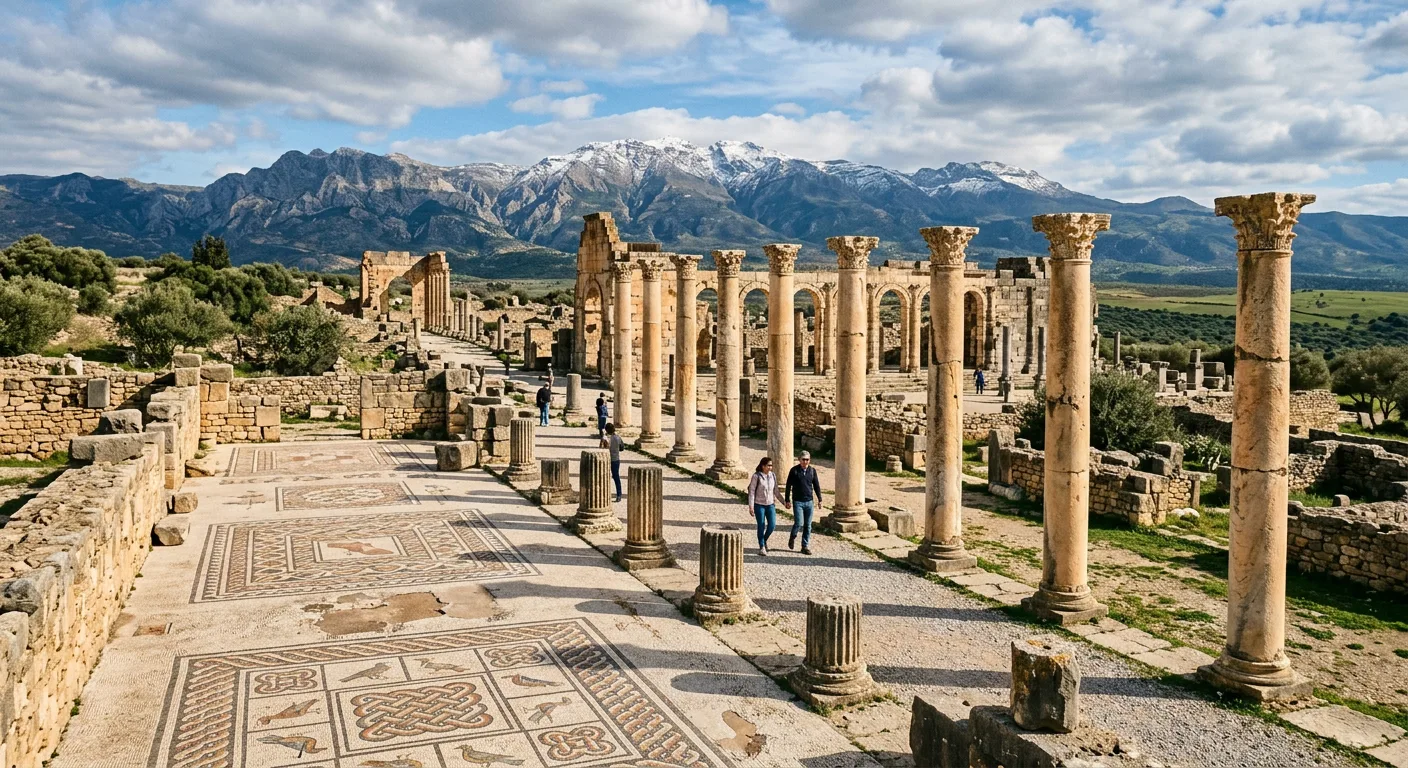
Volubilis is a UNESCO World Heritage Site and the best-preserved Roman city in Morocco, set on a plateau in the Zerhoun massif roughly 33 km north of Meknes. It was the westernmost city of real consequence in the Roman Empire during its occupation between the 1st and 3rd centuries AD, serving as capital of the province of Mauretania Tingitana. Its excavated ruins cover 42 hectares and take in the Capitoline Temple, the Arch of Caracalla, the House of Orpheus with its famous mosaic floors, and the Decumanus Maximus, the main colonnaded street. Three kilometres on, the town of Moulay Idriss Zerhoun is Morocco's holiest settlement: the burial place of Moulay Idriss I, founder of the Idrisid dynasty and of the Moroccan state, who came from Arabia in 788 AD. Non-Muslims were barred from staying overnight until 2005; the town's whitewashed quarters spill over twin hills above the Roman plain, and the circular minaret of the mosque he built is one of the rarest forms in Moroccan architecture.

What to see

Highlights of Volubilis & Moulay Idriss.

01

What Roman mosaics survive at Volubilis?

Volubilis holds some of the finest in-situ Roman mosaic floors anywhere. The House of Orpheus carries a circular mosaic of Orpheus charming the animals; the House of the Labours of Hercules depicts the twelve labours; the Gordian Palace and the House of Venus add further mythological scenes — all dated to the 2nd–3rd century AD and saved by the plateau's dry climate.
02

Arch of Caracalla

A triumphal arch raised in 217 AD to honour the Emperor Caracalla and his mother Julia Domna — partly reconstructed and the visual anchor of the site, flanked by the colonnaded Decumanus Maximus.

03

Moulay Idriss Zerhoun — Morocco's holiest town

Three kilometres from Volubilis, the whitewashed town of Moulay Idriss tumbles over two hills above the farmland. Non-Muslim visitors may now enter freely and walk the lanes to viewpoints over the rooftops; only the mausoleum itself stays off-limits. The moussem (annual festival) each August–September is among the largest religious gatherings in Morocco.

04

The Zerhoun massif landscape

The plateau around Volubilis is planted with olive and almond groves much as it was in Roman times — the city's wealth rested on olive oil exported via Sala Colonia (Rabat). The view from the Arch of Caracalla across the valley to the distant Zerhoun ridge is one of the finest Roman landscapes outside Italy.

Itineraries

Our Volubilis & Moulay Idriss tours.

Every itinerary below is privately operated, fully customisable, and includes a deep stop in Volubilis & Moulay Idriss. Click any tour for the day-by-day plan, the map, dates and pricing.

1 day

Volubilis, Meknes & Moulay Idriss

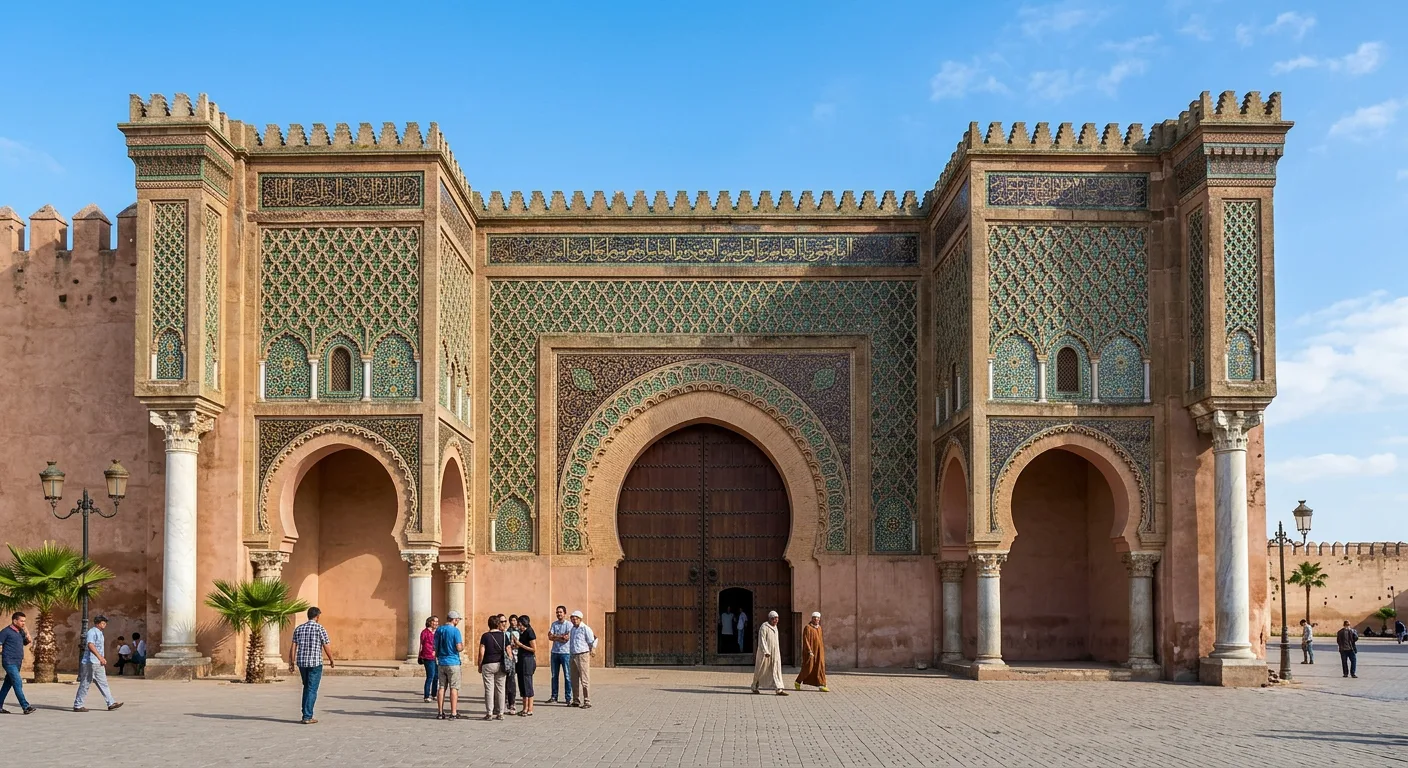
One private day out of Fes: the Roman mosaics of Volubilis, the imperial gates and Heri es-Souani of Meknes, and the holy hill town of Moulay Idriss.

from $240Enquire →
8 days

Imperial cities, privately

Volubilis and Moulay Idriss form the centrepiece day of the eight-night royal route from Marrakech to Fes.

from $2,450Enquire →

Before you go

Practical notes.

  • Getting there: 33 km (40 min) north of Meknes by road, or 60 km (1h15) from Fes; with no direct bus, a private transfer or taxi from Meknes is the usual way in
  • Entry: Volubilis charges admission (currently 70 MAD for adults); Moulay Idriss is free to enter
  • Timing: Take Volubilis in the morning for the best mosaic light and ahead of the midday heat, then move on to Moulay Idriss for a late lunch and the town views
  • Best combined with: Meknes — the three sites (Volubilis, Moulay Idriss and Meknes's imperial monuments) make one natural private day

Concierge

Have your Volubilis & Moulay Idriss trip designed by a local

Tell us your dates, group size and pace. We'll send back a written proposal within 24 hours — private guides, transfers, riads, the lot.

Request a proposal

FAQ

Volubilis & Moulay Idrisscommon questions.

Is Volubilis the best Roman site in North Africa?+

It's the best-preserved Roman city in Morocco and among the most evocative anywhere, helped by its setting in open farmland rather than a modern city. Leptis Magna in Libya is larger for sheer scale; but Volubilis's mosaics, the Arch of Caracalla and the landscape together make it a peer-level classical site.

Can non-Muslims visit Moulay Idriss?+

Yes — non-Muslim visitors have been free to enter and stay overnight since 2005. The town is openly walkable; only the interior of the mausoleum of Moulay Idriss I stays closed to non-Muslims. The lanes, viewpoints and circular minaret are all open.

How long does a visit to Volubilis take?+

Give it 1.5–2 hours to walk the main excavated area at an easy pace, reading the panels at the Orpheus mosaic, the Hercules house and the Decumanus. A 30-minute dash misses most of the mosaics, while an in-depth tour with a classical historian can run to 3 hours.

Is the combination of Volubilis and Moulay Idriss worth a full day?+

Comfortably — add Meknes, 40 minutes away, and you get a superb single day spanning 2,000 years: the Roman city, the holy Moroccan dynastic town, and the 17th-century imperial monuments of Moulay Ismail. It's one of the most rewarding days in the country.

Read more

From the journal.

Stories, guides and practical tips to help you plan your time in Volubilis & Moulay Idriss and beyond.

Book now