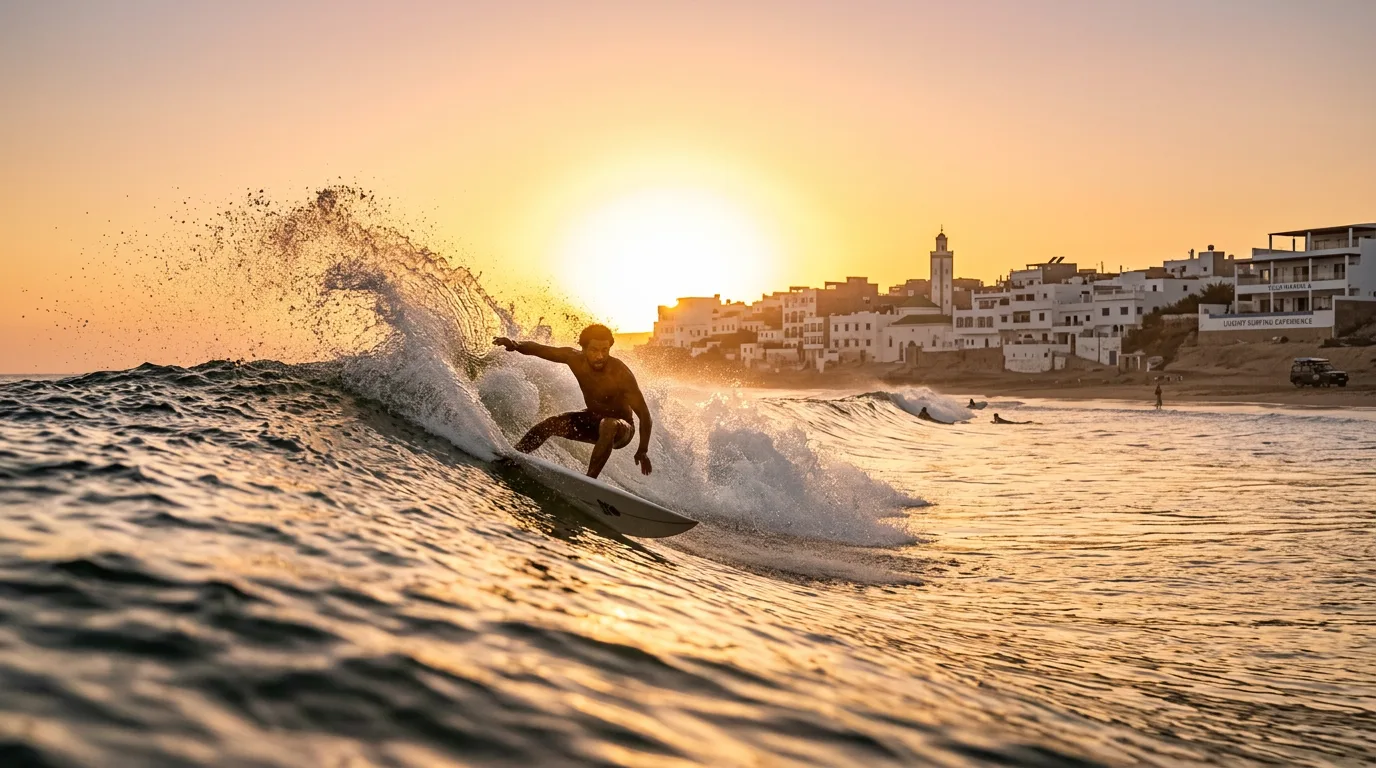
Marrakech is landlocked, but the Atlantic is closer than you think — Essaouira, the classic beach escape from the city, is a three-hour drive west. From there Morocco's coast runs on for thousands of kilometres: Agadir's calm family bays, the surf breaks of Taghazout, the dramatic arches of Legzira and the warm Mediterranean coves of the north. Here is where to go, and when.
In this guide
Which Moroccan beach suits which traveller?
Morocco's coast splits along the Atlantic–Mediterranean line and by what you want from the sea. The Atlantic stretches from Tangier down to Dakhla and is consistently windier, cooler and wilder than European beaches at the same latitude — the Canary Current keeps the water somewhere between roughly 17°C and 22°C year-round. The Mediterranean coast, running east from Tangier, is calmer, warmer and far less exposed to the Alizé trade wind.
For anyone based in Marrakech, Essaouira is the obvious first call — a walled, whitewashed port where the same Alizé wind that cools the medina makes the long beach a year-round windsurfing arena. Push further and the character keeps changing: around Agadir, wide sheltered crescents suit families and cautious swimmers; around Taghazout and Imsouane, rocky point breaks pull in surfers from across Europe; up north, Plage Quemado at Al Hoceïma and the sands near Saidia offer Mediterranean calm.
- Plage d'Essaouira: the classic escape from Marrakech; wild, windy and a world-class windsurfing and kitesurfing beach.
- Sidi Kaouki: a near-empty beach south of Essaouira where horses outnumber sunbathers; solitude and big skies.
- Plage d'Agadir: a long sheltered crescent with calm swimming; the most family-friendly beach in the country.
- Taghazout and Anchor Point: Atlantic point breaks for intermediate and advanced surfers.
- Imsouane: a long, mellow right-hand wave that longboarders adore.
- Plage de Saidia (east of Nador): calm Mediterranean and one of Morocco's longest stretches of sand.
- Plage Quemado, Al Hoceïma: clear Mediterranean water that is good for snorkelling.
How warm is the sea along Morocco's coast?
The Canary Current, a cold upwelling from the deep Atlantic, keeps Morocco's Atlantic coast cooler than its latitude suggests. Off Essaouira and Agadir the water sits around 17°C in winter and climbs to roughly 22°C by early autumn; a wetsuit makes longer swims comfortable through the cooler months. In high summer it reaches the low twenties — pleasant for a dip, but not the bathtub warmth many European visitors expect.
The Mediterranean coast around Al Hoceïma and Saidia runs a few degrees warmer for most of the year and pushes toward the mid-twenties in late summer. If warm-water swimming is the priority, the north-eastern Mediterranean and the sheltered coves south of Tangier are your best bet — though they are a long haul from Marrakech compared with Essaouira.
When should you go?
For pure beach time, late spring through early autumn brings the warmest water, the most reliable sun and Agadir's resorts at full tilt. Bear in mind the Alizé wind blows hardest along the Essaouira and Agadir coast in midsummer — perfect for windsurfers, a little breezy for sunbathers. Taghazout's surf season runs through the cooler months when the Atlantic swells build; summer there is flatter and the beach is most pleasant for non-surfers.
If you are pairing the coast with inland Marrakech, autumn is the sweet spot: warm enough to swim at Agadir or Essaouira, comfortable for the medina, and prime time for the desert if you tack on a Sahara leg.
Where are the quieter, lesser-known beaches?
Morocco rewards anyone willing to drive past the main resorts. Legzira Beach, north of Sidi Ifni in the Anti-Atlas south, is famous for the dramatic sandstone arches rising from the sand — one of the great arches collapsed some years ago, but a second still stands above an isolated cove reached on foot from the clifftop road.
Oued Laou, in the Rif foothills near Chefchaouen, is a sheltered bay where a river meets the Mediterranean, busy with Moroccan families in summer but little known to outsiders. Mirleft, south of Tiznit, is a small clifftop village above a run of Atlantic coves and headlands that rival the famous surf coast further north, with a fraction of the crowds.
- Legzira Beach (near Sidi Ifni): dramatic red sandstone arch; clifftop descent on foot.
- Mirleft coves (south of Tiznit): Atlantic cliffs and sheltered coves with little tourist build-up.
- Oued Laou (Rif coast): a river-mouth beach popular with Moroccan families in summer.
- Plage Blanche (Guelmim province): a vast, empty Atlantic strand reachable only by 4WD.
How do beaches fit into a Marrakech-based itinerary?
Essaouira, three hours west of Marrakech, is the natural pairing — a one- or two-night add-on of ramparts, fresh seafood and sea air that decompresses you nicely after the souks or the desert. Agadir has its own airport (AGA), so it works as a standalone beach week or a base for Taghazout, the argan forest and Paradise Valley. The warmer Mediterranean beaches around Saidia and Al Hoceïma are better stitched into a northern Fes–Chefchaouen loop than a southern circuit out of Marrakech.
Frequently asked
Which is the closest beach to Marrakech?
Essaouira is the closest proper beach to Marrakech — about a three-hour drive west, making it the classic day trip or overnight escape from the city. Its long Atlantic beach is broad and atmospheric, though the wind makes it more of a windsurfing and walking beach than a swimming one. For calm family swimming, Agadir is a little further south.
What is the best beach in Morocco for families?
Agadir's long sheltered crescent — calm water, lifeguards in season and resort hotels right behind the sand — is the most family-friendly beach in the country, consistently gentle enough for children. The wind-exposed Atlantic beaches further north, including Essaouira, are far less suited to young swimmers.
Is Morocco's Atlantic water warm enough to swim in?
In summer the Atlantic around Agadir reaches the low twenties Celsius — cool but swimmable without a wetsuit for most people, since the Canary Current keeps the coast cooler than its latitude suggests. For genuinely warm water, the Mediterranean coast around Saidia and Al Hoceïma in late summer is your best option.
What is the best surfing beach in Morocco?
Anchor Point at Taghazout is the most famous break — a powerful right-hand point for intermediate and advanced surfers. Imsouane, up the coast, has a long, forgiving right-hander loved by longboarders. Beginners are safest on Agadir's gentle beach break.
Is Essaouira's beach good for swimming?
Essaouira's beach is broad and beautiful but used mainly for windsurfing, kitesurfing and walking. The Alizé wind and Atlantic power create rip currents, so swimming is possible only for confident swimmers who respect the conditions — it is not for young children. For safe swimming, Agadir to the south is the better choice.
Planning a trip?
Let a Marrakech atelier handle the details.
Tell us your dates and style and we'll send a written itinerary and a transparent quote within 24 hours.
Request an itineraryKeep reading
Planning
Surfing in Morocco: Taghazout, Agadir & Imsouane
Morocco's Atlantic coast is the most reliable surf in North Africa — consistent September-to-April swells, mild winters, low costs and an easygoing culture centred on Taghazout, with the marathon right-hand point at Imsouane and gentle town beaches around Agadir. From a Marrakech base it is a roughly three-hour transfer to the lineup, which is why plenty of visitors pair medina days with a coastal surf escape.
Planning
Things to Do in Essaouira: The Essential Guide
Essaouira is Marrakech's Atlantic release valve — the classic day trip or overnight from the red city, roughly 2.5 to 3 hours west. A fortified white-and-blue port of ramparts and gulls, a working fishing harbour, peerless grilled seafood, world-class windsurfing and a medina that is calm and genuinely liveable. After the intensity of the Marrakech souks, it feels like a long exhale.
Planning
The Best Time to Visit Morocco
For a Marrakech city break, spring (March–May) and autumn (September–November) hit the sweet spot — sun-warmed days in the medina, cool enough rooftops at dusk, and perfect conditions for Agafay, the Ourika valley and an Atlas or desert day trip.