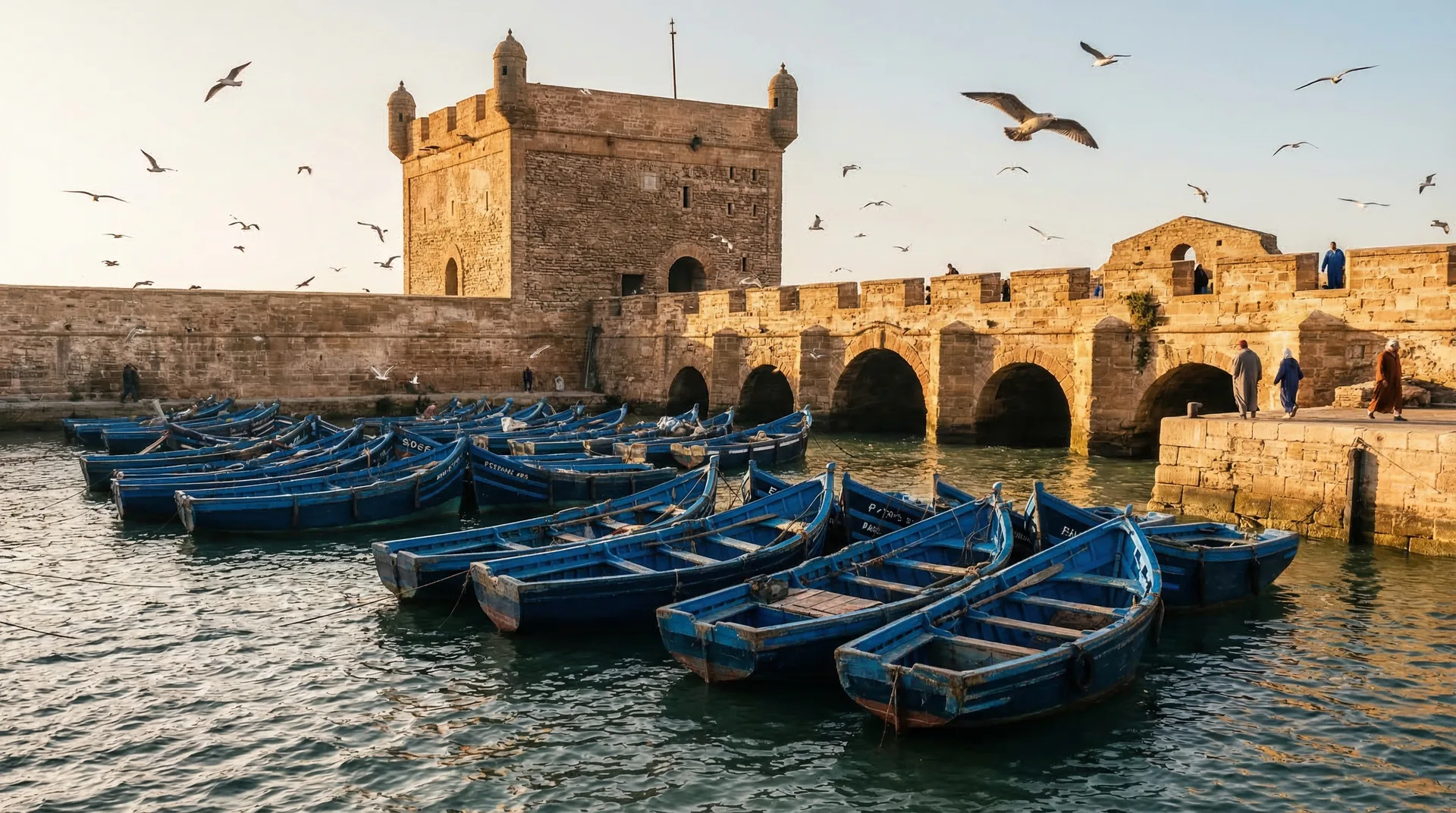
Essaouira is Marrakech's Atlantic release valve — the classic day trip or overnight from the red city, roughly 2.5 to 3 hours west. A fortified white-and-blue port of ramparts and gulls, a working fishing harbour, peerless grilled seafood, world-class windsurfing and a medina that is calm and genuinely liveable. After the intensity of the Marrakech souks, it feels like a long exhale.
In this guide
What are the top things to see in Essaouira?
The Skala de la Ville — the sea bastion the Portuguese raised in the 18th century — is the postcard image: a line of antique brass cannons trained west over the Atlantic from a windblown white rampart. The late-afternoon light here is something else, with spray and gulls and constant wind. Below it, the older Skala du Port looks south across the working harbour, where the cobalt-blue boats come and go and fishermen gut the catch on the quay — one of the most photogenic working scenes anywhere in Morocco, and a world apart from the inland bustle of Marrakech.
The medina is UNESCO-listed and, unusually, laid out on a regular Portuguese grid — a relief to navigate after the organic tangle of Fes or Marrakech. The main spine, Avenue de l'Istiqlal continuing as Rue Mohammed el-Qory, runs straight from the main gate down to the harbour. In the lanes behind the Skala de la Ville, thuya workshops turn out astonishingly fine marquetry from the fragrant burr-roots of the local thuya tree — a craft you will not find back in the Marrakech souks.
- Skala de la Ville — sea bastion with antique cannons; best at sunset.
- Skala du Port and fishing harbour — working port; fresh catch auctions at dawn.
- Medina ramparts walk — full circuit takes about 40 minutes.
- Thuja wood workshops — behind the Skala; unique fragrant marquetry craft.
- Musée Sidi Mohammed Ben Abdallah — 19th-century regional museum of music and crafts.
- Galerie Frederic Damgaard — important contemporary Essaouira art gallery.
What is the windsurfing and kitesurfing like in Essaouira?
Essaouira sits high on most lists of the world's great windsurfing towns. The Alizé — a dependable north-east trade wind blowing at 20–35 knots for much of the year — sets up steady flat-water, side-shore conditions on the wide beach south of the medina (Plage d'Essaouira). The wind is strongest April to October, with June through August the most reliable months; outside that window it still blows, just less predictably. It is the single biggest reason wind-sport travellers base here rather than making Essaouira a quick hop from Marrakech.
Ocean Vagabond and Explora are two long-established beach centres renting kit and running lessons and storage. Windsurfers and kitesurfers share a generous spread of beach, and the shallower water by the Oued Ksob river mouth is the spot to learn. Swimmers and body-surfers should respect the power of this stretch of Atlantic — the rip currents near the river mouth are genuine — and a wetsuit is needed year-round in water that holds at 17–20°C.
- Best wind months: June–September (20–35 knots Alizé trade wind).
- Windsurfing level: intermediate to advanced; consistent side-shore conditions.
- Kitesurfing: established and popular; local schools offer IKO-certified tuition.
- Surfing: bodyboarding and shortboard surfing work in autumn and winter swells.
- Camel and horse rides on the beach — offered by licensed operators south of the medina.
Where should you eat seafood in Essaouira?
The harbour fish market — the morning's catch laid out on ice and grilled to order at open-air stalls — is one of the great eating experiences in the country, and reason enough to make Essaouira a day trip from Marrakech. Point at what you fancy, settle the price first, and eat it straight off the grill with bread and harissa at a plastic table on the quay. Sardines, sea bass (loup de mer), sole and monkfish are the staples; lobster and prawns appear in season. Reckon on MAD 60–120 for a full grilled-fish plate.
For a proper sit-down, Chez Sam — a timber shack hanging out over the harbour — is an Essaouira institution, charming precisely because it is a little ramshackle. Les Alizés Mogador in the medina is a reliable Moroccan table, and La Table by Madada takes a more polished, contemporary line on local seafood. And the café culture along the medina lanes — strong coffee, fresh-pressed orange juice, warm bread — is part of the slow morning rhythm that the city does so much better than hurried Marrakech.
What day trips can you do from Essaouira?
The argan forest spreading between Essaouira and Agadir is the only place on earth the Argania spinosa tree grows wild. The goats that famously clamber into its branches for the fruit are part of the scene; the kernels are gathered and pressed by women's co-operatives into argan oil. Co-ops dot the roadside, where you can watch the painstaking hand-cracking and buy certified oil at source — and the same argan road is the one you travel on the drive in from Marrakech, so it folds neatly into a longer excursion with a beach stop.
Sidi Kaouki, a windswept beach village 25 km south, draws surfers and anyone after even more solitude — the sand is wilder and emptier than Essaouira's, and a handful of guesthouses make an overnight possible. Diabat, just 5 km south across a river ford, is a tiny village with the ruins of the Borj el-Berod (the so-called Fortress of Mogador) half-swallowed by sand on the dunes — a lonely, wind-scoured scene that puts the raw Atlantic into perspective after the closed-in lanes of Marrakech.
What is the Gnaoua Music Festival and when does it take place?
The Gnaoua World Music Festival is Essaouira's signature event — usually four days in late June — and turns the city into one of the most atmospheric music venues anywhere. Gnaoua is a centuries-old tradition of trance music and healing ritual carried to Morocco by sub-Saharan enslaved people; the festival sets Gnaoua master musicians (mâalems) alongside international jazz, blues, reggae and world-music acts in free open-air concerts across the medina squares and along the ramparts. Beds vanish months out, so anyone hoping to attend — including those planning to base in Marrakech and travel over — should reserve close to a year ahead.
Frequently asked
How far is Essaouira from Marrakech?
About 180 km, roughly 2.5–3 hours by private car or CTM bus, on a straightforward road through the argan forest. Buses run several times a day, but a private driver lets you stop at the argan co-operatives en route. It is the most popular day trip from Marrakech, and an easy overnight if you want to slow down.
Is Essaouira worth visiting?
Absolutely. It is the perfect foil to Marrakech's medina intensity — calmer, cooler, lighter and turned toward the sea. The harbour, the ramparts, the seafood and that constant wind are unique in Morocco, and most people who come over for a single day from Marrakech wish they had booked a night.
What is the weather like in Essaouira?
Mild and breezy all year. The Alizé trade wind blows steadily from spring through autumn, holding summer temperatures in the low-to-mid 20s°C even while Marrakech bakes at 38°C — which is exactly why Marrakech-based travellers flee to the coast in high summer. Winters are mild (14–18°C), sometimes wet and notably quiet.
Can you swim at the beach in Essaouira?
The beach is broad and beautiful, but this stretch of Atlantic is powerful and there is a persistent rip near the Oued Ksob river mouth. Swimming is possible for confident, careful swimmers, though the wind makes sunbathing bracing rather than restful. In practice the beach is used most for windsurfing, kitesurfing and long walks.
What is thuya wood and why is it special to Essaouira?
Thuya (Tetraclinis articulata) is an Atlas cypress whose roots form dense, fragrant burr-wood patterned with natural swirls. Essaouira's craftsmen have shaped it into marquetry boxes, chess sets, frames and trinkets for centuries. The scent lingers for years, and a small thuya box is one of the most distinctive souvenirs to carry back — a craft you simply will not find in the Marrakech souks.
Planning a trip?
Let a Marrakech atelier handle the details.
Tell us your dates and style and we'll send a written itinerary and a transparent quote within 24 hours.
Request an itineraryKeep reading
Planning
The Best Time to Visit Morocco
For a Marrakech city break, spring (March–May) and autumn (September–November) hit the sweet spot — sun-warmed days in the medina, cool enough rooftops at dusk, and perfect conditions for Agafay, the Ourika valley and an Atlas or desert day trip.
Itineraries
Morocco Itinerary: 10 Days
Ten days is the sweet spot for Morocco — long enough to start in our home city of Marrakech and loop through the Sahara and the imperial north unhurried, with the Essaouira coast as an optional finish.
Planning
Surfing in Morocco: Taghazout, Agadir & Imsouane
Morocco's Atlantic coast is the most reliable surf in North Africa — consistent September-to-April swells, mild winters, low costs and an easygoing culture centred on Taghazout, with the marathon right-hand point at Imsouane and gentle town beaches around Agadir. From a Marrakech base it is a roughly three-hour transfer to the lineup, which is why plenty of visitors pair medina days with a coastal surf escape.
Planning
Things to Do in Marrakech: The Essential Guide
Marrakech is glorious sensory overload — a thousand-year-old medina, the cobalt of the Majorelle garden, the ritual of the hammam, candlelit rooftop dinners, and a square that reinvents itself every evening into one of the world's great open-air theatres. This is our insider map to where your hours are best spent, from the souks and the palaces to the day trips that fan out into the Atlas and the desert.