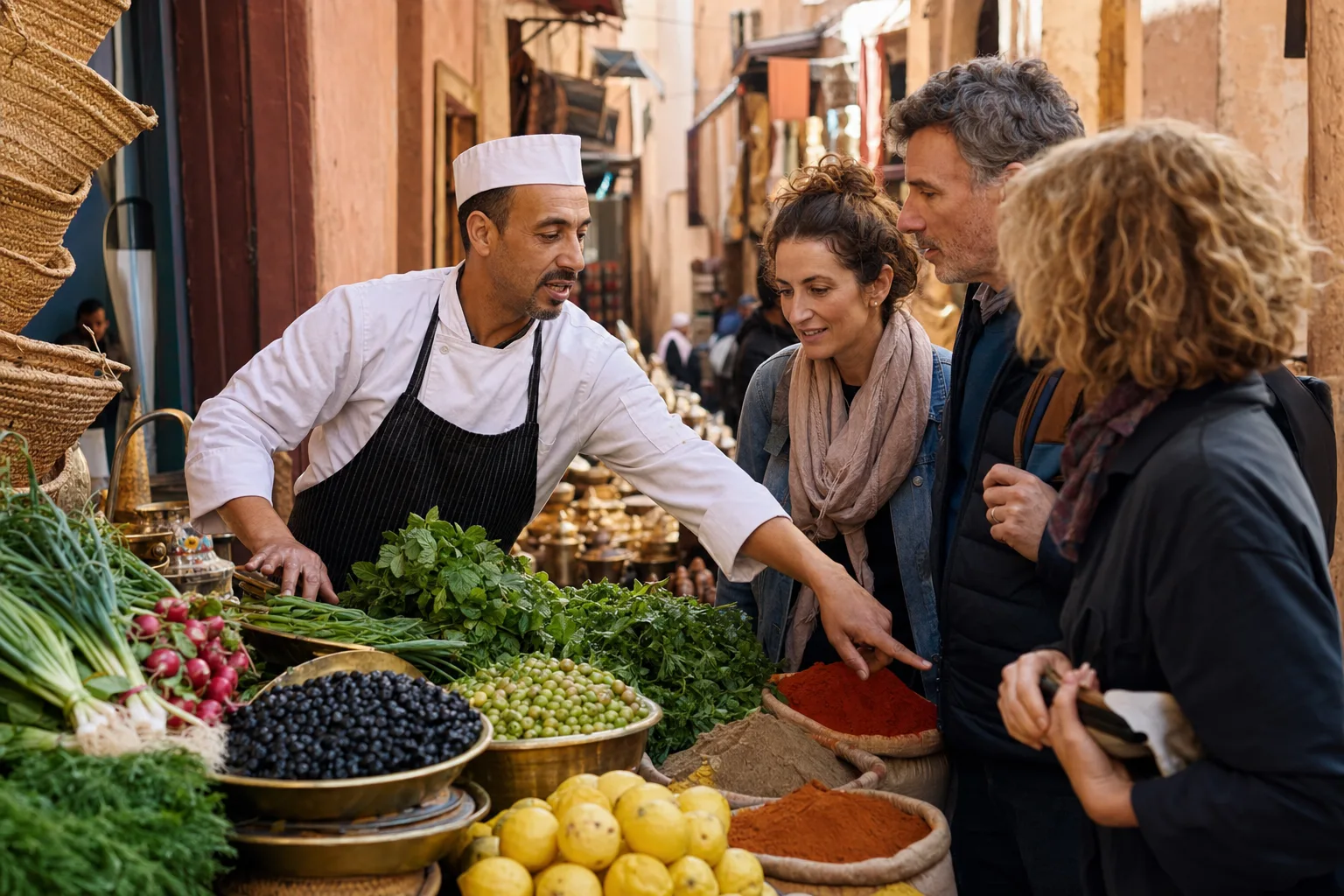
Marrakech runs on Darija (Moroccan Arabic) in the souks and the street, and on French in restaurants, hotels and on the road signs — with Tamazight heard in the Atlas villages on your day trips. A handful of phrases opens doors in the medina that money alone never will.
In this guide
Greetings and basics
Greetings matter enormously in Marrakech. Opening with the right words in a souk stall or a riad doorway signals respect and almost always earns a warmer welcome — and a fairer first price. Darija greetings echo Modern Standard Arabic but carry a distinctly Moroccan accent: the 'q' often softens to a glottal stop and the vowels are compressed. Don't fret about getting it perfect; the attempt is what counts.
- Salam / Salam alaykum — Hello / Peace be upon you (standard greeting)
- Wa alaykum salam — And upon you peace (response)
- Labas? / Labas, hamdullah — How are you? / Fine, praise God
- Shukran — Thank you
- La shukran — No, thank you (essential for polite refusals)
- Smah liya — Excuse me / I'm sorry
- Bslama — Goodbye
- Wakha — OK / Alright
Numbers and money
Numbers in Darija follow a familiar pattern from Modern Standard Arabic. For haggling over a lamp in the souks or settling a petit-taxi fare across Gueliz, these are the ones you will reach for most:
- Wahed, jouj, tlata, rba, khamsa — 1, 2, 3, 4, 5
- Stta, sba, tmanya, tsa'oud, a'shra — 6, 7, 8, 9, 10
- A'shr-in, tlat-in — 20, 30 (and so on by tens)
- Miya — 100 | Alf — 1,000
- Bshhal? — How much?
- Ghali bzzaf — Too expensive
- Khfef shwiya — A little cheaper
- Mashi mushkil — No problem
French essentials
French is the language of the menu in a Gueliz bistro, the riad reception, the road signs and most business in Marrakech — a legacy of the French Protectorate (1912–1956) that remains deeply embedded. Even a little French dramatically widens what you can say, especially in the ville nouvelle districts of Gueliz and Hivernage.
- Bonjour / Bonsoir — Good day / Good evening
- S'il vous plaît / Merci — Please / Thank you
- L'addition, s'il vous plaît — The bill, please
- Où est...? — Where is...?
- Je voudrais... — I would like...
- Combien ça coûte? — How much does it cost?
- C'est trop cher — It's too expensive
- Parlez-vous anglais? — Do you speak English?
Pronunciation notes and haggling
Darija compresses vowels heavily compared with Modern Standard Arabic — 'drari' (children) almost collapses into a single syllable. The letters 'gh' (غ) and 'kh' (خ) are guttural sounds absent from English: 'gh' resembles a soft French 'r'; 'kh' resembles the 'ch' in 'loch'. Neither takes long to get the hang of.
In the Marrakech souks the haggle is a friendly ritual and entirely expected. Open in French or Darija, ask 'bshhal?' (how much?), meet the first price with a wince and 'ghali bzzaf' (too expensive), counter at roughly 40–60% of the opening figure, and trade upward from there. Keep a smile and good humour throughout and both sides enjoy it. Drifting slowly toward the door of the stall often conjures the real final price.
Frequently asked
Do people in Marrakech speak English?
In riads, hotels, the better restaurants and with licensed guides — yes, often quite well. Younger Marrakchis increasingly speak good English. Deeper in the souks, French and Darija dominate; out in the Atlas and Ourika villages on day trips, it is Darija or Tamazight with limited French. A few phrases in either language go a very long way.
What language is spoken in Marrakech?
Morocco's official languages are Classical Arabic and Amazigh (Tamazight). Darija (Moroccan Arabic) is the everyday spoken tongue in Marrakech. French is widely used in business, hospitality and on signage, and Tamazight is common in the Atlas villages around the city. In practice, French and Darija cover almost every travel situation here.
Is Moroccan Arabic the same as Egyptian or Lebanese Arabic?
Darija is a distinct dialect with heavy Amazigh, French and Spanish influences. It differs markedly from Egyptian, Levantine or Gulf Arabic — speakers of those dialects often struggle to follow Darija. Modern Standard Arabic (the written, formal register) is understood but not spoken conversationally in the streets of Marrakech.
How do you say 'thank you' in Moroccan Arabic?
'Shukran' (شكراً) — borrowed directly from Modern Standard Arabic and universally understood. The purely Darija equivalent is 'baraka llahu fik' (God bless you), which you'll hear in response to a compliment or act of generosity.
Do I need French to travel in Marrakech?
Not strictly — the riads, headline sights and main souks run well enough in English. But French opens far more of the city: menus at neighbourhood restaurants, conversations with riad owners, directions, taxi negotiations and everything beyond the tourist core. Even a few phrases make a disproportionate difference.
Planning a trip?
Let a Marrakech atelier handle the details.
Tell us your dates and style and we'll send a written itinerary and a transparent quote within 24 hours.
Request an itineraryKeep reading
Culture
Morocco Etiquette & Customs
A little cultural awareness goes a long way in Marrakech. Dress modestly for the medina, greet warmly, ask before photographing people in the souks, use your right hand, and lean into the unhurried rhythm of mint tea and conversation.
Culture
Moroccan Food & Drink
Marrakech is one of the great eating cities of North Africa: slow-cooked tagines in the medina, the legendary food stalls of Jemaa el-Fna at dusk, rooftop dinners over the Koutoubia, and the endless ritual of sweet mint tea.
Practical
Getting Around Morocco
Within Marrakech you'll mostly walk the medina and grab petit taxis between districts. For the airport, the day trips and onward cities, the choice is between the train (to Casablanca, Rabat, Fes) and a private driver — and which you want depends on where you're headed.