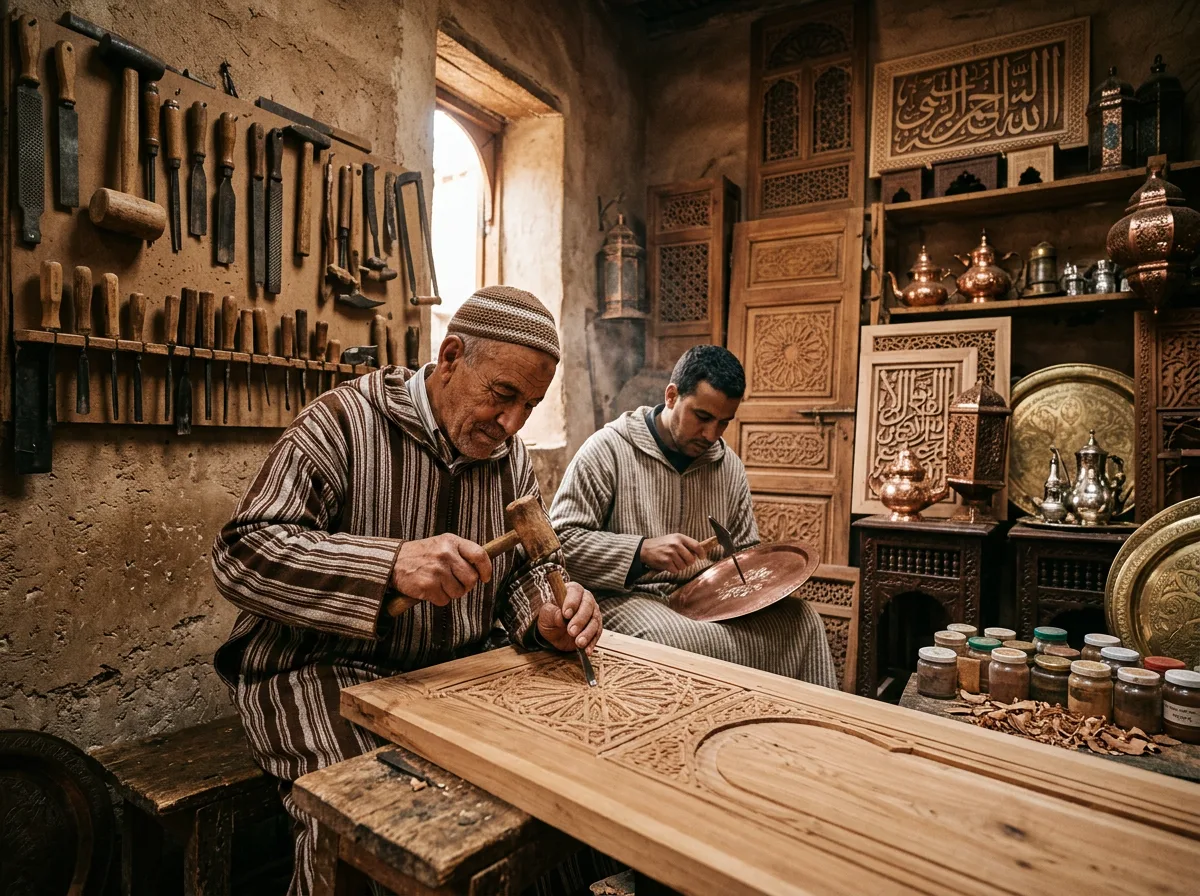
The souvenirs worth carrying home from Marrakech are the ones made by hand and used for generations — a hand-knotted rug, a pair of soft babouche slippers, a pierced-brass lantern, a bottle of argan oil. This guide walks you souk by souk through the Marrakech medina and tells you what to buy, what to pay and how to spot the fakes.
In this guide
What are the best things to buy in Marrakech?
The Marrakech medina is one continuous workshop. Behind almost every shopfront in the souks north of Jemaa el-Fna someone is hammering brass, stitching leather or knotting wool, and the goods that come out of those workrooms are the souvenirs worth packing. A hand-knotted rug carried down from an Atlas village, a pair of vegetable-tanned babouches, a pierced-brass lamp that throws lace shadows across a riad wall, a tin of toasted argan oil — these are objects you will still be using years after the holiday photos have faded.
Set those against the mass-produced trinkets piled outside the cafes on the square — the resin camels and machine-printed scarves — and the difference is obvious. Spend your dirhams where the craft is real, and you take home a piece of the medina rather than a keychain.
- Hand-knotted rugs (Beni Ourain, boucherouite, Azilal): the carpet souk's highest-value buy, and genuinely one of a kind.
- Leather: babouche slippers, poufs and bags worked in the medina tanneries north-east of the souks.
- Ceramics: hand-painted tagines, bowls and Safi-style plates stacked along the pottery stalls.
- Argan oil: culinary (toasted and nutty) and cosmetic (pale gold and mild) — buy from a co-operative, not a souk stall.
- Lanterns: hand-pierced brass and copper lamps — the lampshade souk (Souk Haddadine) is the place for these.
- Spices: ras el hanout, saffron, cumin and dried rose petals, sold loose by weight at Rahba Kedima.
- Thuya wood: fragrant marquetry boxes brought up from Essaouira and sold around the medina.
Which Marrakech souk sells what?
The medina souks are loosely organised by trade, and knowing the geography saves hours. Rahba Kedima — the old apothecaries' square just north-east of Jemaa el-Fna — is where you buy spices, dried herbs, rose petals and the cosmetic curiosities of the herbalists. Push north and you reach the Souk des Teinturiers (the dyers' souk), where skeins of dyed wool hang dripping over the lane, and the carpet souk (Souk Zrabi / La Criée Berbère), the medina's most theatrical corner for rugs.
For metalwork, Souk Haddadine and Souk Cherratine ring with the sound of hammers — this is the place for lanterns, trays and pierced lamps. Leather goods cluster around Souk Cherratine and the tannery quarter at Bab Debbagh on the medina's eastern edge. For argan oil, skip the souk middlemen entirely: the women's co-operatives on the road out towards Essaouira and the Ourika Valley press it fresh and sell it at honest, fixed prices, with the income going to the women who do the work.
- Spices and herbs: Rahba Kedima, the old apothecary square off Jemaa el-Fna.
- Rugs: Souk Zrabi / La Criée Berbère (the carpet souk) — the medina's rug heart.
- Lanterns and metalwork: Souk Haddadine (the blacksmiths' lane).
- Leather: Souk Cherratine and the Bab Debbagh tanneries on the eastern medina edge.
- Wool and textiles: Souk des Teinturiers, the dyers' souk.
- Argan oil: women's co-operatives on the Essaouira and Ourika roads — fixed prices, real provenance.
How do you spot a fake in the Marrakech souks?
The same stall in the carpet souk can hold a genuine hand-knotted rug and a machine-woven imitation propped right beside it; the same shelf can hold honest cold-pressed argan oil and a cut, adulterated bottle. A few quick checks keep you honest.
Turn a rug over: hand-knotted work shows individual, slightly irregular knots on the reverse, while machine-made rugs have a smooth, fabric-like backing. Real wool feels springy and warm; synthetic fibre is cooler and faintly plasticky. Genuine cosmetic argan oil is a clear golden-amber, fluid, with a soft nutty scent — suspiciously cheap, pale or chemical-smelling oil has been stretched with cheaper oils. On ceramics, look for the small wobbles of a hand-painted brushstroke; perfectly even, repeated patterns mean a printed transfer rather than a Marrakech painter's hand.
What makes a good gift to carry home from Marrakech?
If suitcase space and weight are the constraint, the medina rewards you anyway. Spices and food (ras el hanout, sealed argan oil, honey, preserved lemons, rose water), a pair of babouches, a hand-painted tea glass or two, and a set of those tea glasses with their filigree silver-coloured holders all fit in a corner of a bag and arrive home intact and unmistakably Moroccan.
A pierced-brass lantern makes a memorable gift but needs careful packing — nest it in clothing. A small boucherouite rug, woven from recycled fabric in jolts of colour, rolls down tight enough to ride in your cabin bag. Steer well clear of anything in tortoiseshell, ivory or other protected animal material: customs will seize it, and buying it is indefensible in the first place.
- Best to carry: spices, sealed argan oil, tea glasses, babouches — all light and easy through security.
- Best to ship: rugs, large lanterns and ceramic sets — most carpet shops arrange international shipping.
- Never buy: tortoiseshell, ivory or protected animal products — illegal to import almost everywhere.
- Argan oil rule: bottles over 100 ml must go in hold luggage, not your cabin bag.
How much should you pay, and how do you haggle?
Opening prices in the Marrakech souks usually sit at two to four times a fair figure, and the haggle is expected — refusing to bargain insults the ritual rather than respecting it. As a rough rule, counter at around a third of the asking price and aim to settle near half. The fixed-price boutiques that advertise 'prix fixe' are the exception: the marked figure is real, and the quality is often more reliably checked than on the open stalls. Argan co-operatives also work on transparent fixed pricing.
The most effective tactic in the medina is the slow, genuine walk-away. A good share of souk sales close the moment the buyer steps out of the shop and the merchant calls them back with a better number. If you genuinely want the piece, drift off, browse the next lane for twenty minutes, then return — the price has a way of softening.
Frequently asked
What is the most popular souvenir to buy in Marrakech?
Argan oil, babouche slippers and hand-painted ceramic tagines are the items most visitors leave the medina with. A hand-knotted rug from the carpet souk is the big investment buy many travellers make; loose spices from Rahba Kedima are the most affordable and most-appreciated gift.
Where is the best place to buy a rug in Marrakech?
The carpet souk — Souk Zrabi, also called La Criée Berbère — has the widest selection in the medina, though opening prices are tourist-facing and quality varies stall to stall. For genuine Berber village rugs like Beni Ourain and Azilal, the dealers here who can show you the weaver's region are the ones to trust, or buy directly from an Atlas co-operative on a day trip. Always turn the rug over to confirm it is hand-knotted.
Is argan oil cheaper in Marrakech or at a co-operative?
A certified women's co-operative on the Essaouira or Ourika road sells genuine cold-pressed cosmetic argan oil for roughly 80–120 MAD per 100 ml (about US$8–12) at a fixed, fair price. Souk stalls inside the medina often ask 200–500 MAD for the same volume, sometimes for adulterated oil. Buying at a co-op is both cheaper and ethical, since the income reaches the women who press it.
Can you take Marrakech souvenirs through customs?
Standard crafts — ceramics, leather, textiles, sealed argan oil, spices — are freely importable almost everywhere. Argan oil over 100 ml must travel in hold luggage rather than your cabin bag. Genuine antiques over 100 years old need Moroccan export documentation; any reputable medina antique dealer can provide the paperwork.
What is ras el hanout and where do I buy it in Marrakech?
Ras el hanout means 'head of the shop' — a house blend of 20 to 35 spices that can include cumin, coriander, ginger, cinnamon, cardamom, rose petals and mace. Buy it loose by weight from a spice merchant at Rahba Kedima rather than in shrink-wrapped tourist jars, and ask the seller to list what is in his blend; a good Marrakech spice man will happily recite it.
Planning a trip?
Let a Marrakech atelier handle the details.
Tell us your dates and style and we'll send a written itinerary and a transparent quote within 24 hours.
Request an itineraryKeep reading
Culture
Shopping in the Marrakech Souks: What to Buy & Fair Prices
The Marrakech medina souks are the beating heart of the city's shopping — a maze of dyers' alleys, spice piles, leather workshops and rug rooms north of Jemaa el-Fna. Knowing which lanes sell what, what a fair price looks like, and how to bargain with good humour turns an intimidating warren into one of the best afternoons of any Marrakech trip.
Culture
Morocco Etiquette & Customs
A little cultural awareness goes a long way in Marrakech. Dress modestly for the medina, greet warmly, ask before photographing people in the souks, use your right hand, and lean into the unhurried rhythm of mint tea and conversation.
Planning
Things to Do in Marrakech: The Essential Guide
Marrakech is glorious sensory overload — a thousand-year-old medina, the cobalt of the Majorelle garden, the ritual of the hammam, candlelit rooftop dinners, and a square that reinvents itself every evening into one of the world's great open-air theatres. This is our insider map to where your hours are best spent, from the souks and the palaces to the day trips that fan out into the Atlas and the desert.