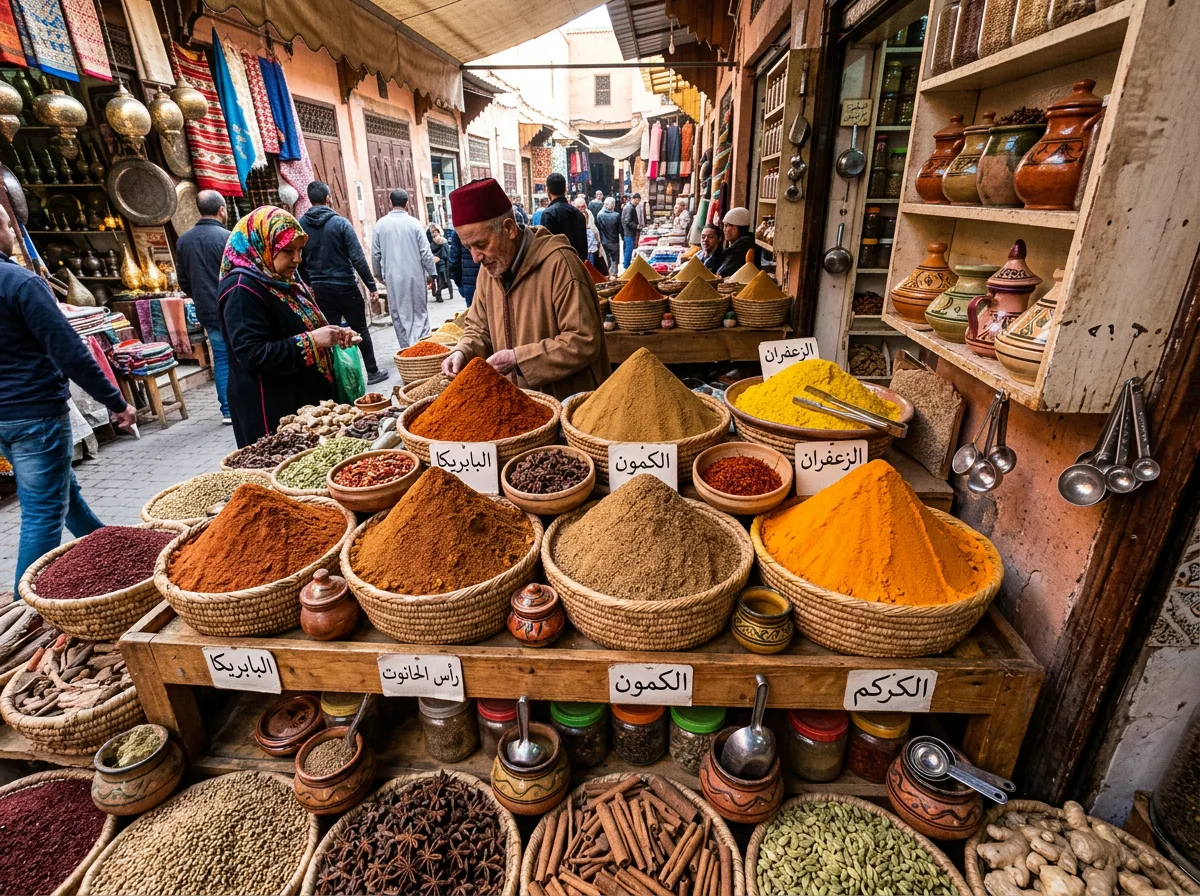
The Marrakech medina souks are the beating heart of the city's shopping — a maze of dyers' alleys, spice piles, leather workshops and rug rooms north of Jemaa el-Fna. Knowing which lanes sell what, what a fair price looks like, and how to bargain with good humour turns an intimidating warren into one of the best afternoons of any Marrakech trip.
In this guide
What should you buy in the Marrakech souks?
The souks fan out north from Jemaa el-Fna along Souk Semmarine, the wide covered spine that branches into dozens of specialist alleys. Within a single block you will pass machine-made imports and genuine hand-knotted Atlas rugs, so the trick is buying things made by Marrakshi and Berber hands using techniques the city has practised for centuries. Five categories stand out.
- Rugs and kilims: the highest-value purchase — handwoven Berber rugs carried down from the High Atlas (Beni Ourain, Boucherouite, Azilal) fill the rug souk around Rahba Kedima and Criée Berbère. Check the reverse for tight, even knotting and feel for natural wool with a slight springiness rather than a plastic sheen.
- Leather babouches and bags: Marrakech is the babouche capital, and the leather souk (Souk Smata) is wall-to-wall slippers in every colour. Belts, satchels and poufs are also strong buys. Supple leather that smells natural is the mark of quality; the thinnest, brightest slippers wear out fastest.
- Lanterns and metalwork: the brass and copper souk (Souk Haddadine) rings with hammering, and the hand-pierced Marrakech lantern is the city's signature buy. Quality shows in the evenness of the piercing and the weight of the metal — brass lasts, while thin tin substitutes rust.
- Spices, herbs and apothecary goods: Rahba Kedima, the old spice and apothecary square, sells saffron, ras el hanout, dried roses, amber and argan products from open sacks. Buy whole spices over pre-ground blends, and be sceptical of 'miracle' aphrodisiac mixes pitched to tourists.
- Ceramics, leather poufs and design pieces: tagine dishes and glazed bowls fill the pottery stalls, while a new wave of concept stores in Gueliz and the Sidi Ghanem industrial-design quarter (Max & Jan, Chabi Chic, Soufiane Zarib and others) sells curated, fixed-price versions of the same crafts for those who prefer not to haggle.
What are fair prices in the Marrakech souks?
Opening prices in the medina are typically 200–400% of what a local would pay, sometimes more. This is not straightforwardly a con — bargaining is the expected mechanism and both sides understand the game — but it does mean paying the first figure always leaves money on the table. A rough rule for the Marrakech souks: counter at 30–40% of the asking price and aim to settle around 50–60% for most goods.
Specific benchmarks (prices in MAD, correct to mid-2026): a pair of standard babouche slippers, 50–120 MAD fair (you will be quoted 300–500); a small glazed bowl, 40–80 MAD (quoted 200–400); a medium hand-knotted Atlas rug, 1,500–5,000 MAD depending on size, weave and age (opening prices of 8,000–15,000 MAD are routine in the rug souk). For argan oil, a 100 ml bottle of quality cosmetic oil runs roughly 80–120 MAD from a reputable source; tourist stalls quote 200–500 MAD for thinner product.
How do you bargain effectively in the Marrakech medina?
Haggling in the souks is a social ritual, not a fight. The shopkeeper expects the back-and-forth, and approaching it with that mindset makes it enjoyable rather than stressful. The principles that hold across every stall: decide what the piece is worth to you before you step inside; keep your enthusiasm hidden until you are ready to make an offer; open well under your ceiling; accept the mint tea if offered, but know that tea carries no obligation to buy; and be ready to walk — slowly and for real.
Walking away is the most powerful move you have. A large share of souk sales close the moment the buyer steps back into the alley and the merchant calls out the genuine price. If you leave a shop near Souk Semmarine and keep moving, you hold more leverage than at any point in the conversation. Circle back twenty minutes later if you really want the item — the number will usually have dropped.
Can you ship souk purchases home from Marrakech?
Yes, and for bulky items (rugs, stacks of ceramics, a full lantern haul) it is often easier than wrestling them through Marrakech Menara airport as luggage. Most rug and ceramics dealers in the medina who deal with international buyers offer shipping — the rug is rolled, bagged or crated and sent by DHL, UPS or Moroccan post. Budget roughly US$80–200 for a medium rug to Europe or the US, plus a packing fee of 50–150 MAD.
Check provenance carefully when spending real money. Pieces sold as an 'antique Berber rug' or a 'grandmother's weaving' may need documentation for customs at home; if you are genuinely buying something with age and value, insist on a signed receipt describing the weave, and avoid anything in ivory or tortoiseshell altogether. For standard modern crafts straight off the souk, shipping is routine and low-risk.
- For rugs: ask the dealer to write a receipt noting the weave, approximate age and origin — useful for customs and insurance.
- For ceramics: bubble wrap is sold all over the medina; shipping through a specialist beats trusting tagine dishes to checked luggage.
- For argan oil: bottles above 100 ml will be taken at Menara airport security — pack them in the hold or ship them.
- For leather: it carries no import restrictions, but condition babouches and bags on arrival if they have dried out in transit.
Frequently asked
What is the best thing to buy in the Marrakech souks?
Hand-knotted Atlas rugs from the rug souk, leather babouches and bags, hand-pierced brass lanterns, and spices from Rahba Kedima are the classic Marrakech buys. All are made locally and hard to replicate at home. Skip the mass-produced trinkets that are imported rather than crafted in Morocco.
How do you know if a Marrakech rug is authentic?
Turn it over — a hand-knotted rug shows individual, slightly irregular knots on the reverse, while a machine-made one has a smooth, fabric-like backing. Real wool feels springy and warm; synthetic fibres feel cool and faintly plasticky. A reputable dealer in the rug souk will happily let you inspect the back and will not take offence at the question.
Is it rude not to bargain in the Marrakech souks?
Not rude, but unusual — and expensive. Paying the first price in the medina means paying the maximum. The exception is the fixed-price concept stores in Gueliz and Sidi Ghanem (and a few stalls marked 'prix fixe'), where the marked figure is the price and haggling is not expected. Those shops also vet quality more reliably.
Where are the main souks in Marrakech?
They all spread north from Jemaa el-Fna. Souk Semmarine is the main covered artery; from it branch the rug souk around Rahba Kedima and Criée Berbère, the leather slipper souk (Souk Smata), the dyers' souk (Souk Sebbaghine) with its hanging skeins, the blacksmiths' souk (Souk Haddadine) for lanterns, and the spice and apothecary stalls of Rahba Kedima.
Can you buy argan oil in the Marrakech souks?
Yes, but with care. Quality varies hugely — plenty of stalls sell oil diluted with cheaper oils or that was never cold-pressed. Safer bets are certified women's co-operatives, reputable pharmacies, and the curated shops in Gueliz. Genuine cosmetic argan oil is golden with a faint nutty scent; the culinary version is darker and toasted. Several day trips toward the Atlas and Essaouira pass roadside co-ops where you can watch it being pressed.
Planning a trip?
Let a Marrakech atelier handle the details.
Tell us your dates and style and we'll send a written itinerary and a transparent quote within 24 hours.
Request an itineraryKeep reading
Culture
Morocco Etiquette & Customs
A little cultural awareness goes a long way in Marrakech. Dress modestly for the medina, greet warmly, ask before photographing people in the souks, use your right hand, and lean into the unhurried rhythm of mint tea and conversation.
Culture
Moroccan Food & Drink
Marrakech is one of the great eating cities of North Africa: slow-cooked tagines in the medina, the legendary food stalls of Jemaa el-Fna at dusk, rooftop dinners over the Koutoubia, and the endless ritual of sweet mint tea.
Planning
Morocco Travel Costs & Budget
Marrakech bends to almost any budget. Mid-range visitors spend roughly US$80–150 per person per day; a private, riad-based city break with a driver-guide and day trips typically runs US$200–400+ per day depending on season and standard.