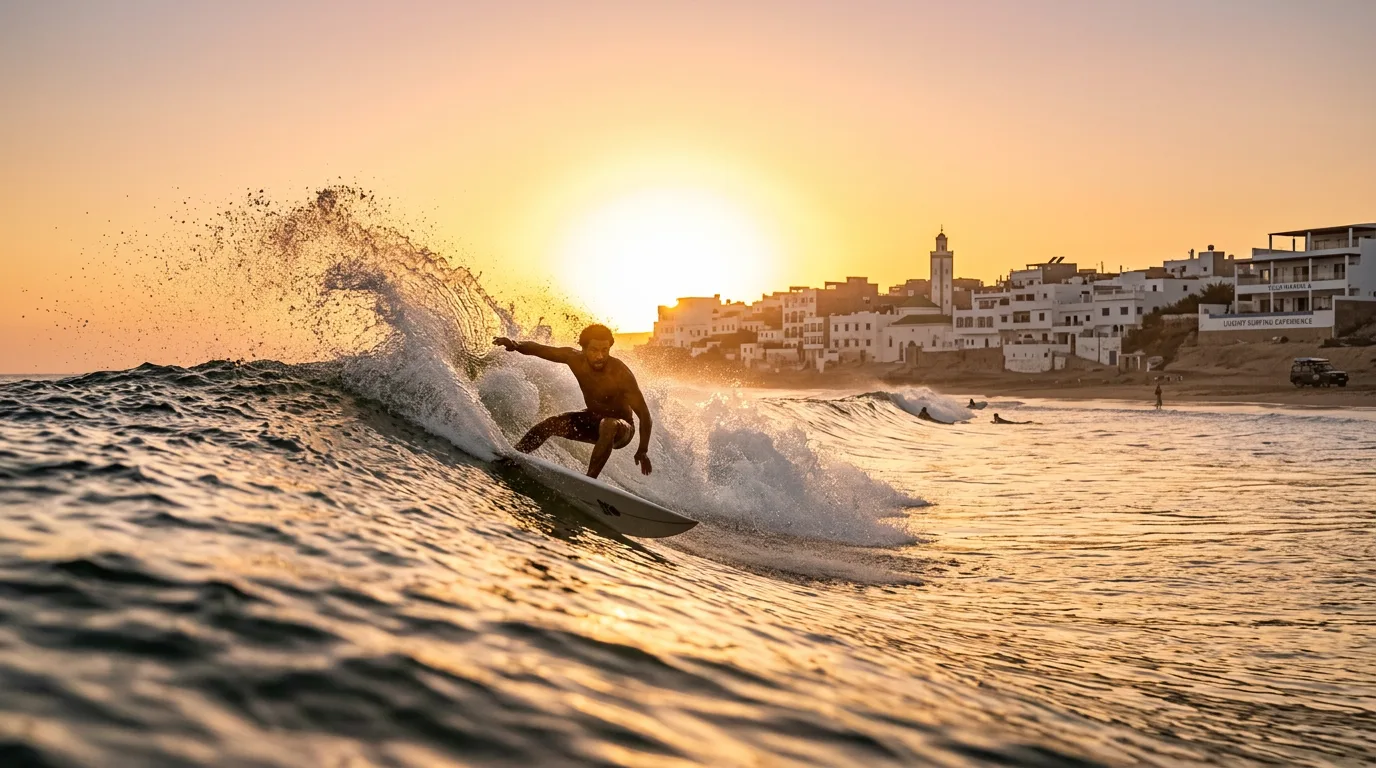
Summer in Marrakech (June–August) is genuinely hot, but with the right rhythm — early starts, a pool riad, late rooftop nights — the city still works. And the escapes are close: the breezy Essaouira coast, the cool Ourika Valley and High Atlas, and the Agafay desert at dawn and dusk.
In this guide
How hot is Marrakech in summer?
Marrakech in summer is properly hot. The city regularly records 38–44°C in July and August, with the occasional 45°C spike during a chergui (the hot desert wind off the Sahara). These are not scare-story figures — they are real daily maxima that shut down comfortable outdoor activity roughly between 11:00 and 17:00. The saving grace is that the heat is dry rather than humid, and a thick-walled medina riad with a shaded courtyard stays markedly cooler than the open streets.
The escapes are mercifully close. Essaouira, 180 km west on the Atlantic, sits at a blissful 22–25°C through July thanks to the north-east Alizé trade wind that blows all summer — a 2.5-hour transfer can drop the temperature by 18 degrees. The Ourika Valley and High Atlas foothills, an hour from the city, are noticeably cooler as you climb, with cold rivers to picnic beside. Even the Agafay stone desert, baking at midday, turns pleasant and photogenic in the cool of early morning and late evening.
- Marrakech: July–August daily maxima of 38–44°C — save sightseeing for early morning and evening.
- Agafay desert: scorching at midday but lovely at dawn and dusk; sunset dinners and stargazing work well.
- Ourika Valley and High Atlas: an hour from the city and several degrees cooler; cold rivers and waterfalls.
- Essaouira: 22–25°C year-round on the Alizé wind — the classic Marrakech summer escape, 2.5 hrs west.
- Sahara (Merzouga, via Ouarzazate): 45–50°C in July–August; most camps reduce services or close.
- Imlil and Toubkal: high-altitude trekking is comfortable in summer — the snow has cleared.
Where should you escape to from Marrakech in summer?
Essaouira is the standout escape. The windswept Atlantic ramparts, the fresh-grilled seafood at the port, the relaxed medina and the kitesurfing all stay comfortable while Marrakech bakes, and the coast road out via the argan forest is one of the country's prettiest drives. Many summer visitors split their trip — a few days in the red city, a few days on the coast — and barely notice the inland heat.
For a shorter reset, the Ourika Valley climbs straight into the High Atlas an hour from Marrakech: Berber villages, the Setti Fatma waterfalls and cold mountain streams to wade in. Higher still, Imlil is the trailhead for Toubkal, and summer is the season for that ascent once the snow has gone. Closer to home, an Agafay desert camp delivers the desert atmosphere — camel silhouettes, sunset, a sky full of stars — without the punishing journey or extreme heat of the deep Sahara.
How do you manage the heat in Marrakech in summer?
If your dates are fixed and Marrakech stays on the itinerary, build the day around the heat. Be out by 7:00 and knock off the big sights before 10:30 — Jardin Majorelle and the YSL museum, the Bahia Palace, the Medersa Ben Youssef and a souk wander all fit into three cool early hours. Retreat to the riad for the afternoon (pool, shade, hammam), then re-emerge after 17:00 as the city exhales. Jemaa el-Fna after dark, with its food stalls and crowds, is still the spectacle it always was.
A riad with a pool is not an indulgence in July–August — it is what makes the trip work. Traditional Marrakech riad construction (thick earth-brick walls, small windows, a central courtyard and fountain) keeps interiors far cooler than the lanes outside: 28°C indoors against 42°C in the street is normal. Rooftop restaurants and air-conditioned riads come into their own for late dinners once the worst heat has lifted.
- Sightseeing window: 7:00–10:30 and 17:00–sunset; stay out of the sun 11:00–17:00.
- Book a riad with a pool — a genuine necessity, not an upgrade, in July–August.
- Wear loose, breathable, light-coloured clothing; keep shoulders covered for the souks and any mosque visit.
- Drink constantly; carry a water bottle and top it up at restaurants and your riad.
- Time a midday hammam — the cool, dim chambers are a civilised way to ride out the hottest hours.
Is the Sahara worth doing from Marrakech in summer?
Honestly, not for the classic camp experience. July and August at Merzouga reach 45–50°C, the long drive over the Tizi n'Tichka is gruelling, camel rides become endurance tests, and many higher-end camps cut services or close. If the Sahara is the heart of your trip, aim for October to April instead. If you are locked into summer dates but still want a desert night, the Agafay just outside Marrakech is the smart substitute — its early-morning and after-dark hours are genuinely pleasant, and you are back at your riad pool within the hour. Ouarzazate and the Drâa Valley, at 1,000–1,200 m, are a touch cooler than the dune fields but still hot in absolute terms.
Frequently asked
Is Marrakech good to visit in summer?
It is workable rather than ideal. Marrakech in July–August is very hot, but with an early-and-late timetable, a pool riad and air-conditioned rooftop dinners it is perfectly doable — and prices and crowds are lower. The trick is to pair the city with cooler escapes: Essaouira on the coast, the Ourika Valley and High Atlas, and the Agafay at dawn and dusk.
What is the coolest place to escape to from Marrakech in summer?
Essaouira, 180 km west, is the classic answer: the Alizé trade wind holds it at 22–25°C in July–August even while Marrakech hits 40°C, and it is a 2.5-hour transfer. For a closer reset, the Ourika Valley and High Atlas foothills get cooler as you climb, an hour from the city.
Can you still do desert and Atlas trips from Marrakech in summer?
Yes, with planning. High Atlas trekking from Imlil up toward Toubkal is actually a summer activity — the snow has cleared and the paths are open, though you should start at dawn and reach hut altitude before the midday heat. The Agafay desert works best at sunrise and after dark. The deep Sahara at Merzouga is best avoided in July–August.
How do Marrakech riads stay cool in summer?
Traditional Marrakech riad design uses thick earth-brick or stone walls, a shaded interior courtyard, small exterior windows and a fountain — passive cooling that predates air conditioning by a millennium. Inside a good medina riad on a 42°C day, 26–28°C indoors is typical. Add a pool and it becomes very comfortable, and most riads also air-condition the bedrooms.
Is Marrakech crowded in summer?
Less than in spring and autumn. Many international visitors avoid the July–August heat, so the medina riads are often easier to book and the palaces quieter. The flip side is the coast: Essaouira and the Atlantic beaches fill with Moroccan domestic tourists and Europeans, so book a coastal escape 2–3 months ahead for peak summer.
Planning a trip?
Let a Marrakech atelier handle the details.
Tell us your dates and style and we'll send a written itinerary and a transparent quote within 24 hours.
Request an itineraryKeep reading
Planning
The Best Time to Visit Morocco
For a Marrakech city break, spring (March–May) and autumn (September–November) hit the sweet spot — sun-warmed days in the medina, cool enough rooftops at dusk, and perfect conditions for Agafay, the Ourika valley and an Atlas or desert day trip.
Planning
Things to Do in Essaouira: The Essential Guide
Essaouira is Marrakech's Atlantic release valve — the classic day trip or overnight from the red city, roughly 2.5 to 3 hours west. A fortified white-and-blue port of ramparts and gulls, a working fishing harbour, peerless grilled seafood, world-class windsurfing and a medina that is calm and genuinely liveable. After the intensity of the Marrakech souks, it feels like a long exhale.
Planning
Surfing in Morocco: Taghazout, Agadir & Imsouane
Morocco's Atlantic coast is the most reliable surf in North Africa — consistent September-to-April swells, mild winters, low costs and an easygoing culture centred on Taghazout, with the marathon right-hand point at Imsouane and gentle town beaches around Agadir. From a Marrakech base it is a roughly three-hour transfer to the lineup, which is why plenty of visitors pair medina days with a coastal surf escape.