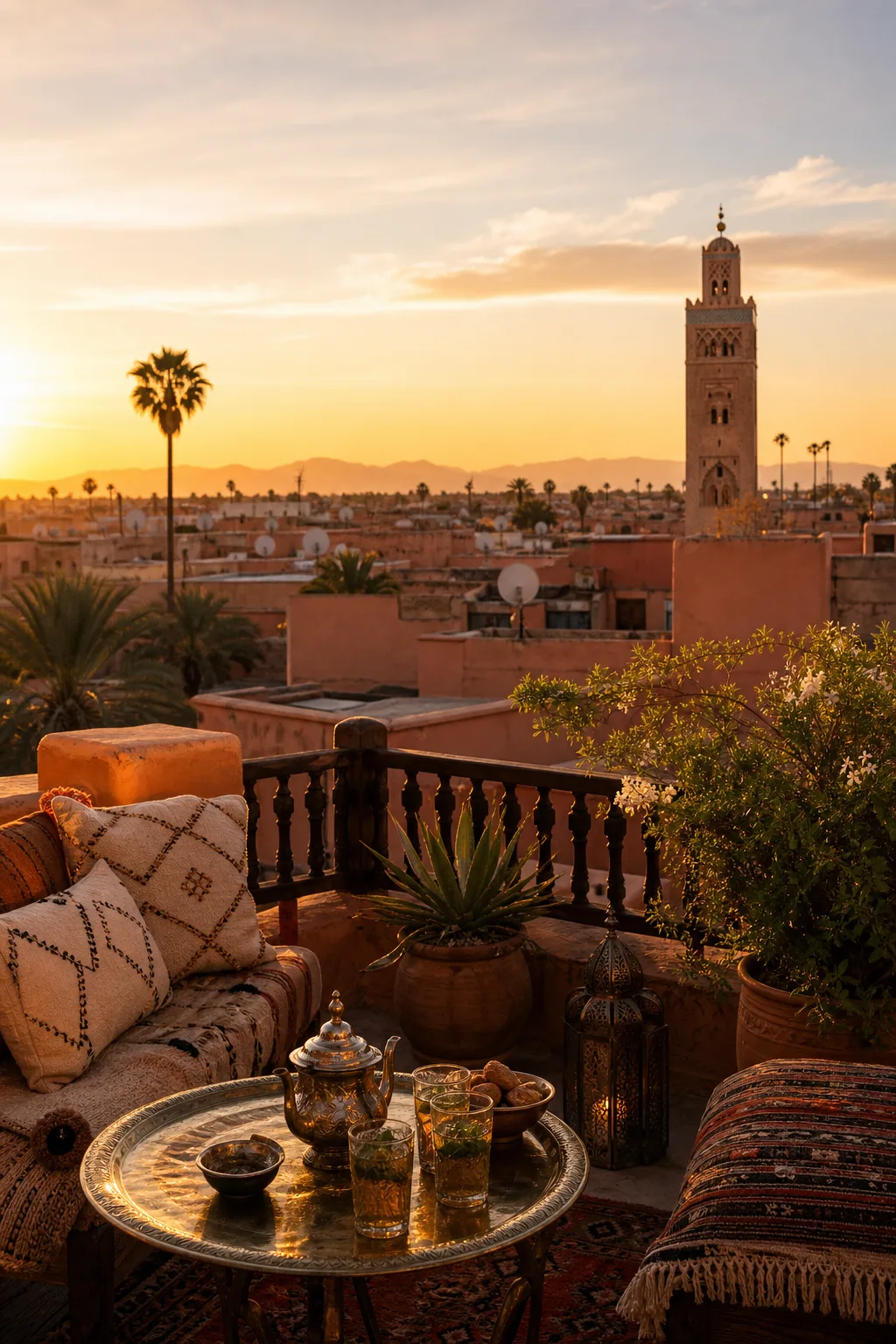
Morocco's calendar weaves together Islamic holy days that drift earlier each year with the moon, fixed national holidays, and a vivid programme of festivals — the Gnaoua World Music Festival just down the road in Essaouira, the Marrakech International Film Festival on the city's own doorstep, the rose festival of Kelaât M'Gouna. Reading the calendar helps you plan around the odd closure and catch Morocco's most colourful events.
In this guide
What are Morocco's national public holidays?
Morocco runs on two calendars at once: fixed national holidays on the Gregorian calendar and moveable Islamic holidays on the Hijri lunar one. On a public holiday, government offices, banks and some shops close, but the things a visitor cares about in Marrakech — the riads, the rooftop restaurants, the major sites — mostly carry on as normal. These fixed dates fall on the same day every year.
- 1 January — New Year's Day
- 11 January — Manifesto of Independence Day (commemorating the 1944 independence document)
- 1 May — Labour Day
- 30 July — Throne Day (anniversary of King Mohammed VI's accession in 1999 — one of the country's most celebrated holidays)
- 14 August — Oued Ed-Dahab Allegiance Day
- 20 August — Revolution of the King and the People Day
- 21 August — Youth Day (King's birthday)
- 6 November — Green March Day (commemorating the 1975 march into Western Sahara)
- 18 November — Independence Day (from French Protectorate, 1956)
Which Islamic holidays affect a Marrakech trip?
The Islamic calendar is lunar and about eleven days shorter than the Gregorian year, so these dates creep earlier each year. A handful of them noticeably change the rhythm of a visit.
- Ramadan: the month of fasting. Cafés and restaurants shift their hours, afternoons in the medina slow right down, and the city comes alive after sunset for the iftar meal. See the dedicated Ramadan travel guide for detail.
- Eid al-Fitr (end of Ramadan): a one-to-three-day holiday when much of Morocco shuts and families gather at home. Marrakech's riads and main sites stay open but run on a skeleton crew.
- Eid al-Adha (Feast of Sacrifice): the larger of the two Eids, roughly seventy days after Eid al-Fitr. The livestock markets on the city's edge in the days before are an extraordinary sight.
- Islamic New Year (Ras as-Sana): the first of Muharram; a low-key holiday next to the two Eids.
- Mawlid an-Nabi (the Prophet's Birthday): marked warmly across Morocco, with music, processions and sweets in the medinas.
- Yennayer (Amazigh New Year): 13 January; a growing public celebration of Berber heritage, felt strongly in the Atlas villages on Marrakech's doorstep.
Which festivals are worth building a trip around?
Beyond the holidays, Morocco's festival calendar offers some of the best windows into the culture — and several sit within easy reach of Marrakech.
- Marrakech International Film Festival (late November / early December): the city's own headline event — ten days of international and Arab cinema, with red-carpet evenings and free public screenings projected onto a giant screen in Jemaa el-Fnaa.
- Gnaoua World Music Festival, Essaouira (late June): a three-hour drive west, four days of free open-air concerts pairing Gnaoua mâalems with international artists on the ramparts and squares. One of Africa's great music festivals — book accommodation far ahead.
- Rose Festival, Kelaât M'Gouna (May): in the Dadès Valley beyond the Atlas, a small-town festival of parades and rose-water stalls in the heart of Morocco's rose-growing country. Pairs well with a longer southern circuit out of Marrakech.
- Fes Festival of World Sacred Music (June): in the courtyards and gardens of old Fes, Sufi, gospel, classical and spiritual traditions from around the world.
- Tan-Tan Moussem (variable, spring): a UNESCO-listed nomadic gathering in the deep south, with camel races and a dense concentration of Saharan culture.
- Marrakech Popular Arts Festival (variable, summer): folk musicians, dancers and performers from across Morocco filling the city's palaces and Jemaa el-Fnaa.
How do these dates shape a visit to Marrakech?
Throne Day (30 July) is the biggest fixed holiday, and Marrakech marks it with decorations, parades and a festive buzz. Offices close briefly, but riads and restaurants stay open and often join in. The two Eids are when Morocco most visibly pauses: the days beforehand are busy as Moroccans head home, many shops shut on the day, and the usually thrumming medina goes unexpectedly quiet.
For a visitor, that hush — Eid morning in the medina, the souks half-shuttered, families in their finest — can be a strangely moving thing to witness. The dip in services is brief and more than offset by seeing the city in a genuine festive or reflective mood. The practical advice is simply to book restaurants and any onward transport ahead of the days around the major Islamic holidays, when availability tightens.
When is Ramadan in the coming years?
Ramadan slides roughly eleven days earlier each Gregorian year. The exact start hinges on the moon sighting and is confirmed by Morocco's Ministry of Habous only a day or two in advance, so treat the windows below as approximate.
- 2027: approximately 28 January – 26 February
- 2028: approximately 17 January – 15 February
- 2029: approximately 6–25 January
Frequently asked
What is Throne Day and what is it like in Marrakech?
Throne Day (30 July) marks King Mohammed VI's accession in 1999 and is Morocco's most jubilant national holiday. In Marrakech you will find flags and lights strung across the avenues, music and a festive mood; royal addresses are broadcast and Rabat hosts the formal parades. Riads and sites stay open, making it a lively time to be in the city.
Is the Gnaoua Festival in Essaouira an easy trip from Marrakech?
Yes — Essaouira is about three hours west, so the Gnaoua World Music Festival in late June makes a feasible overnight or two from Marrakech. Across four days, Gnaoua mâalems (masters of a centuries-old Moroccan trance tradition) play free open-air concerts alongside international jazz, blues and world artists. Book accommodation months ahead, as the town fills.
Can you visit Marrakech during Eid al-Adha?
Yes, with a little planning. The days before Eid are busy as Moroccans head home, and on Eid day itself many shops and restaurants close while riads and major sites stay open. The atmosphere in and around the city the day before — livestock brought in for the feast — is extraordinary and well worth seeing.
Is the Rose Festival worth the trip from Marrakech?
The Rose Festival (Fête des Roses) at Kelaât M'Gouna in the Dadès Valley each May is a highlight for travellers who like regional events off the main trail. The town processes much of Morocco's Damask rose harvest; during the festival the valley is pink with blooms, the air is heavy with rose-water, and the parades and music feel genuine rather than staged. It suits a longer southern circuit out of Marrakech.
Which Islamic holidays should I plan around for a Marrakech trip?
Eid al-Fitr and Eid al-Adha are the two most likely to affect logistics — transport packed in the days before, some shops and services closed on the day, accommodation prices firmer. They are not bad times to visit; the atmosphere can be wonderful, but book everything ahead. Ramadan mainly shifts restaurant hours and is easy to manage with a little preparation.
Planning a trip?
Let a Marrakech atelier handle the details.
Tell us your dates and style and we'll send a written itinerary and a transparent quote within 24 hours.
Request an itineraryKeep reading
Planning
Travelling in Morocco During Ramadan
Ramadan rewires the daily rhythm of Marrakech in ways that can be unexpectedly magical — a hushed medina by day that erupts into life after sunset, the cannon at Koutoubia signalling iftar, families streaming into Jemaa el-Fna. The trick is knowing what shifts and planning your days around it.
Planning
The Best Time to Visit Morocco
For a Marrakech city break, spring (March–May) and autumn (September–November) hit the sweet spot — sun-warmed days in the medina, cool enough rooftops at dusk, and perfect conditions for Agafay, the Ourika valley and an Atlas or desert day trip.
Culture
Morocco Etiquette & Customs
A little cultural awareness goes a long way in Marrakech. Dress modestly for the medina, greet warmly, ask before photographing people in the souks, use your right hand, and lean into the unhurried rhythm of mint tea and conversation.