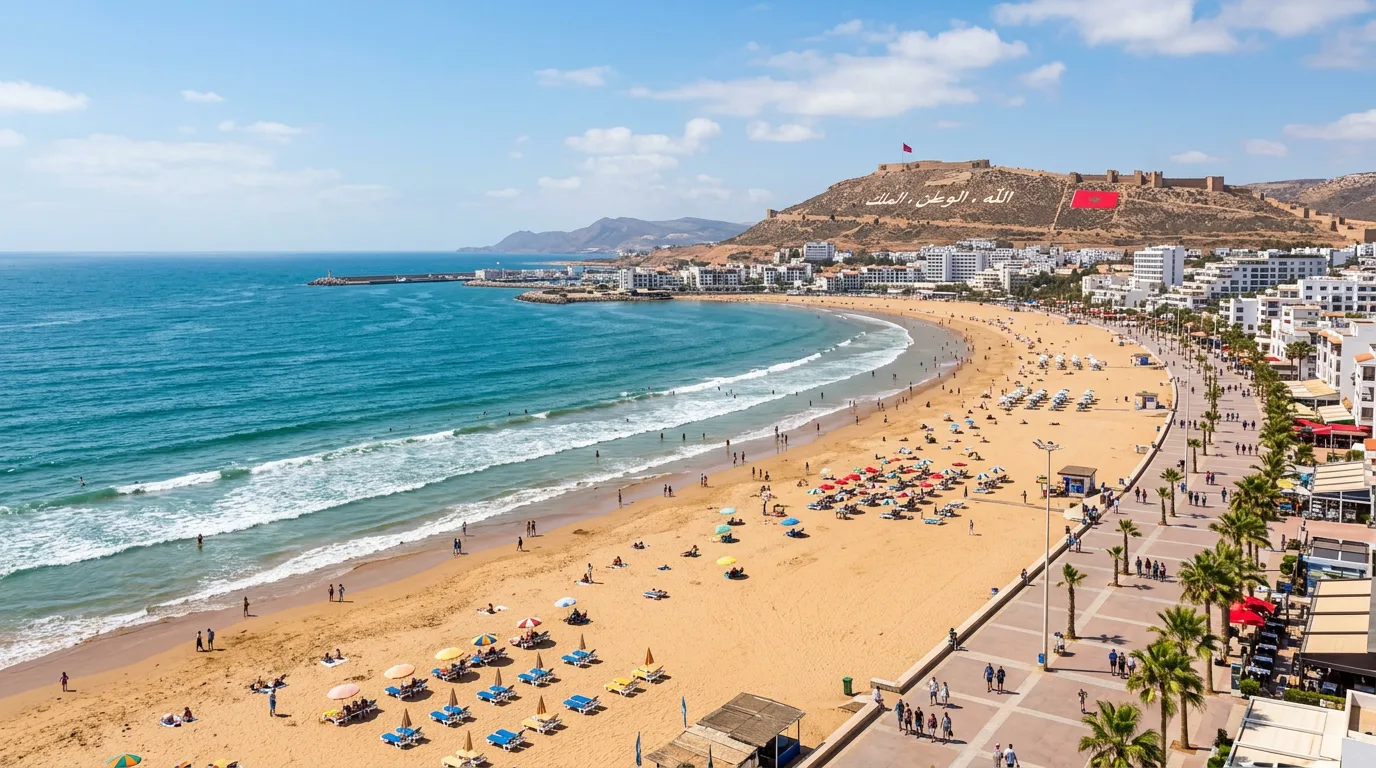
Agadir is Morocco's beach-resort capital — rebuilt from the ground up after the 1960 earthquake and organised entirely around 10 km of Atlantic sand, near year-round sun and package-holiday comfort. It is also the gateway to the Souss Valley, the argan forests and the Taghazout surf coast. From a Marrakech base it is a 3.5–4 hour drive south over the Atlas, and it answers a different question entirely from the medina city: sea and sun rather than souks and palaces.
In this guide
What are the main things to do in Agadir?
Do not come to Agadir for old monuments — the 1960 earthquake killed some 15,000 people and flattened the old medina in seconds, leaving almost nothing standing. What rose in its place is modern, orderly and built around the seafront. The beach (Plage d'Agadir) is the headline: a 10 km golden crescent with water calm enough for swimming, steady enough for first surf lessons, and broad enough to swallow big crowds without ever feeling packed. The promenade behind it is tidy, walkable and lined with cafés, restaurants and resort hotels — a planned, easygoing waterfront a world away from the Marrakech medina.
Above the town, Oufella Hill (236 m) keeps the ruins of the pre-earthquake kasbah and a wide panorama over the bay, now reachable by a cable car. The Ancienne Medina d'Agadir — also called Medina Polizzi — is a reconstruction of a traditional medina built by Italian architect Coco Polizzi between 1992 and 2000 using old materials and techniques, with artisan workshops, galleries and a small hotel inside. It is not a genuine historic quarter, but it is thoughtfully done and worth an hour.
- Plage d'Agadir — 10 km beach; swimming, surfing, horse riding, water sports.
- Oufella Hill kasbah ruins — panoramic bay view; best at sunset.
- Ancienne Medina Polizzi — reconstructed traditional medina; artisan workshops and gallery.
- Valley of the Birds (Vallée des Oiseaux) — small urban park with birds and a children's zoo.
- Agadir Souk el Had — the city's large weekly market; fresh produce, spices and household goods.
- Marina d'Agadir — yacht marina with restaurants and a lively evening promenade.
What day trips and excursions are there from Agadir?
Agadir earns its keep as a launchpad for the surrounding region. Taghazout, 20 km north, is Morocco's leading surf village and works best as a day trip or short stay from Agadir; the coast road up there rolls past Tamraght and Banana Beach with the Atlantic on one side and the argan hills on the other. Imsouane, 70 km north, holds Africa's longest right-hand wave and makes a superb half-day for surfers about 1.5 hours up the coast.
South of the city, the Souss-Massa National Park (60 km) is one of Morocco's most important coastal reserves, sheltering the rare bald ibis along with flamingos, ospreys and wetland birds; a morning with binoculars pays off, and there is a visitor centre at Sidi Rbat. North-east in the Anti-Atlas foothills, Paradise Valley (about 60 km) is a lush gorge of pink granite, oleander and natural rock pools — a lovely half-day hike and swim in summer and autumn. For travellers comparing routes, these excursions are markedly different in character from the Atlas day trips out of Marrakech, leaning coastal and Anti-Atlas rather than High Atlas.
- Taghazout — 20 km north; Morocco's surf capital; half day or overnight.
- Imsouane — 70 km north; Africa's longest wave; 1.5 hr drive.
- Paradise Valley — 60 km north-east; pink granite gorge, rock pools, half-day hike.
- Souss-Massa National Park — 60 km south; bald ibis, flamingos, coastal wetlands.
- Tiznit — 85 km south; walled Berber city with a famous silver souk.
- Taroudant — 80 km east; the 'little Marrakech' with intact ramparts and a relaxed medina.
What is Agadir like for families?
Agadir is the easiest city in Morocco to travel with children. The beach is safe for them; the resort hotels lay on pools, kids' clubs and dependable facilities; the food in hotels and seafront restaurants is international enough to please fussy eaters; and the relaxed resort mood is far gentler on small children than the sensory crush of the Marrakech or Fes medinas. The promenade surf schools take beginners from around age eight.
Crocoparc — a park of more than 300 Nile crocodiles about 10 km north of town — and the Oufella Hill cable car are the main kid-pleasers. The Valley of the Birds, a small urban park, is a calm 20-minute stop in the centre, and beach horse rides and quad bikes on the sand keep older children and teenagers happy. Families pairing this with Marrakech often do the medina first and unwind on the Agadir coast afterwards.
Where should you eat and what food is Agadir known for?
Agadir's food has less character than Essaouira's or Marrakech's, but it rewards anyone who steps past the hotel buffet. The Port d'Agadir fish market, where the Atlantic catch lands each morning, runs informal grill stalls turning out impossibly fresh sardines, bream and bass at harbour prices. Talborjt, the city's lived-in heart behind the tourist strip, has Moroccan cafés and small kitchens serving honest harira, brochettes and couscous at local rates.
The Souss Valley is Morocco's breadbasket — the source of argan oil, of saffron from Taliouine (about two hours east), and of almonds and citrus. Women's argan co-operatives line the Agadir–Essaouira road; stopping at one to watch the oil pressed from hand-cracked nuts and buying direct is among the most genuine food experiences in the region. Real cold-pressed cosmetic argan oil at source runs roughly MAD 80–120 per 100 ml — and the same co-ops sit on the route many travellers take between Marrakech, Essaouira and Agadir.
How does Agadir compare to Essaouira?
Agadir and Essaouira are the two big Atlantic-coast choices, and the difference matters. Agadir is larger (around 400,000 people), more modern, with a broad, safe, swimmable beach but little cultural texture — a beach resort, and best taken as one. Essaouira is a historic fortified port with a real medina, magnificent ramparts, better food and far more atmosphere, but a windier beach and stronger surf. Note too that Essaouira is the classic 2.5–3 hour day trip from Marrakech, while Agadir, 3.5–4 hours south, suits a dedicated beach base rather than a quick hop.
For families with young children and anyone wanting a beach-led holiday with easy excursions, Agadir is the stronger base. For culture, history, seafood and a place that simply feels more Moroccan, choose Essaouira. The two are about 2.5 hours apart and slot together easily on a longer coastal trip, often tied back to a few days in Marrakech.
Frequently asked
Is Agadir worth visiting?
Yes — provided you know what it is. Agadir is Morocco's best beach resort and a fine base for surf, nature reserves, argan country and the Anti-Atlas. It is not a city of historic medinas or architectural set-pieces, so anyone expecting the atmosphere of Marrakech or Fes will be let down. As a relaxed, beach-led destination with strong day trips, it delivers exactly what it promises.
Is the beach in Agadir safe for swimming?
Yes — Agadir's beach is rated among the safest for swimming in Morocco. The long curved bay shelters the water from the heaviest Atlantic swells, and lifeguards patrol in season. Water sits around 18–22°C; a light wetsuit is comfortable from October to April. It is far calmer than the surf-driven beach at Essaouira.
How do you get to Agadir?
Al Massira Airport (AGA) lies 25 km south-east of the centre and links to European airports via Ryanair, easyJet, Royal Air Maroc and Transavia, plus domestic hops to Casablanca and Marrakech. Taxis and transfer firms run to the beach hotels. By road from Marrakech, the motorway via Taroudant — or the spectacular Tizi n'Test pass — takes roughly 3.5–4 hours.
What is the best time to visit Agadir?
Agadir has the steadiest sunshine of any Moroccan city, over 300 days a year, so any month works. The beach is warmest June to September (water 20–22°C, air 25–32°C). October to May is a touch cooler (air 18–24°C) and ideal for surfing, hiking and birdwatching. July and August fill with Moroccan and European holidaymakers; spring and autumn are quieter — handy if you are timing it around a Marrakech stay.
What is the Paradise Valley near Agadir?
Paradise Valley is a lush Anti-Atlas gorge about 60 km north-east of Agadir in the Aït Baha hills. A seasonal river has cut pink granite walls and left natural swimming pools shaded by oleander and palms. A clear path drops from the roadside to the pools in around 30 minutes on foot. Go April to October, when the pools hold water and the oleander is in flower.
Planning a trip?
Let a Marrakech atelier handle the details.
Tell us your dates and style and we'll send a written itinerary and a transparent quote within 24 hours.
Request an itineraryKeep reading
Planning
The Best Time to Visit Morocco
For a Marrakech city break, spring (March–May) and autumn (September–November) hit the sweet spot — sun-warmed days in the medina, cool enough rooftops at dusk, and perfect conditions for Agafay, the Ourika valley and an Atlas or desert day trip.
Planning
Surfing in Morocco: Taghazout, Agadir & Imsouane
Morocco's Atlantic coast is the most reliable surf in North Africa — consistent September-to-April swells, mild winters, low costs and an easygoing culture centred on Taghazout, with the marathon right-hand point at Imsouane and gentle town beaches around Agadir. From a Marrakech base it is a roughly three-hour transfer to the lineup, which is why plenty of visitors pair medina days with a coastal surf escape.
Planning
Things to Do in Essaouira: The Essential Guide
Essaouira is Marrakech's Atlantic release valve — the classic day trip or overnight from the red city, roughly 2.5 to 3 hours west. A fortified white-and-blue port of ramparts and gulls, a working fishing harbour, peerless grilled seafood, world-class windsurfing and a medina that is calm and genuinely liveable. After the intensity of the Marrakech souks, it feels like a long exhale.
Itineraries
Morocco Itinerary: 10 Days
Ten days is the sweet spot for Morocco — long enough to start in our home city of Marrakech and loop through the Sahara and the imperial north unhurried, with the Essaouira coast as an optional finish.