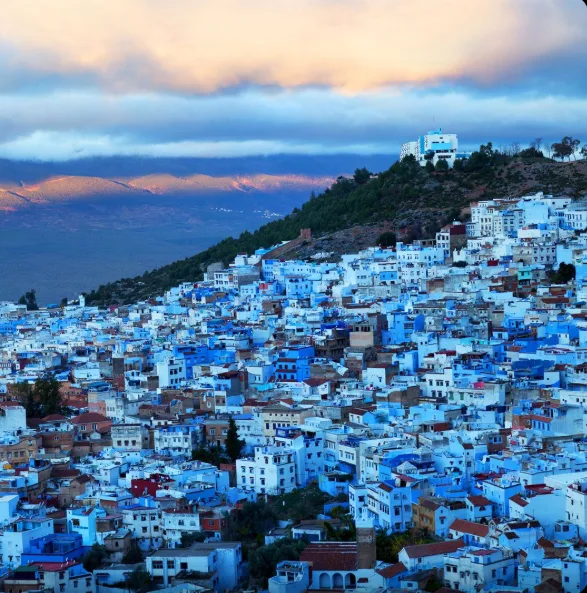
Chefchaouen — the blue city folded into the Rif Mountains — is far more than a photo backdrop. The medina is small, walkable and genuinely lovely; the surrounding peaks reward hikers; the food is distinctly Rifian; and the pace is the most unhurried in Morocco. It sits at the opposite end of the country from Marrakech, so most travellers reach it on a northern loop through Fes and Tangier.
In this guide
What is there to see in Chefchaouen's medina?
Chefchaouen's medina is tiny — you can cross it on foot in twenty minutes — which makes it one of the easiest to enjoy in Morocco, a world away from the sprawling tangle of Fes or the souk-maze of Marrakech. Most people gravitate to Place Uta el-Hammam, the café-lined central square, anchored by an 18th-century kasbah on one flank and a 15th-century mosque with an unusual octagonal minaret on the other. The kasbah, now a small ethnographic museum with a terraced garden, gives the best elevated look over the square and the red-tiled roofs riding above the blue.
The true pleasure here is wandering with no plan at all. Every turn delivers another shade of blue — indigo, cobalt, powder, sky — washed over walls, steps, plant pots and doorframes. The origins of the colour are debated: some credit the Jewish community that settled here from the 15th century, for whom blue carried sacred meaning; others point to a 1930s campaign said to deter mosquitoes. Whatever its source, the wash is beautiful and photographs almost by itself in the soft light of early morning and late afternoon.
- Place Uta el-Hammam — the central square; cafés, kasbah gate, mosque minaret.
- Kasbah museum — ethnographic displays and gardens; best viewpoint in the medina.
- Ras el-Maa waterfall — 5-minute walk from the medina; local women do laundry in the stream above.
- Bab Onsar — the eastern gate; quieter neighbourhood beyond it worth exploring.
- The blue lane (Rue Targui and side alleys off Rue Ibn Askar) — the most photogenic passages.
What outdoor activities are there near Chefchaouen?
The Rif Mountains wrapped around Chefchaouen are quietly one of Morocco's best walking areas. The classic short outing is the climb to the Spanish Mosque on the hill east of the medina — about 30 minutes up to a roofless shell that frames a sweeping view of the blue roofscape against the peaks, unbeatable at sunset. Rising straight above the town, Talassemtane National Park threads marked trails through cedar and fir with long panoramas over the range.
For something more demanding, the Jbel el-Kelaa circuit climbs to a 1,616 m summit on a full-day route through Berber hamlets and forested ridges, and is best done with a local guide. Gentler but no less lovely is the Cascades d'Akchour: a roughly 7 km trail from a trailhead east of town that follows a river gorge past a chain of waterfalls to the soaring 'God's Bridge' rock arch. It ranks among the finest half-day walks in northern Morocco — and the lushness is a striking contrast to the arid hills behind Marrakech.
- Spanish Mosque — 30 min climb; best sunset view of the blue city.
- Cascades d'Akchour — 7 km river gorge walk; waterfalls and God's Bridge natural arch.
- Talassemtane National Park — cedar forest trails; panoramic ridge views.
- Jbel el-Kelaa — full-day summit hike with a local guide.
What is Rifian food like in Chefchaouen?
Chaouen cooking stands apart from the Marrakchi tagine tradition. The Rif yields good goat's cheese, olives, wild mountain herbs and a long-cultivated cannabis crop (kif) — the latter visible in the hawking that goes on in the hills above town, though buying or carrying it remains illegal and best left well alone. The food itself is plainer and fresher than in the imperial cities: river trout crusted with herbs, msemen flatbread with honey and olive oil, and a soft goat's cheese (jben) that turns up on every breakfast table.
Cafés ring the square for coffee and mint tea, and the best kitchens are small family affairs in the lanes just off Place Uta el-Hammam — Bab Ssour and Chez Aziz earn steady praise for Rifian lamb and trout. For an evening with a medina view, the rooftop terraces along the south side of the square trade a little culinary polish for plenty of atmosphere.
Where to stay in Chefchaouen and how to get there?
Up north the guesthouses are called dar rather than riad, and Chefchaouen's are mostly small, family-run and beautifully woven into the medina. The pick of them sit in the upper, quieter streets near the Bab Onsar gate, out of earshot of the square at night. Lina Ryad, Casa Perleta and Dar Echchaouen come up repeatedly for blending real character with comfort, and rates undercut Marrakech and Fes — a well-kept room runs roughly MAD 400–900 a night.
There is no airport here. CTM buses link Chefchaouen with Fes (4–5 hours), Tangier (3 hours) and Casablanca (5–6 hours), while private drivers from Fes — the usual approach — take 3.5–4 hours through mountain scenery, and the run down from Tangier is a spectacular 2.5–3 hours. Crucially, there is no direct service from Marrakech: from a Marrakech base you fly or take the train to Fes first, then transfer north by road, which is why Chefchaouen suits a longer northern loop rather than a quick add-on.
Frequently asked
Why is Chefchaouen blue?
The leading explanation traces the blue-wash to the Jewish community that settled here after 1492, for whom blue was a sacred colour evoking the sky and the divine. A second theory ties it to a 1930s effort to repel mosquitoes. Either way, the wider town took up the practice and has maintained and deepened it ever since as a matter of civic identity and pride.
How many days should you spend in Chefchaouen?
Two nights is the comfortable rhythm: one day for the medina and the climb to the Spanish Mosque, a second for the Cascades d'Akchour or a longer Rif hike. A single night feels rushed; three nights suit anyone who wants to slow right down and walk properly. Within a wider Moroccan trip it pairs naturally with Fes rather than Marrakech.
Is Chefchaouen worth visiting?
Yes — with the right expectations. The blue medina is genuinely beautiful, the mountains are excellent and the tempo is the most relaxed in the country. What it is not is a city of grand monuments on the scale of Fes or Marrakech; the reward here is atmosphere, walking and scenery rather than headline landmarks.
What is the best time to visit Chefchaouen?
Spring (March–May) and autumn (September–October) are ideal — green or golden hills, comfortable temperatures around 15–22°C in the medina, and lovely light in the blue lanes. Summer is warm and busy with Moroccan holidaymakers. Winter brings rain and occasional snow on the Rif peaks, leaving the medina quiet and atmospheric if you can take the cold evenings.
Is Chefchaouen safe?
Yes — it is one of the most laid-back, visitor-friendly medinas in Morocco. The kif trade is visible up in the hills but poses no problem for travellers who simply leave it alone, and the medina is small enough that getting seriously lost is unlikely.
Planning a trip?
Let a Marrakech atelier handle the details.
Tell us your dates and style and we'll send a written itinerary and a transparent quote within 24 hours.
Request an itineraryKeep reading
Planning
The Best Time to Visit Morocco
For a Marrakech city break, spring (March–May) and autumn (September–November) hit the sweet spot — sun-warmed days in the medina, cool enough rooftops at dusk, and perfect conditions for Agafay, the Ourika valley and an Atlas or desert day trip.
Itineraries
Morocco Itinerary: 7 Days
A week is plenty to pair our home city of Marrakech with the Sahara, or to trace the imperial cities of the north. Here are two proven 7-day Morocco itineraries, both designed to start or finish in Marrakech — and how to choose between them.
Itineraries
Morocco Itinerary: 14 Days — The Grand Two-Week Route
Two weeks is enough to cover Morocco's full sweep and finish in our home city: the imperial cities of the north, the High Atlas, the kasbah road, a night in the Sahara, and a final flourish in Marrakech — all at a genuinely unhurried pace.
Planning
Things to Do in Fes: The Essential Guide
Fes el-Bali is the largest living medieval city on earth — a UNESCO-listed medina of some 9,400 lanes, Marinid madrasas, the world's oldest university and the famous Chouara tanneries. Where Marrakech dazzles, Fes immerses: it asks for a good guide, unhurried days and real curiosity. Many travellers pair the two imperial cities on a single Moroccan loop.