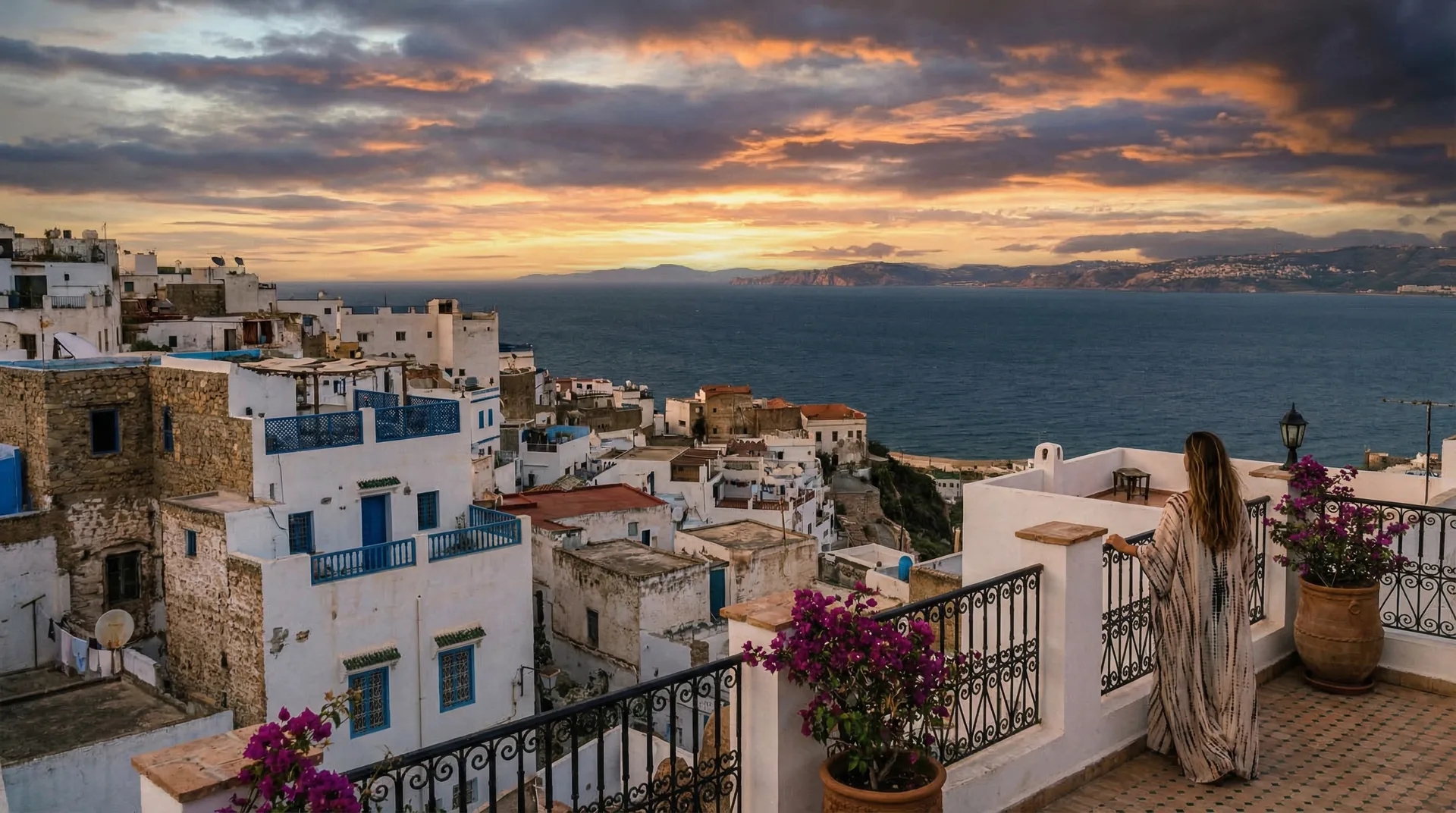
Tangier has gone from the faded, edgy gateway of decades past to one of Morocco's most rewarding cities — kasbah restored, seafront rebuilt, and its legend as a haven for expatriate writers and artists proudly reclaimed. Far up on the Strait, it makes the natural northern bookend to a trip that starts among the Marrakech souks.
In this guide
What are the top things to see in Tangier?
The Kasbah of Tangier — the hilltop citadel above the Strait of Gibraltar — is the city's most rewarding quarter. Wander the lanes in the late morning before the day-trip coaches arrive; the Musée de la Kasbah, set in the former sultan's palace (Dar el-Makhzen), holds a strong spread of Moroccan arts, crafts and antiquities and ranks among the country's better regional museums. From the kasbah terrace the view across the Strait is extraordinary — on a clear day the Spanish coast stands out just 14 km away, a reminder of how narrowly Europe and Africa miss touching.
The Grand Socco (officially Place du 9 Avril 1947) is Tangier's social hub — a big, slightly chaotic square linking the ville nouvelle to the medina gate, with a flower market on Monday and Thursday mornings. The American Legation museum in the medina is a fascinating detour: a historic consular building and the only US National Historic Landmark on foreign soil, holding documents and artworks tied to Morocco–US relations going back to 1777.
- Kasbah museum (Dar el-Makhzen) — Moroccan arts and antiquities inside the former sultan's palace.
- Kasbah terrace — sweeping views over the Strait of Gibraltar to the Spanish coast on clear days.
- Grand Socco — the main square; flower and produce market on Monday and Thursday.
- American Legation — the only US National Historic Landmark abroad, in the first US diplomatic building outside America.
- Cap Spartel — where the Atlantic meets the Mediterranean; 19th-century lighthouse; 14 km west of the city.
- Caves of Hercules — sea caves 18 km west of Tangier; the mouth famously echoes the silhouette of Africa.
What are the Caves of Hercules and Cap Spartel?
The Caves of Hercules, 18 km south-west of Tangier near Cap Spartel, are a major Atlantic sea-cave complex whose inner chamber served from the Neolithic through the Phoenician era as a place of worship, and later as a millstone-cutting site. The cave's opening to the Atlantic traces, in outline, the shape of Africa flipped upside-down — one of the region's more uncanny geographical coincidences. Legend credits the caves to Hercules, said to have rested here before tearing Africa from Europe as one of his labours.
Cap Spartel itself — the north-westernmost point of Africa — lies 5 km further along the same road. A 19th-century lighthouse crowns the cape, and from the headland the Atlantic and the Mediterranean meet in a single view on a clear day. The approach from Tangier runs along a wooded corniche above the Atlantic cliffs.
What is Tangier's literary and artistic history?
Tangier's spell as an International Zone between 1923 and 1956 — run jointly by eight European powers and the United States, outside Moroccan or French colonial control — made it shorthand for permissiveness, intrigue and creative licence. The American novelist Paul Bowles settled here from 1947 until his death in 1999, drawing a parade of Beat writers and artists: William Burroughs drafted parts of Naked Lunch in the city; Allen Ginsberg, Jack Kerouac, Truman Capote and Tennessee Williams all passed through. Francis Bacon visited repeatedly, and Henri Matisse produced some of his most important work over two stays in 1912 and 1913.
The American Legation museum records part of this story. Café Hafa — a legendary terraced café clinging to the cliffs above the Strait, open since 1921 — is where Bowles, the Rolling Stones and countless others sipped tea facing Spain. The Librairie des Colonnes on Boulevard Pasteur, the bookshop that published Bowles, Choukri and Mrabet, still trades and is worth a browse.
What day trips are possible from Tangier?
Asilah — 46 km south on the Atlantic coast — is a beautifully kept fortified town with 15th-century Portuguese walls, whitewashed medina lanes splashed with murals during its August art festival, and a fine cluster of fish restaurants along the ramparts. It is an easy half-day by grand taxi or private car, and the coast road down is a pleasant drive.
Chefchaouen is 2.5–3 hours by private car through the Rif Mountains — the usual northern approach to the blue city. Tetouan, a UNESCO-listed medina 40 km east, sees far fewer visitors than the imperial cities yet carries a Hispano-Moorish character found nowhere else in Morocco and rewards a half-day. Travellers tackling the country end to end often pair this northern cluster with a Marrakech-and-desert leg further south.
- Asilah — 46 km south; Portuguese walled town; Atlantic ramparts; excellent seafood.
- Chefchaouen — 2.5–3 hrs by car through the Rif; the standard approach from Tangier.
- Tetouan — 40 km east; UNESCO medina; Hispano-Moorish architecture; half-day trip.
- Hercules Caves and Cap Spartel — 18 km west; Atlantic cliffs; accessible by taxi or private car in a morning.
How do you get to Tangier and where do you arrive?
The Al Boraq high-speed train from Casablanca (2 hours) and Rabat (under 2 hours) is the most comfortable overland route, with Tangier Ville station a 10-minute taxi from the medina; from Marrakech, ride the standard ONCF service up to Casablanca and change onto Al Boraq. Tangier Ibn Battouta Airport (TNG) has direct links to European cities (Ryanair, EasyJet, Royal Air Maroc) and domestic flights to Casablanca. The Tangier Ville ferry terminal runs crossings to Tarifa and Algeciras in Spain (35 minutes by fast ferry); the Tangier Med port, 40 km east, handles cargo and some passenger ferries — confirm which terminal your ferry uses.
Frequently asked
Is Tangier worth visiting in Morocco?
Yes — for its kasbah, its rare dual-ocean geography, its literary heritage and the day trip out to Cap Spartel and the Caves of Hercules. Tangier is now one of Morocco's most modernised cities, a world away from the raw place it was 20 years ago. Two nights gives a good feel, and it works beautifully as the northern bookend to a trip that begins down in Marrakech.
How far is it from Tangier to Spain?
The Strait of Gibraltar at its narrowest point is approximately 14 km wide, putting Spain visible from Tangier's kasbah on a clear day. Fast ferry crossings to Tarifa take 35 minutes; to Algeciras approximately 1 hour. Tangier Med port (40 km east) is the main cargo and passenger terminal.
What is the Grand Socco in Tangier?
The Grand Socco (Place du 9 Avril 1947) is Tangier's main public square, joining the ville nouvelle to the medina gate (Bab Fahs). The Monday and Thursday flower and produce market sets up here, and it remains the city's chief point of social exchange. The streets around it pack in many of Tangier's cafés, banks and transport links.
When is the best time to visit Tangier?
Spring (March–May) and autumn (September–October) are the most comfortable — 17–24°C, reliable sun and the cleanest light for photographing the Strait. Summer is warm (25–30°C) and busy with Moroccan holidaymakers, but far milder than inland Marrakech in the same months, which makes the north a natural summer counterweight. Winter is mild yet can turn overcast and rainy, though the Strait views are often sharpest in crisp winter air.
How do you get from Tangier to Chefchaouen?
By private car or driver (2.5–3 hours through spectacular Rif Mountain roads) is the most comfortable option. CTM buses also connect the two cities in approximately 3 hours. There is no direct train — Chefchaouen has no rail connection.
Planning a trip?
Let a Marrakech atelier handle the details.
Tell us your dates and style and we'll send a written itinerary and a transparent quote within 24 hours.
Request an itineraryKeep reading
Planning
Things to Do in Chefchaouen: The Essential Guide
Chefchaouen — the blue city folded into the Rif Mountains — is far more than a photo backdrop. The medina is small, walkable and genuinely lovely; the surrounding peaks reward hikers; the food is distinctly Rifian; and the pace is the most unhurried in Morocco. It sits at the opposite end of the country from Marrakech, so most travellers reach it on a northern loop through Fes and Tangier.
Planning
Things to Do in Fes: The Essential Guide
Fes el-Bali is the largest living medieval city on earth — a UNESCO-listed medina of some 9,400 lanes, Marinid madrasas, the world's oldest university and the famous Chouara tanneries. Where Marrakech dazzles, Fes immerses: it asks for a good guide, unhurried days and real curiosity. Many travellers pair the two imperial cities on a single Moroccan loop.
Planning
Things to Do in Rabat: The Essential Guide
Rabat, Morocco's understated capital, trades the souk frenzy of Marrakech for UNESCO-listed monuments, a blue-and-white royal kasbah, Roman ruins and a calm, lived-in rhythm. It sits on the high-speed line that also feeds Marrakech, so it slots neatly into a wider loop built around the red city.
Itineraries
Morocco Itinerary: 7 Days
A week is plenty to pair our home city of Marrakech with the Sahara, or to trace the imperial cities of the north. Here are two proven 7-day Morocco itineraries, both designed to start or finish in Marrakech — and how to choose between them.