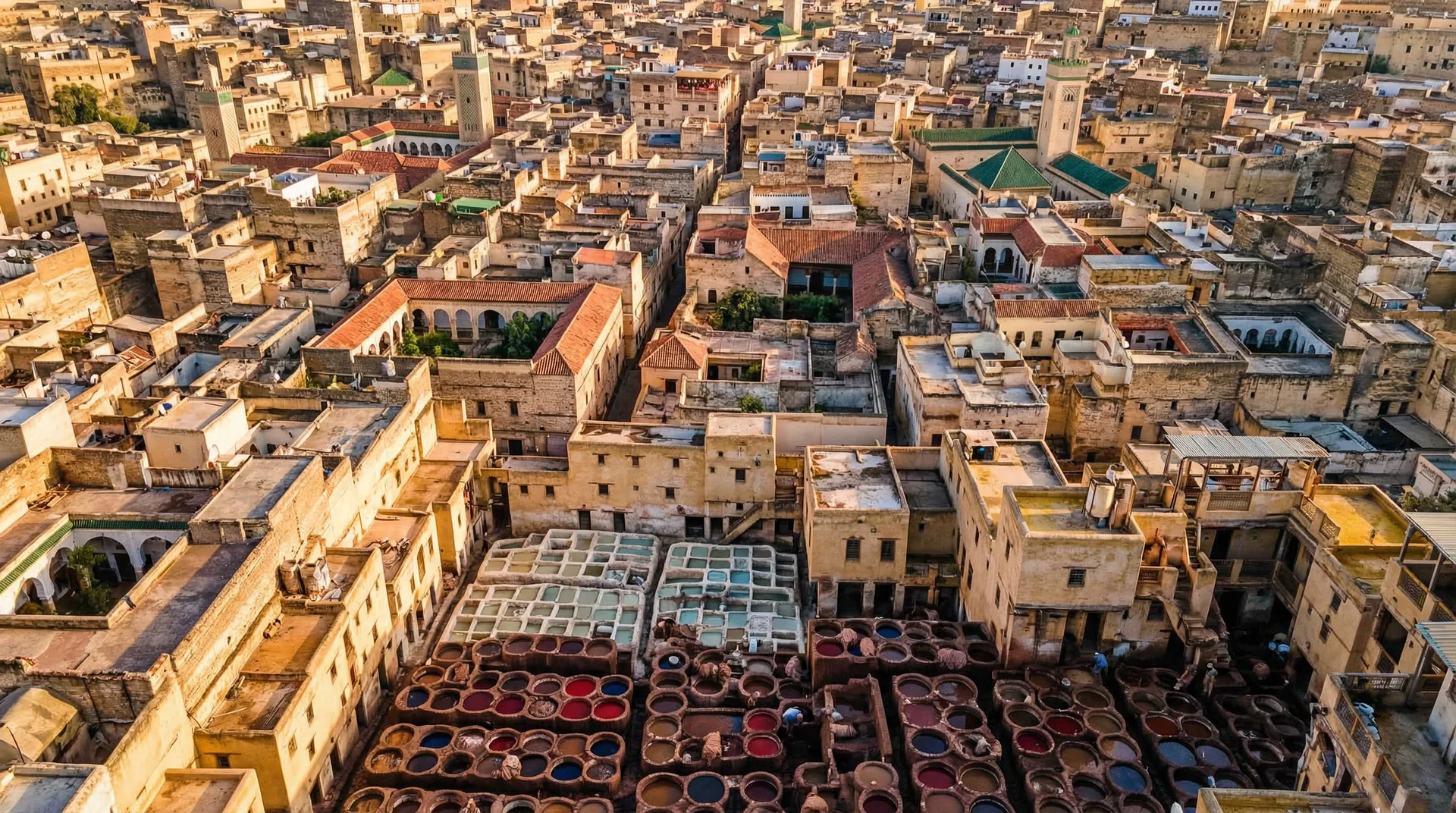
Most of our guests arrive with a Marrakech itinerary already taking shape and ask the same thing: is Fès worth the detour? It is. Fès el-Bali — the old walled medina, a UNESCO World Heritage site founded in 789 CE — is the most complete medieval city still in daily use anywhere on earth, and it makes the perfect cultural counterweight to the Red City's theatre. Whether you fly the short hop, take the train, or fold it into a longer loop, walking Fès for the first time is an act of surrender: you will get lost, and you will be glad of it.
Start with a licensed guide
Here is the one piece of advice we never soften: on day one in Fès, take a licensed guide. The medina folds something like 9,000 lanes into a hillside, a great many of them dead ends, and there is almost no signage — the city assumed you already lived here. A licensed guide, badge issued by the Ministry of Tourism, earns their fee three times over: they walk the circuit in a sensible order, they open the doors of family workshops and courtyards that stay shut to wanderers, and they soak up the touts so you can actually look up. Reckon on US$60–100 for the full day, which we fold into every Fès extension.
The Chouara tanneries
Chouara is the image you have already seen — the honeycomb of stone vats brimming with saffron, indigo and madder dye, worked the same way since the eleventh century. You take it in from the leather-shop terraces ringing the rim. Someone presses a sprig of mint into your hand for the ripe ammonia smell and walks you past the shelves; buying is genuinely optional, though Fès leather is the finest in Morocco and honestly priced this close to the source.
Come before 11:00 while the light is kind and the vats are full — by mid-afternoon the sun flattens the colour and the dyers down tools. A good guide times your arrival without you having to think about it.
The Qarawiyyin — older than any university in Europe
Fatima al-Fihri founded al-Qarawiyyin in 859 CE, and it carries a serious claim to being the oldest continuously running university on the planet — two centuries ahead of Oxford. Non-Muslims stop at the threshold of the mosque itself, but the carved cedar doors framing the lane and the slice of courtyard fountain glimpsed through the iron grilles are among the loveliest sights in the country. Stand still for a minute and let the tilework geometry do its work; the Marrakech madrasas will feel familiar afterwards, but this is the source.
A few steps on, the restored Nejjarine fountain and caravanserai shelter a fine woodwork museum. Climb to its rooftop terrace for a quarter of an hour — the aerial sweep across the medina rooftops is the photograph no street-level shot can give you.
Getting gloriously lost
Once the guided morning is done, ask to be dropped at the edge of the Andalusian quarter — the quieter half of the medina across the Oued Fès — and give yourself two unscheduled hours. Over here the crowds thin, the vendors soften, and neighbourhood bakeries fill with locals queueing with trays of unbaked dough headed for the communal oven, baked for a handful of dirhams. None of it shows up on a routing app.
When you are ready to surface, any passer-by will point you to Bab Rcif or Bab Guissa in seconds. Getting lost in Fès is part of the deal; getting genuinely stranded is more or less impossible.
Where to sleep, what to eat
Sleep inside the walls, in a riad — the jolt between the cramped lane outside and the light pooling in the courtyard within is the whole point of Fès. We keep a short list of riads restored slowly and properly rather than flipped for the calendar; ask for it when you plan a Fès extension.
Fès is also the kitchen Morocco measures itself against. Pastilla — that flaky dome of pigeon or chicken, almonds and a dusting of icing sugar — is a Fassi invention; order it as a starter on a rooftop above the Bou Inania madrasa. For lunch, let your guide steer you to a back-street place where the set menu — harira, a main, mint tea — lands under 80 MAD. Give the tourist terraces on Rcif Square a miss; it is the same plate at triple the price.
When to make the trip
March through May and September through November are the windows to aim for — 18 to 26 °C, clean light and fewer coach groups than high summer. July and August push past 40 °C with barely a strip of shade in the lanes. Winter, December to February, runs cold and now and then wet, but it is the medina at its most atmospheric and emptiest, woodsmoke curling from the hammam chimneys.
If your dates flex, line Fès up for the cooler shoulder of the trip and save the hottest nights for the higher-altitude south around Marrakech and the Atlas.
Frequently asked
Is Fès worth visiting as an extension from Marrakech?
Very much so. Fès el-Bali is a different Morocco from the Red City — older, denser, more scholarly and far less geared to tourism. From a Marrakech base it works as either a fast train day-and-overnight (the ONCF Al Boraq/standard line runs Marrakech–Fès in roughly seven hours, so most guests fly the short hop or stay two nights) or a two-night medina immersion. We usually frame it as the cultural counterweight to a Marrakech week.
Do you need a guide for the Fès medina?
On a first visit, yes. Fès el-Bali holds something like 9,000 lanes and almost no through-streets — the city was laid out for residents who already knew the way. A licensed guide carries an official Ministry of Tourism badge, threads the tanneries, the Qarawiyyin quarter and the artisan derbs in a sensible loop, and shoulders the attention of unofficial touts. Without one, most first-timers burn their opening two hours simply trying to orient.
How much does a licensed Fès guide cost?
Budget US$60–100 for a full day with a licensed private guide, depending on how much workshop access they arrange; half-days run US$40–60. Steer clear of the self-described 'students' who fall into step beside you in the lanes — their income comes from shop commissions, not from your fee.
Can you see the Chouara tanneries without paying?
The classic view of the Chouara vats comes from the terraces of the leather shops ringing them. You will be waved up, handed a sprig of mint for the smell, and shown the wares — buying is optional, though declining a glass of tea graciously is perfectly fine. A few shops near Sidi Moussa offer rooftop views with no pressure at all.
Is Fès safe for solo travellers?
Yes. The medina is calm and safe by day. The main friction is the steady stream of unsolicited 'guidance' — a warm but firm 'la shukran, my guide is meeting me' usually ends it. Keep a bag worn to the front in the tightest, busiest lanes, exactly as you would in the Marrakech souks.
When is the best time to make the Fès trip?
March to May and September to November are the sweet spots — mild air, clean light and thinner coach traffic. Fès bakes in June through August, regularly near 40 °C, and its shadeless lanes are punishing. Winter turns cold and sometimes wet, but the medina is at its emptiest and most atmospheric, woodsmoke rising from the hammam flues.
Add Fès to your Marrakech week?
We'll line up the licensed guide and the right riad.
Every Marrakech Tours Fès extension pairs a guided medina day with a riad we have chosen for the quality of its restoration, plus the back-street restaurant list we actually eat from — slotted neatly around your Marrakech itinerary.
Add a Fès extension