Seven days is the sweet spot for a first trip — long enough to feel the full sweep of the country, short enough to dodge the burnout of trying to see all of it. The loop below, which we begin and base from Marrakech, is one we've sharpened over hundreds of private journeys: imperial cities, mountain passes, desert edge and canyon roads, with no wasted hours in between.
Day 1 — Land in Marrakech: settle in, slow down
Most flights touch down in the afternoon. Don't sprint into the medina the moment you drop your bags — jet lag plus sensory overload is a rough mix. Let the riad fold you in: a glass of mint tea, the roof terrace at sunset, dinner in the courtyard. This first evening sets the pace for the whole week. If you're staying deep in the medina, your driver-guide parks at the edge and walks you through the derb to the door — part of the Marrakech arrival ritual.
Day 2 — Marrakech: the medina at its own pace
Begin early, before the heat climbs and Jemaa el-Fna thickens with grill smoke. The souks at 9 am are another world: traders laying out their stalls, light dropping through the reed slats, nobody pushing you to buy. Give the Ben Youssef Medersa a slow hour. Lunch inside the walls at a small Berber café, not the tourist tables ringing the square. The afternoon is open — the silver workshops of the Mellah, the northern tanneries, or, in all honesty, a hammam and a nap before dinner.
Day 3 — Over the Tizi n'Tichka to Ouarzazate
Roll out of Marrakech by 8 am to clear the pass before the midday heat. The Tizi n'Tichka (2,260 m) is Morocco's highest paved road and one of its most theatrical — red rock walls, Berber hamlets gripping the ledges, argan groves thinning to bare scree. Break at Aït Ben Haddou for lunch and an hour walking the ksar; the harsh noon light suits its mud towers. Push on to Ouarzazate for the night — the country's film-studio capital lives up to its odd reputation — and dine on a rooftop over the kasbah walls.
Day 4 — The Road of a Thousand Kasbahs to Dades Gorge
The N10 east of Ouarzazate is one of Africa's great drives. Pull over at Skoura to wander the palmery and step inside Kasbah Amerhidil. The kasbahs come thicker as the road sinks into the pre-Saharan plain — and in April and May, the rose harvest around Kelaa M'Gouna scents the whole valley. Reach Dades Gorge by late afternoon, when the canyon walls flush blood-red. Settle into a small lodge above the gorge floor and eat simply and well: tagine, salad, a drizzle of home-pressed argan oil.
Day 5 — Todra Canyon and on to Merzouga
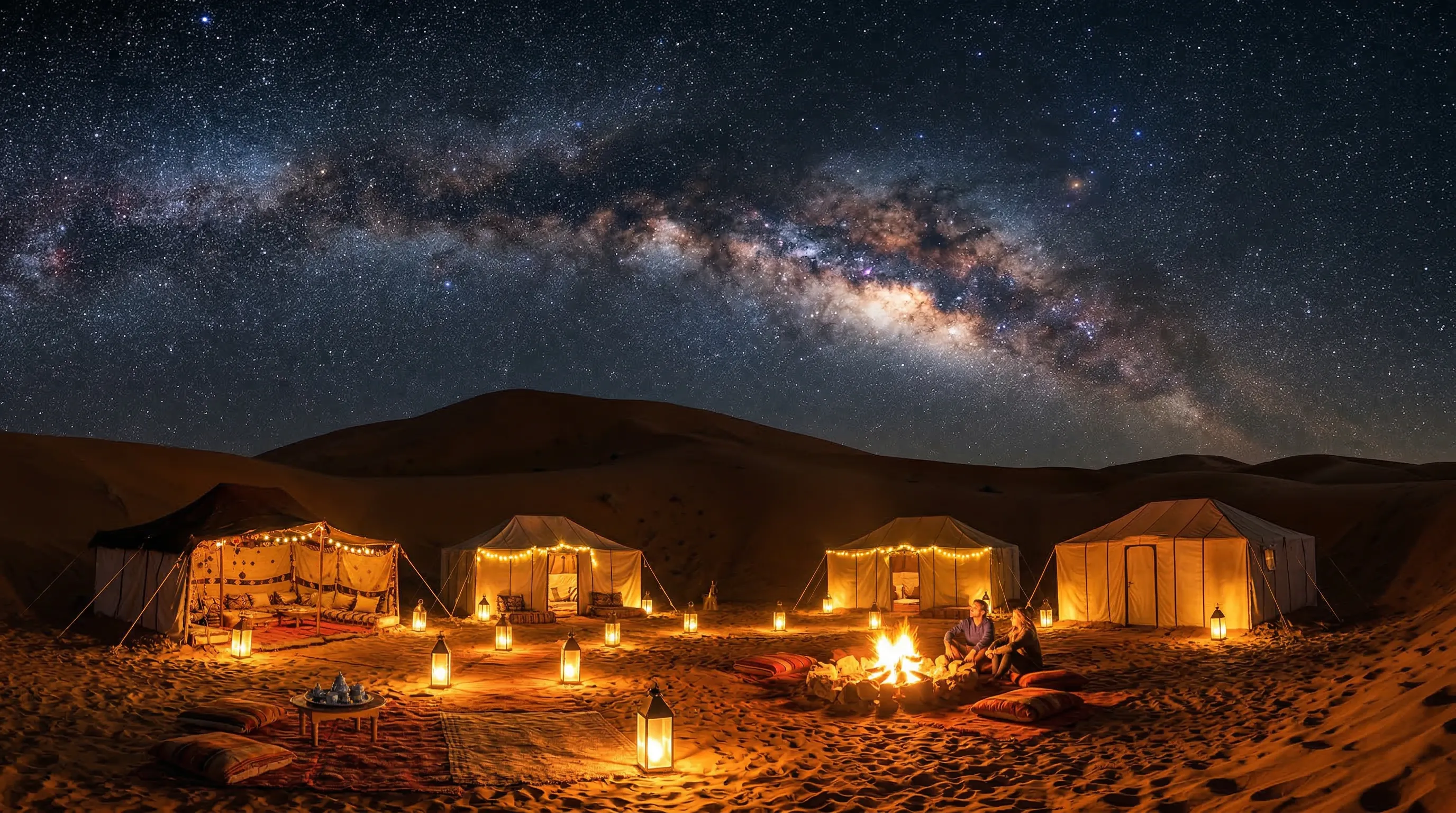
An early run north from Dades puts you in the Todra Gorge by 9 am — a slot canyon with 300-metre walls that pinches to eight metres at its narrowest, and the morning light is the best of the day. Walk the canyon floor for half an hour before the coaches arrive. Then it's south and east across the stony hammada to Merzouga and the great wall of Erg Chebbi. Make camp before sunset. The camel ride in is optional — plenty of guests take a 4x4 instead — but the dinner under that unpolluted sky is the whole reason you drove all this way.
Day 6 — Sahara sunrise, then the long road to Fès
Wake before dawn — 5:30 am feels cruel right up until the dunes catch fire amber. Coffee in camp, then back to the vehicle for the long haul north: Erfoud, Rich, up through the Middle Atlas cedar forests, into Fès by early evening. It's five to six hours with stops — a driving day, yes, but the run past Azrou and the alpine oddity of Ifrane keeps you looking out the window. Check into a riad inside Fès el-Bali, the largest car-free quarter on earth, then dinner at a Fassi table.
Day 7 — Fès el-Bali: tanneries, medersa, farewell
Fès deserves a slow final day. The Bou Inania Medersa shows off some of the finest stucco and zellige in the country. See the Chouara tanneries from the leather-shop terraces above, and go before 11 am while the dye vats are working. The Andalusian quarter across the river stays quiet and almost untouristed. Lunch at a neighbourhood spot, then transfer to the airport for your evening flight — seven days, one country, a notebook full of memories.
Frequently asked
Is seven days enough to see Morocco?
It's plenty for a rich first visit, provided you keep the loop disciplined: start in Marrakech, then the High Atlas, Aït Ben Haddou, Dades Gorge, the Sahara edge at Merzouga, and finish in Fès. Bolting on the north — Chefchaouen, Tangier — in the same week just leaves you frazzled and rushing. Marrakech makes the natural starting block.
When is the best time of year to run this loop?
March to May and September to November strike the best balance of comfortable temperatures and clear skies. In July and August the Sahara and the desert valleys can hit 40 °C, which turns a sunrise camel ride into an ordeal. December to February is lovely in Marrakech and the cities, though the High Atlas passes occasionally close after snow.
Should we fly into Marrakech or Casablanca?
For the loop below, flying into Marrakech and out of Fès (or the reverse) is cleanest — no doubling back. Both airports connect directly to most European hubs. If you'd rather start and end in Marrakech, a one-hour internal flight from Fès closes the circle neatly.
How much does a private 7-day tour from Marrakech cost?
Fully private — driver-guide, comfortable riads, most meals and every transfer — usually runs US$2,500–4,500 per person depending on group size and riad category. Bigger groups bring the per-head figure down sharply. We quote exact numbers once we understand how you like to travel.
Can we drive this loop ourselves without a guide?
You can — the roads are sealed, the navigation apps work, and most riads speak English. But a private driver-guide out of Marrakech unlocks local knowledge, deals with medina parking, handles the souk haggle, and reroutes around closures over the Atlas passes. For a first trip, most of our guests say it changes everything.
What should we pack for the week?
Pack light layers whatever the season: High Atlas mornings stay cool even in summer, while the desert afternoons roast. Sturdy walking shoes are non-negotiable — Marrakech's medina cobbles eat suitcase wheels alive. A light scarf covers shoulders at religious sites and keeps the desert dust off. Bring a small daypack and leave the roller bag at your riad.
Ready to plan?
We'll shape this loop around you, starting in Marrakech.
Every Marrakech Tours journey is private and made to measure — we tune the pace, the riad category and the detours to your group. Send us your dates and we'll come back with a tailored proposal within 24 hours.