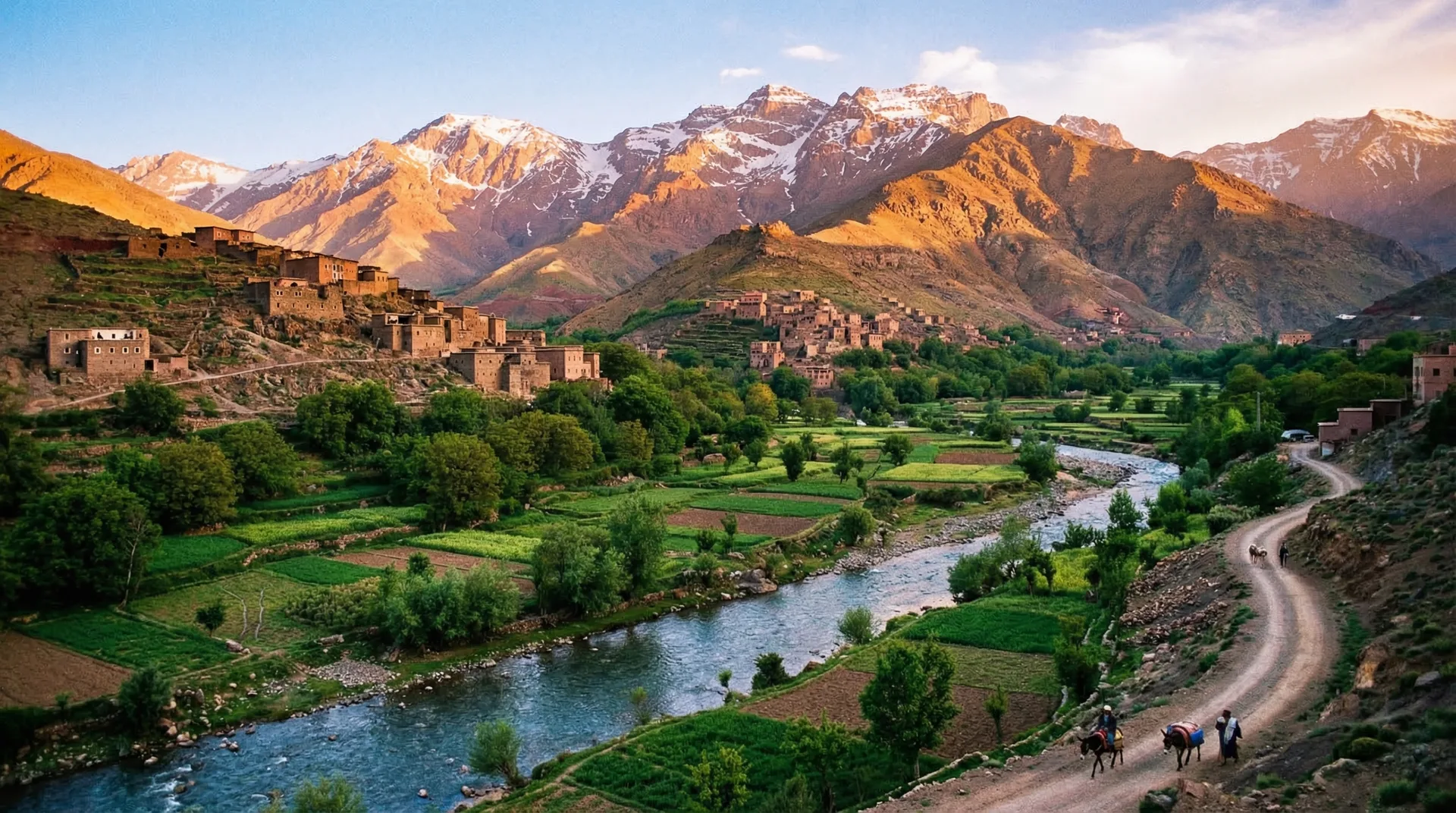
For most first-timers, three to four days in Marrakech is the right amount — roughly two days for the medina, souks, Jemaa el-Fna and the palaces and gardens, and one or two days for a trip out of the city. Of the surrounding day trips, the High Atlas Mountains (Imlil and the Ourika valley) are the closest and the one most people are happiest they did; the Agafay stone desert is the easiest taste of wilderness at under an hour away; Essaouira and the Ouzoud waterfalls are longer, two-and-a-half to three-hour outings best for travellers with a little more time.
So how many days do you need in Marrakech?
The city itself is compact and intense rather than vast, so it does not take long to get the measure of it — but it rewards a slower pace than people expect. We suggest a simple rule of thumb: two days for the city, plus one day per trip out.
- 2 days — enough to see the headline sights, but you will be choosing what to skip and you will leave a little frazzled.
- 3–4 days — the comfortable sweet spot: the medina and gardens at a human pace, plus one or two day trips into the region.
- 5–7 days — slow mornings, a couple of day trips, and room to add an overnight to the Sahara or the coast without rushing.
If you want the day-by-day version, we set one out in Marrakech in three days, and weigh up trip length in more detail in how many days in Marrakech.
What should you actually see in the city?
Spend your first day in the medina: the souks, the Koutoubia minaret as your compass, the Bahia and El Badi palaces, and Jemaa el-Fna as it turns from market to open-air food court at dusk. Give the second day to the calmer side of the city — the Jardin Majorelle and Yves Saint Laurent museum, Le Jardin Secret, a hammam, and time simply to sit. That two-day core is what frees up your remaining days for the region, where Marrakech's real range opens up.
Which day trips are worth it — and how far is each?
Here is the honest at-a-glance version. Drive times are one-way and approximate; traffic leaving the city, road works and photo stops all move them around.
| Day trip | Approx. drive (one way) | What it is | Best for |
|---|---|---|---|
| High Atlas (Imlil / Ourika) | ~1–1.5h | Berber villages, valleys, peaks | Your one day, if you only have one |
| Agafay desert | ~40min–1h | Rocky "stone desert", Atlas views | Sunset, dinner or a camp night |
| Ouzoud waterfalls | ~2.5–3h | 110 m falls, pools, monkeys | Nature lovers with a full day |
| Essaouira | ~2.5–3h | Atlantic ramparts, port, medina | A change of pace by the sea |
The High Atlas (Imlil & Ourika) — the closest big landscape
About an hour to ninety minutes south of the city, the High Atlas is the fastest way to swap the heat and noise of Marrakech for something completely different: terraced valleys, walnut and cherry groves, Berber villages clinging to the slopes, and snow on the peaks for much of the year. Imlil is the gateway for short walks beneath Mount Toubkal; the Ourika valley is gentler, with riverside cafés and waterfalls. If you only have one free day, this is the one we point most people to. We go deeper in our High Atlas day trip guide.
Agafay — the desert without the long drive
Agafay is the closest of all the trips, under an hour from the city, and the answer for travellers who want a desert feeling but cannot spare the two to three days a real Sahara trip demands. It is a rocky, lunar-looking "stone desert" rather than sand dunes, with the Atlas as a backdrop — at its best for a sunset, an open-air dinner, or an overnight in a camp. If golden dunes are the whole point for you, that is a different journey altogether; we compare them in Merzouga vs Zagora.
Ouzoud waterfalls — for a full nature day
The Ouzoud waterfalls drop around 110 metres in a series of cascades, with pools, olive groves and resident Barbary macaques along the path down. At roughly two and a half to three hours each way it is a committed full-day outing, so it suits people who genuinely love waterfalls and walking over those wanting a quick half-day.
Essaouira — the coast as a counterpoint
Essaouira is the laid-back, wind-blown opposite of Marrakech: blue-shuttered ramparts, a working fishing port and a relaxed, walkable medina, about two and a half to three hours west on a good road through argan country. It works as a long day trip, but it genuinely rewards an overnight, when the day-trippers leave and the evening light arrives. Our Essaouira weekend guide makes the case for staying.
When should you go?
Spring (March–May) and autumn (September–November) are the most forgiving all round — warm days, cool evenings, comfortable both in the city and the mountains. Summer is genuinely hot in Marrakech, which is exactly when the cooler Atlas valleys and breezy Essaouira earn their place. Winter brings sunny, crisp days in the city and snow on the High Atlas peaks above Imlil. For the month-by-month detail, see the best time to visit Marrakech.
How we would put it together
For a typical four-day trip we would spend two days on the city, give one day to the High Atlas, and use the fourth either for a sunset in Agafay or a longer run to Essaouira, depending on whether you are after mountains or sea. With a week, the same shape holds with an overnight added to the coast or the Sahara. If you would rather not juggle drivers and timings, our team runs all of these from Marrakech as private days out — see our private tours or tell us your dates and we will build the days around you.
Frequently asked
How many days do you really need in Marrakech?
For the city itself, three to four days is the sweet spot: two unhurried days for the medina, souks, Jemaa el-Fna and the palaces and gardens, plus one or two days to step out into the surrounding region. Two days is enough only if you accept you will skip things; a week lets you slow right down and add an overnight to the Sahara without rushing.
Which day trip from Marrakech is the best one to choose if I only have time for one?
If you only have a single free day, the High Atlas (Imlil and the Ourika valley) is the one most first-timers are gladest they did — it is the closest real landscape change, roughly an hour to ninety minutes out, with Berber villages, walnut groves and snow on the peaks much of the year. If your one day is more about atmosphere than mountains, Essaouira's breezy Atlantic ramparts are the other strong pick, though it is a longer drive.
How far is each day trip from Marrakech?
Approximate one-way drive times: the Ourika valley and Imlil in the High Atlas are about 1 to 1.5 hours; the Agafay 'stone desert' is the closest of all at roughly 40 minutes to an hour; the Ouzoud waterfalls are about 2.5 to 3 hours; and Essaouira on the coast is about 2.5 to 3 hours. Times vary with traffic out of the city, road works and how many photo stops you make.
Is the Agafay desert worth it, or should I go to the real Sahara?
Agafay is a rocky, lunar-looking desert about an hour from Marrakech — not sand dunes, but a genuine wilderness feel with Atlas views, and it works beautifully for a sunset, dinner or overnight camp when you cannot spare the two to three days a real Sahara trip needs. If big golden dunes are non-negotiable, you want Merzouga or Zagora, which are full multi-day expeditions, not a day trip.
Can you do Essaouira as a day trip from Marrakech, or should you stay overnight?
You can do Essaouira in a long day — it is about 2.5 to 3 hours each way — and many people do, fitting in the ramparts, the fishing port and the medina. But the town rewards an overnight: it is at its best in the soft evening light once the day-trippers leave, and a night there turns a rushed visit into a proper coastal break.
When is the best time of year to visit Marrakech and do these day trips?
Spring (March to May) and autumn (September to November) are the most comfortable, with warm days and mild evenings ideal for both the city and the mountains. Summer is very hot in Marrakech, which is when the cooler Atlas valleys and breezy Essaouira come into their own; winter brings sunny, crisp days in the city and snow on the High Atlas peaks above Imlil.
Marrakech and its region, planned for you
Tell us your days — we will fit the city and the best trips around them.
Two days in the medina, a morning in the Atlas, a sunset in Agafay or a day on the coast at Essaouira — with an English-speaking driver and no schedules to wrangle. Send us your dates and we will shape the route.
Request an itinerary