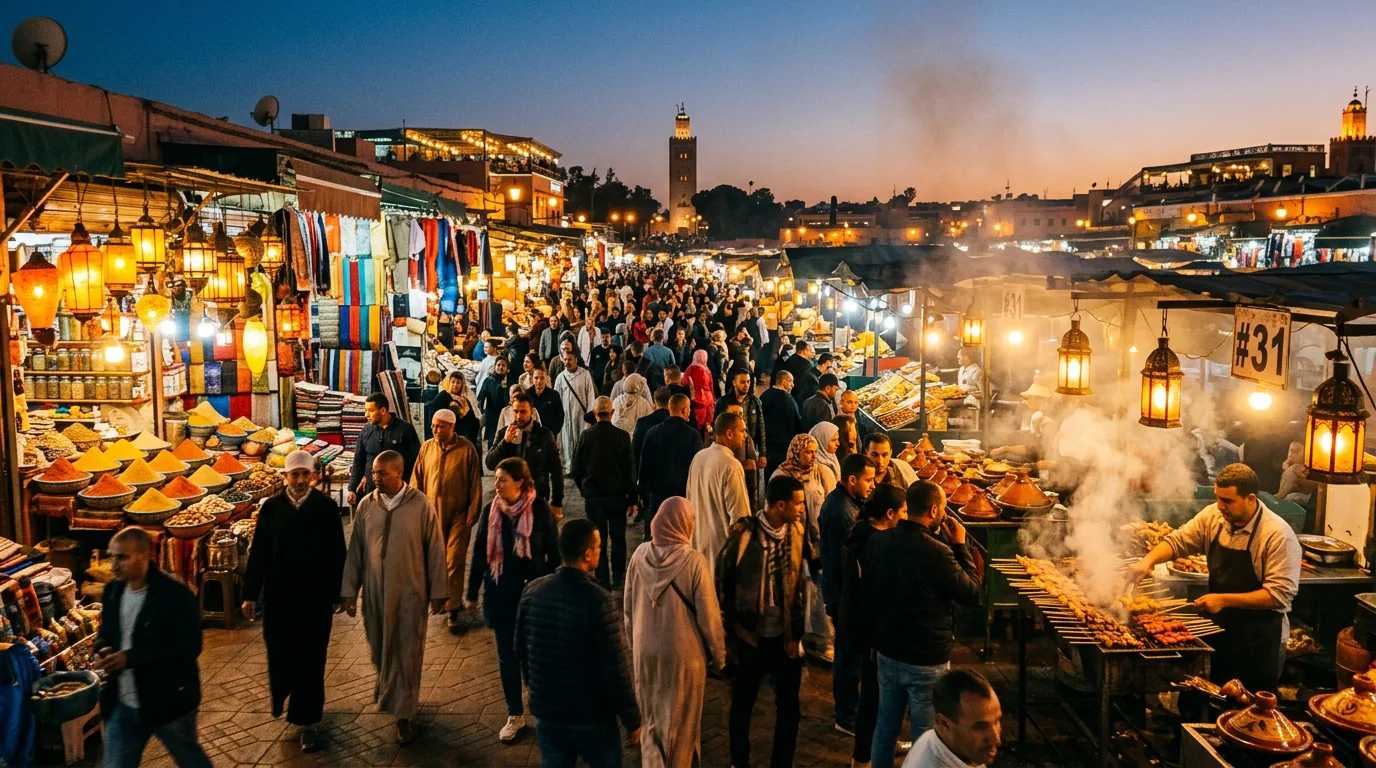
Marrakech has a reputation as a place that empties your wallet, and it can — the riad spas, the rooftop restaurants and the headline monuments all add up. But the truth most guidebooks underplay is that the city's greatest pleasures are free. The medina itself is the attraction: a maze you wander, a square you sit in, a call to prayer you hear roll across the rooftops at dusk. You can have a rich few days here and spend very little. Here is how.
Jemaa el-Fna — the free show
The great square at the heart of the medina is the best free thing to do in Marrakech, and it is at its most extraordinary after dark. As the light goes, the food stalls roll in and the open space fills with storytellers, Gnaoua musicians, acrobats and the smoke of a hundred grills. You pay nothing to walk through it and soak up the spectacle. What costs is the juice, the food and the photographs — the henna women and the performers will expect a few dirhams if you stop or point a camera, so decide before you do, and carry small change.
By day the same square is quieter — orange-juice carts, snake charmers, water sellers in their fringed hats — and just as free to drift across. See our full Marrakech destination guide.
Wandering the souks and the medina
Browsing the souks costs nothing, and getting pleasantly lost in them is half the point of Marrakech. The labyrinth north of Jemaa el-Fna is loosely grouped by trade — dyers, metalworkers, leather, slippers, lanterns, spices — and you are free to watch the artisans work without buying a thing. Rahba Kedima, the old spice and apothecary square, is a fine place to stand and take in the pyramids of cumin, saffron and dried roses. Just be ready to bargain hard if you do decide to buy. Our guide to haggling will save you more than the entry fee to any monument.
The Koutoubia, the gardens and the gates
The Koutoubia minaret — the city's tallest and most famous landmark — cannot be entered by non-Muslims, but its exterior is free to admire, and the rose gardens and esplanade laid out beside it are a free, calm place to sit away from the souk crush. The old Mellah, the historic Jewish quarter near Place des Ferblantiers, is free to wander and rewards a slow walk.
The city ramparts — kilometres of pisé walls in that distinctive pinkish-red — and the monumental gates such as Bab Agnaou cost nothing to walk up to and photograph. And the Cyber Parc (Arsat Moulay Abdeslam), off Avenue Mohammed V, is a free, well-kept public garden — shade, fountains and paths — and a genuine break from the heat and the hustle.
Eating cheaply — and well
You can eat very cheaply in Marrakech without eating badly. The food stalls of Jemaa el-Fna are the obvious budget option — grilled meats, snail soup, harira — though their terraces lean towards tourists, so the further you push into the working medina the more your money buys. A msemen (flaky griddle bread) or harcha (semolina flatbread) eaten warm off a cart is a few coins. Fresh orange juice from the square is one of the city's small joys.
Look for hole-in-the-wall sandwich and tagine spots where workers eat, a bowl of bessara (broad-bean soup) on a winter morning, and the universal glass of sweet mint tea that rents you a table for as long as you like. Prices are modest but they vary by season and spot — treat any figure as a guide and check on the day. Our Marrakech food guide goes deeper on where locals actually eat.
Getting around for next to nothing
The medina is compact and largely car-free, so the cheapest transport is your own two feet — and walking is also the only way to really see it. For longer hops, the small beige petits taxis are the budget option: insist on the meter (le compteur), or agree the fare before you climb in. They are allowed to take on other passengers and split the fare, so sharing costs even less. Keep small notes handy, as change is a perennial headache, and expect fares to run a little higher after dark. See our full guide to getting around Marrakech.
Sleeping cheaply in the medina
The budget beds are inside the walls: simple guesthouses and hostels tucked down the derbs, many of them converted riads with a courtyard below and a rooftop above. Staying in the medina also saves on transport, since you can walk to almost everything worth seeing. Rates swing widely with season and location, so compare and book ahead in the busy months rather than counting on a fixed price. Our neighbourhood guide helps you pick the right base.
Where the real costs are — and money-saving tips
Honesty matters here: plenty of Marrakech's headline sights do charge. The Bahia Palace, the Saadian Tombs, the Ben Youssef Medersa and Le Jardin Majorelle all carry an entry fee, and the fees move over time — so rather than trying to pay into everything, pick the two or three you most want to see and budget for those. Much of the rest of the city you can have for free.
The practical rules: carry cash in small denominations, because much of the medina takes no cards and nobody ever has change; haggle, because the first price is an opening bid; walk the medina rather than taxi short hops; eat where locals queue, not where the menu is translated into five languages; and steer clear of the tourist-trap cafés ringing the square with their inflated terrace prices. Do that, and Marrakech becomes one of the better-value cities you can visit.
Frequently asked
Is Jemaa el-Fna free to visit?
Yes — the square itself costs nothing, and it is the single best free thing to do in Marrakech. By day it is orange-juice carts and snake charmers; after dark it transforms into an open-air theatre of food stalls, storytellers, musicians and acrobats. Wandering it is free; what costs money is the juice, the food and the photo with a performer, so carry small change and agree any price first. Performers and the henna women will expect a few dirhams if you stop, watch closely or photograph them.
What can you do in Marrakech for free?
A surprising amount. Jemaa el-Fna by night, wandering the souks and the medina lanes, the exterior of the Koutoubia mosque with its esplanade and rose gardens, Rahba Kedima (the spice and apothecary square), the old Mellah quarter, the city ramparts and gates such as Bab Agnaou, and the Cyber Parc — a free public garden off Avenue Mohammed V. None of these have an entry fee. Note that many of the big-ticket monuments (the Bahia Palace, the Saadian Tombs, the Ben Youssef Medersa, Le Jardin Majorelle) do charge admission, so a free-leaning day means leaning on the streets, squares and gardens rather than the palaces.
How much does street food cost in Marrakech?
Eating cheaply is easy if you eat where locals eat. A msemen or harcha flatbread off a griddle, a freshly squeezed orange juice on the square, a bowl of snail soup, a bessara (broad-bean soup) or a hole-in-the-wall sandwich or tagine all run to modest sums rather than restaurant prices — but figures shift with season, location and the moment, so treat any number as a guide and check on the day. The rule of thumb: the further you get from Jemaa el-Fna's tourist-facing terraces and into the working medina, the cheaper and often the better the food.
Are petits taxis cheap in Marrakech?
They are the budget way to cross the city — small, beige metered cars for up to three passengers. The key is to insist on the meter (le compteur); if a driver refuses, agree the fare before you get in or wave the next one down. Petits taxis are also legally allowed to pick up other passengers along the route and split the fare, so a shared ride costs even less. Keep small notes ready, as change is a perennial problem. Fares run a little higher after dark.
Where can you stay cheaply in Marrakech?
The medina is where the budget beds are: simple guesthouses and hostels tucked into the derbs, many in converted riads with a courtyard and a rooftop. Rates vary widely with season, location and how far down a lane you are willing to walk, so compare and book ahead in peak months rather than relying on a fixed figure. A bed inside the walls puts you within walking distance of nearly everything worth seeing, which itself saves on transport.
What are the best money-saving tips for Marrakech?
Carry cash in small denominations — much of the medina does not take cards, and change is scarce. Haggle in the souks; the first price is an opening bid, not a fixed one. Walk the medina, which is compact and largely car-free, rather than taking taxis for short hops. Eat where locals queue, not where menus are translated into five languages. Insist on the taxi meter. And accept that some monuments charge a modest fee — budget for the two or three you most want to see rather than trying to pay into all of them.
Spend on what matters
A well-planned day costs less and shows you more.
Marrakech Tours shapes private itineraries to your budget — free-leaning medina walks, the monuments worth the fee, and the cheap eats locals love.
Plan a budget-aware trip