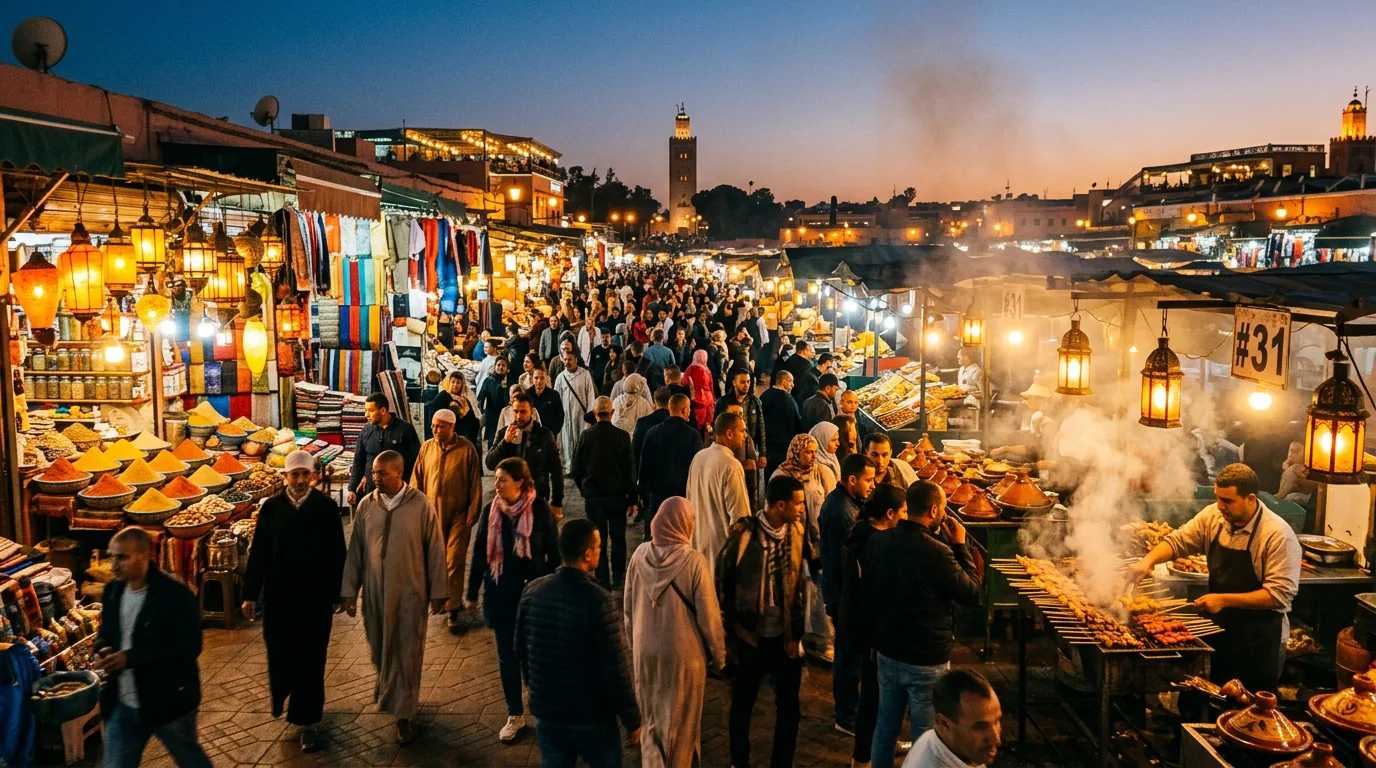
Marrakech moves at two speeds. Inside the old walled medina you walk, weaving through a maze of derbs where cars can't follow; out in the new town and beyond the ramparts you ride — petits taxis for quick hops, a pre-booked transfer to the airport, a calèche for a scenic loop, or a private car for the day trips that lure most people here. None of it is complicated once you know the rules, but a few of those rules are worth learning before you arrive. Here's an honest, practical guide to getting around the city.
Walking the medina — a beautiful maze
The medina is largely walkable, and walking is the whole point — the souks, Jemaa el-Fna, the palaces and most of the riads are all on foot within the old walls. It is also a genuine labyrinth. The derbs twist, double back and rarely run straight, and even seasoned visitors get lost. That's part of the charm, but plan for it: download an offline map before you go, drop a pin on your riad, and note the nearest medina gate (bab) so a taxi can get you close.
One thing to be ready for: if you look lost near a junction, someone — sometimes a child — may offer to lead you and then expect a tip, or steer you toward a shop. Unofficial "guides" are common around the busy lanes. A polite, firm "la, shukran" (no, thank you) and walking on with confidence is the usual answer; if you do want guiding, arrange a licensed guide through your riad or with us. For where each neighbourhood sits and how walkable it is, see our guide to where to stay in Marrakech.
Petits taxis — the meter and the fare
For anything beyond walking distance, the workhorse is the petit taxi — the small beige or khaki cabs that buzz around the city. They're cheap and everywhere, but you need to handle the fare up front. By law they should run the meter, so ask for the compteur as you get in; if the driver declines, agree a price out loud before you set off rather than negotiating at the destination. Carry small change, expect a modest, legitimate surcharge late at night, and don't be surprised if the driver picks up other passengers heading your way — shared petits taxis are normal here.
Remember petits taxis are limited to short, in-city hops and can't legally leave the urban area, so they're for getting around town, not out of it. There is no official Uber in Marrakech, and while some informal ride apps exist, they sit in a legal grey area — we'd be cautious and stick to metered taxis or a booked driver.
Calèches — the scenic green carriages
The green horse-drawn calèches lined up near Jemaa el-Fna are a leisurely, old-fashioned way to loop the ramparts, the Menara gardens or the palm groves — a sightseeing ride rather than real transport. There are official posted tariffs for set routes and for hourly hire, so look for the displayed rates and confirm the route and price with the driver before you climb aboard. If the welfare of the horse matters to you, take a moment to look at its condition first, and feel free to walk away.
Buses — city lines and the tourist loop
Marrakech has a city bus network (run by Alsa) that's very cheap and covers the main corridors between the medina, Guéliz and the outer districts — useful if you're on a budget and not in a hurry, though routes and crowding take a little patience to learn. There's also a hop-on, hop-off tourist bus that loops the headline sights and out toward the palmeraie, which some visitors find a relaxed way to orient themselves on a first day. For most short trips, though, a petit taxi is faster and barely more expensive.
From Menara Airport into town
Marrakech Menara Airport is only about 6 km from the centre, so the ride in is short. The smoothest option is a private transfer arranged ahead through your riad, hotel or operator: a fixed price, a name board on arrival and a driver who knows which gate is nearest your accommodation — which matters when cars stop at the medina walls and you walk (or a porter carts your bags) the rest of the way. Petits taxis serve the airport too, usually at a set airport rate rather than the meter, so agree it before you go. A city bus link also runs into town, but with luggage and narrow lanes, a transfer is usually worth it. See our private transfer and tour options if you'd like us to handle it.
Day trips and reaching other cities
Most visitors use Marrakech as a base for day trips — the High Atlas, Essaouira, the Ouzoud falls, Aït Ben Haddou or the desert. For these, a private transfer or guided tour with its own vehicle is the most flexible and comfortable choice, since the driving, timing and stops are taken care of. The local alternative is the grand taxi — older, often cream Mercedes that run shared between towns on fixed routes; agree the terms first and know they generally leave once full, or you can pay to charter the whole car. For longer hauls, comfortable intercity coaches (CTM, Supratours) are bookable in advance.
If you'd rather not piece the logistics together yourself, our Atlas Mountains day-trip guide shows how a typical excursion is run, and we can build the transport into a wider itinerary.
Scams, tips and staying safe
Marrakech is generally safe for visitors, and most hassle is commercial rather than threatening. The recurring tactics are predictable: a taxi without the meter, an unofficial "guide" who attaches himself to you, someone insisting a route or attraction is "closed" to redirect you to a shop, or a child offering directions for a tip. The defences are simple — agree fares before you ride, carry small change, keep your offline map handy, decline guiding you didn't ask for, and stay aware of your bag in crowds around Jemaa el-Fna. Note that posing with the square's snake charmers, monkeys or henna artists is expected to come with payment, so settle that before, not after. Our honest look at safety in Morocco goes into more detail.
Frequently asked
Can you walk around Marrakech?
Yes — the medina, the old walled city where most visitors spend their time, is largely walkable, and walking is genuinely the best way to experience it. The catch is that it's a dense, disorienting maze of narrow derbs (alleys) that don't always follow a logical grid, so expect to get lost at least once. Download an offline map before you arrive and drop a pin on your riad. The newer districts of Guéliz and Hivernage are laid out on wide, orderly boulevards and are easy to walk too, but the distances between them and the medina are better covered by taxi.
How much does a petit taxi cost in Marrakech, and do they use the meter?
Petits taxis — the small beige or khaki cabs — handle short hops within the city and are inexpensive, but you have to be proactive about the fare. By law they should run the meter (compteur), so a polite "compteur, s'il vous plaît" before you set off is the simplest approach; if the driver won't use it, agree a price out loud before you get in rather than after. Short rides across town are typically modest, and there's a small, legitimate surcharge late at night. Carry small change, since drivers rarely have much, and don't be surprised to share a petit taxi with other passengers heading the same way.
Is there Uber in Marrakech?
There is no official Uber operating in Marrakech, and standard ride-hailing apps aren't reliably available the way they are in many cities. Some grey-market or informal ride apps circulate, but they sit in a legal grey area and we'd treat them with caution. For most visitors the practical, dependable options remain petits taxis for short trips around the city and a pre-arranged private transfer or driver for the airport and longer journeys, where you know the price and the vehicle in advance.
How do I get from Marrakech airport to the medina?
Marrakech Menara Airport sits roughly 6 km south-west of the centre, so it's a short drive into town. The easiest option is a private transfer arranged in advance by your riad, hotel or tour operator — your name on a board, a fixed price and a driver who knows which medina gate is closest to your accommodation, which matters when cars can't reach the door. Petits taxis are also available from the airport; agree the fare before setting off, as airport runs are commonly charged at a set rate rather than the meter. There is also a city bus link, but with luggage and narrow medina lanes, a transfer is usually worth it.
What is a calèche and how much does a ride cost?
Calèches are the green horse-drawn carriages you'll see lined up near Jemaa el-Fna and along the ramparts — a relaxed, scenic way to loop the city walls, the Menara gardens or the palmeraie rather than a practical means of getting from A to B. There are official posted tariffs for set routes and hourly hire, so look for the displayed rates and confirm the price and the route with the driver before you climb in. If animal welfare matters to you, take a look at the condition of the horse before committing, and feel free to walk on.
How do I get to day trips and other Moroccan cities from Marrakech?
For day trips into the Atlas Mountains, Essaouira, the Ouzoud waterfalls or the desert, a private transfer or a guided tour with its own vehicle is the most comfortable and flexible option, and it folds the driving and timing into the day for you. Grands taxis — older, often cream-coloured Mercedes that run shared, fixed routes between towns — are a cheaper, more local way to travel between cities; agree the terms before departing and know they usually leave once full unless you pay to charter the whole car. There are also intercity coaches (such as CTM and Supratours) for longer hauls, which are comfortable and bookable in advance.
Skip the guesswork
Let us handle the transfers, taxis and day trips.
Airport pickup, a driver for the Atlas or the coast, the right medina gate for your riad — tell us your plans and we'll fold the logistics into a single, comfortable itinerary so you can spend your time exploring, not negotiating fares.
Request an itinerary