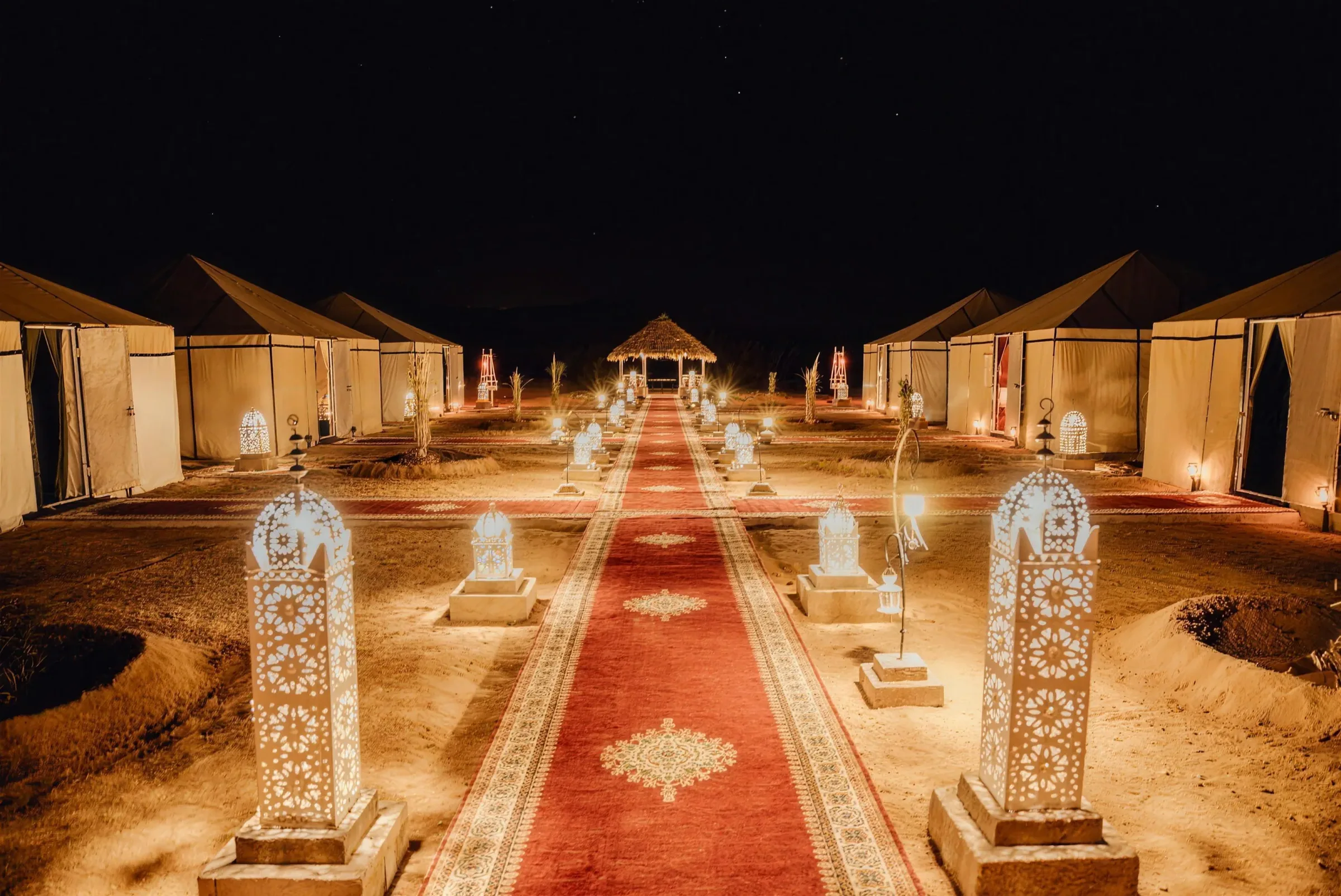
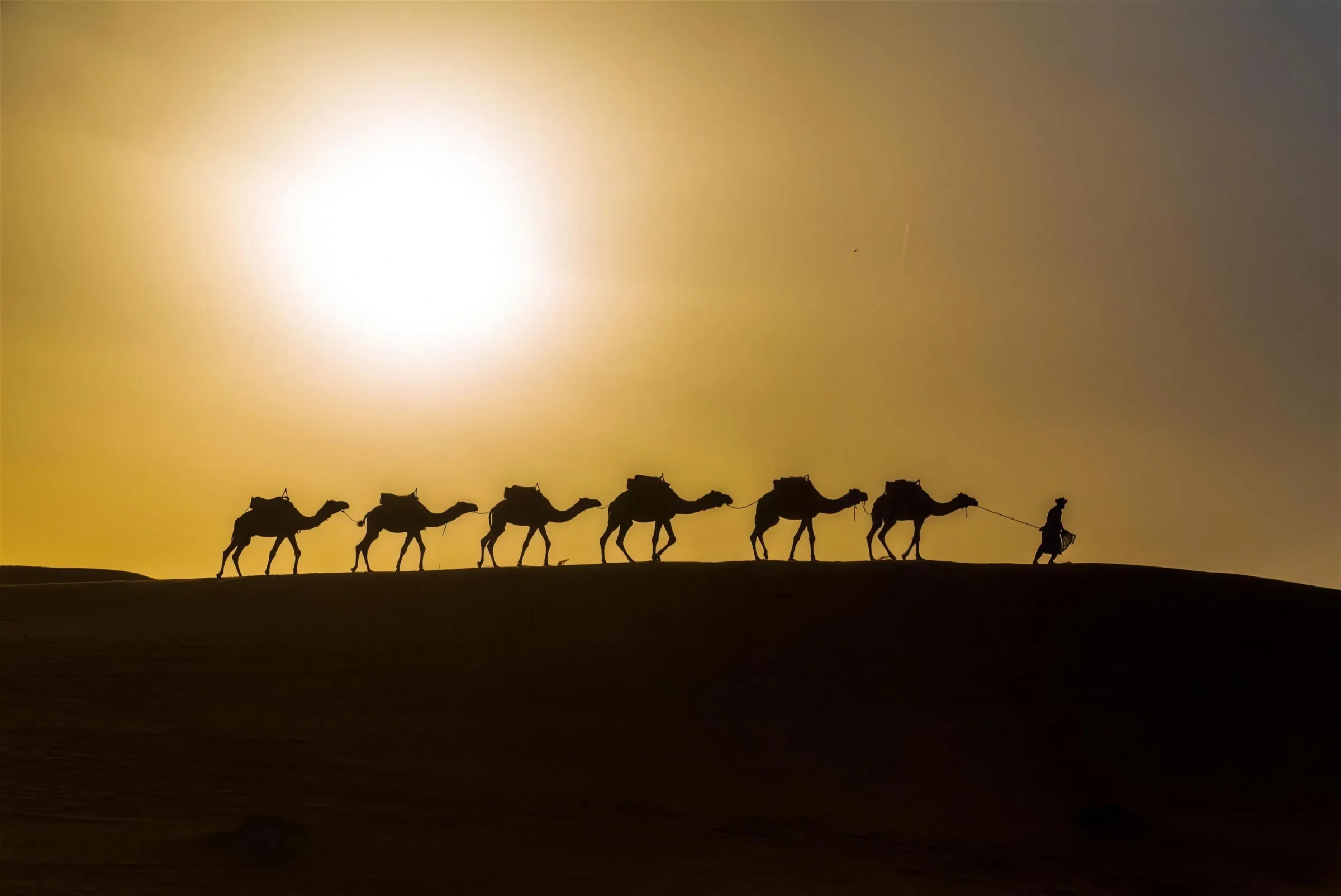
A night in a desert camp is the part of a Marrakech trip people talk about for years — the horizon glowing at sunset, the silence once the fire dies down, a sky so dark you can pick out the Andromeda galaxy with the naked eye. But "desert camp" stretches from a shared tent on a rope cot to a freestanding pavilion with a king bed, an outdoor shower and a private terrace, and the right choice for you depends a lot on how far you want to drive from Marrakech. Here is the honest version, so nothing surprises you at check-in.
Start here: Agafay, the desert on Marrakech's doorstep
Before the long haul south, know that there is a desert night you can do without leaving Marrakech's orbit. The Agafay is a rolling stone desert — not sand, but bare ochre hills with the snow-capped Atlas behind — that sits just 30–40 minutes from the medina. A cluster of smart tented camps here has turned it into the easiest way to sleep under the stars: dinner at sunset, a camel loop or a quad through the hills, and back in the city by late morning. It is not the towering orange dunes of the Sahara, but for one night, with no eight-hour drive, it is hard to beat. We send most short-stay guests to Agafay and save the deep ergs for those with the days to spare.
Erg Chebbi (Merzouga) vs Erg Chigaga (M'Hamid)
For the real Sahara, Morocco has two great ergs — sand seas — that host overnight camps, both reached on multi-day trips out of Marrakech. Erg Chebbi, by the village of Merzouga in the Tafilalet, is the one from the photographs: a concentrated wall of orange dunes rising to 150 m, with camps lined along the edge a short camel or quad ride away. It is the more reachable of the two (tarmac to the doorstep, flights via Errachidia) and has the widest spread of camps, from budget to ultra-luxury.
Erg Chigaga, around 50 km east of M'Hamid el-Ghizlane near Zagora, is Morocco's largest erg and far more remote. The final two hours are 4×4 over piste, and most guests add a camel or quad leg to reach camp. The payoff is near-total silence and a fraction of the crowds. We point travellers who have already done Erg Chebbi, or for whom solitude is the whole point, toward Erg Chigaga. Browse our Sahara destination pages for more on both ergs.
Standard camps
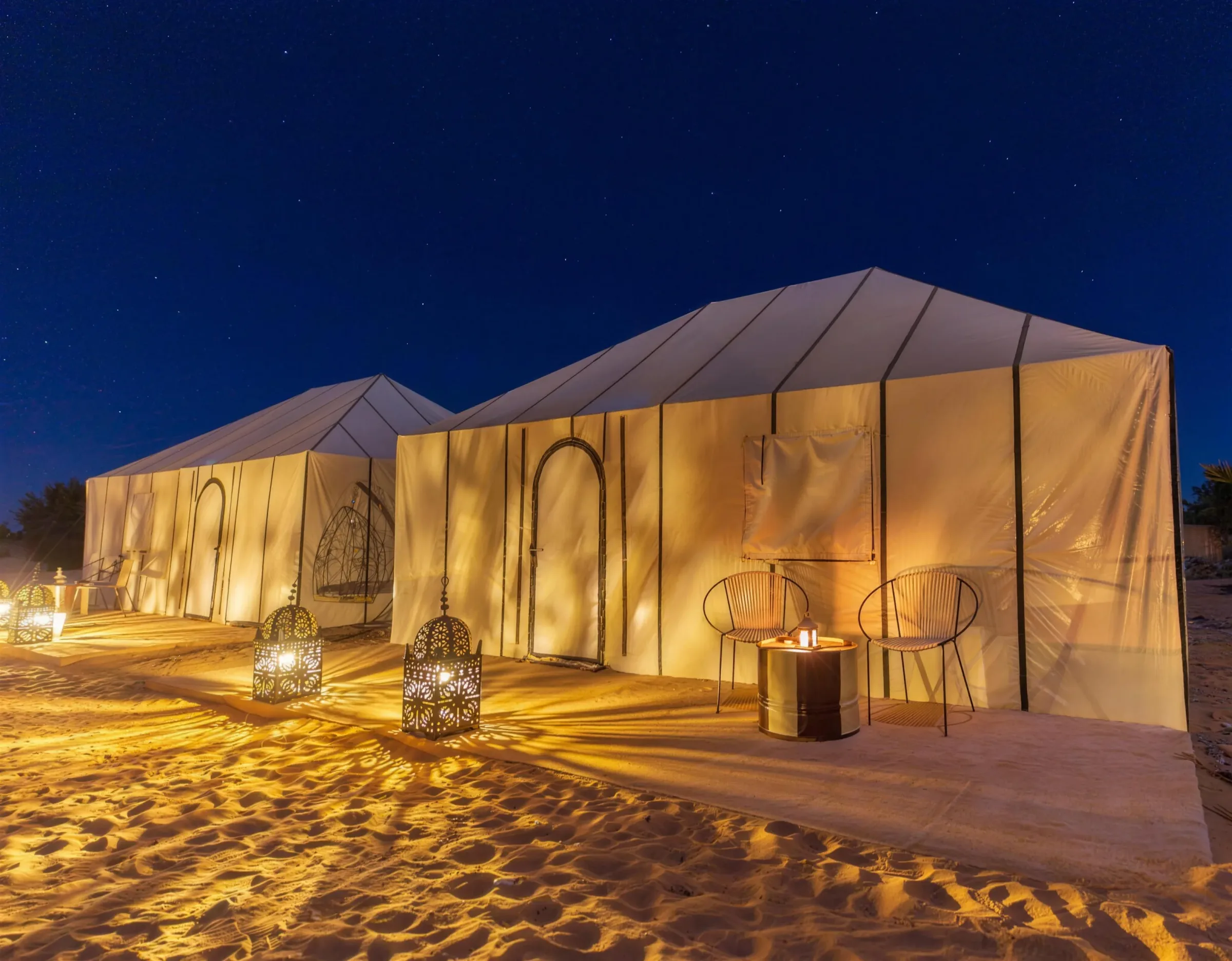
Standard camps — the bulk of what operates at Erg Chebbi — use large canvas or haima tents with plain iron or wooden bed frames, basic cotton bedding, and a shared toilet and cold-shower block for every four to eight tents. Dinner is a communal tagine or couscous in a central marquee. The price per person usually includes dinner, breakfast and a sunset camel ride.
The experience is real and often unforgettable, but the variables are high — tent condition, food and plumbing swing a lot between operators. Booking independently, read reviews from the last three months only. Booking through us, you get a camp we know and can tell you about plainly.
Luxury and boutique camps
The top end has changed beyond recognition in a decade, in Agafay as much as the Sahara. The best camps now give you freestanding private tents of 30–50 m² with real king beds (not cots), en-suite or adjacent private bathrooms with hot showers and flush toilets, terrace seating, and in some cases a private plunge pool. The look runs from pared-back Bedouin to full riad-in-the-dunes opulence.
Dinner at a good luxury camp is a proper multi-course affair — harira, pastilla, slow-cooked mechoui, Moroccan pastries — laid at a candlelit table rather than a buffet, with a house musician after. Prices are several times a standard camp and vary with the camp, the season and how exclusive it is. The polished Agafay camps and the most remote Erg Chigaga lodges both sit at the upper end and price as all-inclusive.
Before the long haul south, know that there is a desert night you can do without leaving Marrakech's orbit.
What a night actually includes
At any decent camp — Agafay or Sahara — the standard inclusions are:
- Transfer from the road to the camp — camel, 4×4, quad or a mix; a few minutes in Agafay, 20–60 in the ergs.
- Sunset on the dunes or hills — camps put guests on a nearby crest for the hour before dark.
- Dinner — communal or private depending on the camp tier.
- The tent itself — comfort varies hugely; this is where the price goes.
- Breakfast — bread, honey, olive oil, coffee and mint tea.
- Morning camel or 4×4 back to the road or village.
Often not included: alcohol (this is a Muslim country — some camps bring wine on request, others do not), sandboarding or quad bikes (usually charged separately), a guided telescope stargazing session (a real add-on at several good camps), and laundry.
Drive times from Marrakech
Marrakech to Agafay: just 30–40 minutes by road southwest of the city — the only desert night you can do as a short out-and-back, with no overnight stop on the way.
Marrakech to Merzouga (Erg Chebbi): around 560 km via Tizi n'Tichka and Ouarzazate, about 8h30 of driving. We almost always split it over two days with a night in Ouarzazate or the Dades Gorges, so the drive becomes part of the trip rather than an endurance test.
Marrakech to M'Hamid (Erg Chigaga): roughly 530 km via Ouarzazate and Zagora, 7–8 hours to M'Hamid, plus 2 hours of 4×4 piste to the erg. A serious journey that suits anyone giving the Sahara at least two nights. See our Sahara tours for multi-day route options.
When to go and what to pack
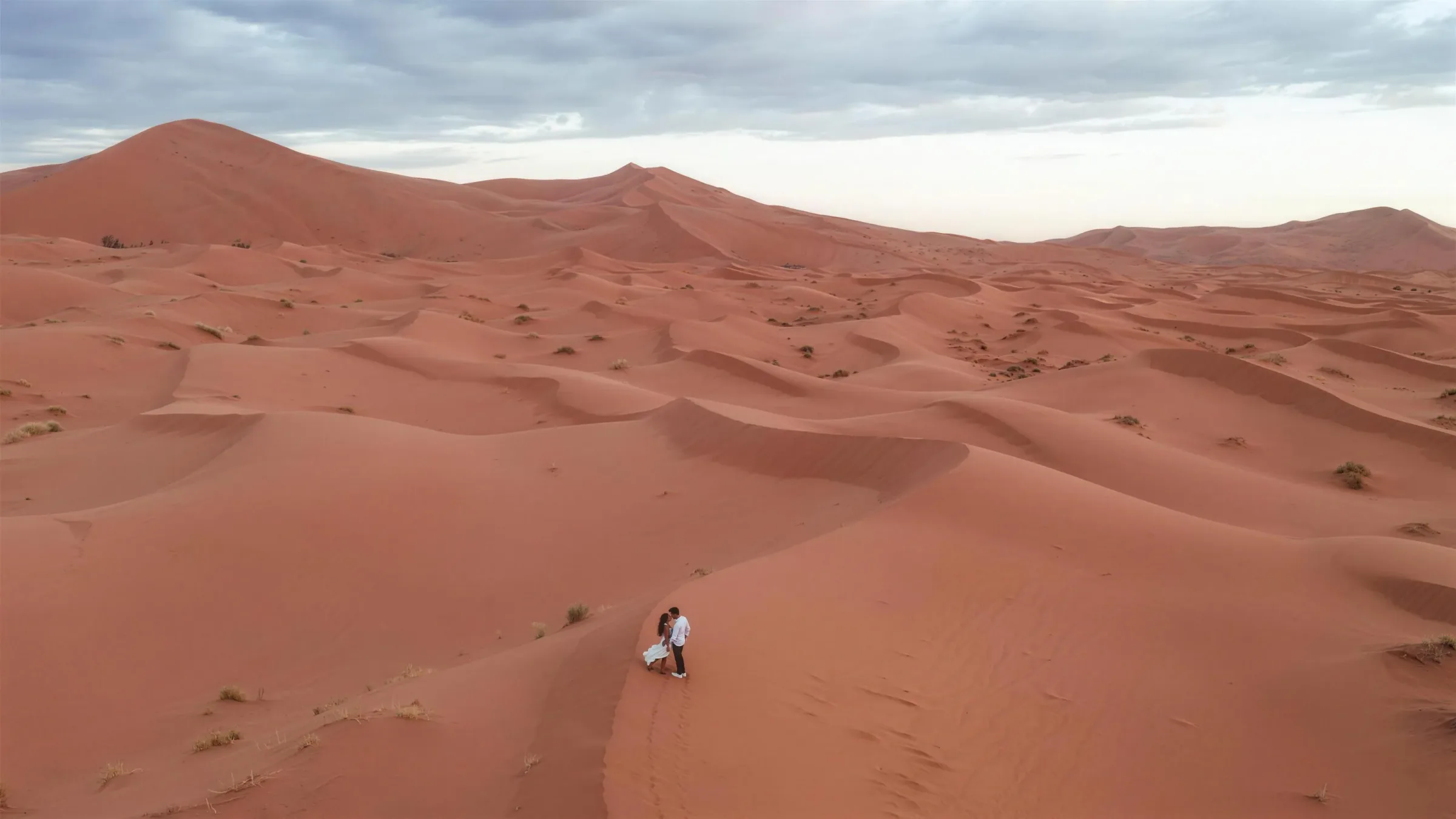
The prime windows are October–November and February–April, and this holds for Agafay as much as the deep Sahara. December and January are cold (lows near 5 °C or below) but reward you with extraordinary quiet. July and August are punishing — 40 °C+ by afternoon — though the nights cool off.
Pack the same kit whatever the season: a mid-weight fleece or down layer for the evening, a head torch, sunscreen, lip balm (the air is bone dry), a scarf or shemagh against wind and dust, and a power bank, since charging is limited at most camps. Fine sand finds its way into everything — keep cameras and phones in a sealed bag.
Related questions: How long is the drive from Marrakech to Merzouga?