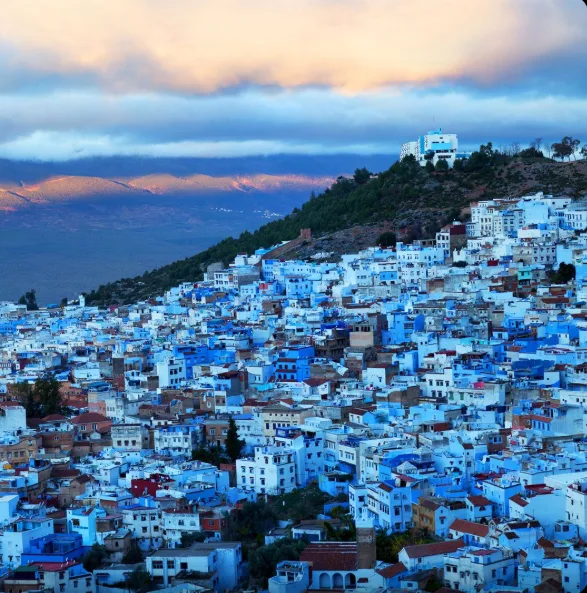
Come over the last ridge of the Ounila Valley and Aït Ben Haddou simply appears — a city the colour of the ground it stands on, because that is exactly what it is made of. This is one of the sights that pulls people out of Marrakech for the day, and it earns the drive. Built up in pisé — rammed earth packed with clay and straw — the fortified village has been lived in for the better part of a thousand years, once marked a caravan stop on the old Marrakech-to-Timbuktu trade road, and has logged more screen time than almost anywhere on the planet. The good news for visitors leaving the red city: it is closer than it looks, and far quieter than its fame suggests if you read the timing right.
So what exactly is a ksar?
Think of a ksar (the plural is ksour) as a fortified village built as one connected mass: earthen towers packed inside an outer defensive wall, with the communal grain stores — the agadirs — set highest up where they were hardest to reach. Two needs shaped the design. One was defence against raiding parties. The other was simply the climate: walls this thick hold the night's cool through a scorching afternoon and trap the day's warmth through a freezing night. Aït Ben Haddou is the one that did it best and lasted longest. Its towers climb four and five storeys, their clay faces worked into geometric relief, and seen from the far bank of the Ounila the whole stacked silhouette stops you mid-step. UNESCO listed it in 1987. Across the south, most ksour have crumbled or emptied out — this one is still standing, and still being patched by hand.
Which films were really shot here?
More than you would guess, and across more than half a century. David Lean framed Lawrence of Arabia against these walls in 1962 and effectively put the place on the industry map. John Huston followed with The Man Who Would Be King in 1975. Martin Scorsese borrowed the ramparts for the Jerusalem scenes in The Last Temptation of Christ (1988). Much of The Mummy (1999) was shot on the plain below. Ridley Scott turned the village into Zucchabar for Gladiator in 2000; Oliver Stone used the same ground for parts of Alexander (2004); and HBO made it the slaver port of Yunkai across Game of Thrones seasons 3 and 4. None of this is coincidence — the working studios of Ouarzazate, CLA and Atlas Corporation, sit just 32 km away, so productions already in town drift over for the silhouette. Keep your eyes open as you climb and you will catch leftover set timber on the plain and in a few of the lower rooms.
How does the drive from Marrakech actually go?
You leave Marrakech heading south on the N9, climb into the High Atlas, crest the Tizi n'Tichka at 2,260 m, then drop toward the Drâa. Call it 205 km and 3 to 3.5 hours when the road is behaving. The pass is not something to grind through — it is half the reason to come: cliffs banded rust and violet, mud-brick villages clinging to ledges that look unlivable, and a horizon that is nothing but more mountains. With your own vehicle the turn off to Aït Ben Haddou costs only 32 extra kilometres before Ouarzazate, and we have never regretted taking it. You can do it by public bus to Ouarzazate plus a shared taxi, but it eats the day and dumps you a rough kilometre short of the river. For a day out of Marrakech this is the one trip where a private driver genuinely pays for itself.
What does a good visit inside the ksar look like?
It starts at the river: stepping stones across the Ounila in the dry months, a small seasonal footbridge when the water is up, and the 10–20 MAD crossing toll handed over on the bank. Through the gate, the thing that catches you first is the decoration — triangles, chevrons and diamonds pressed into the clay while it was still soft, generations ago, and held intact ever since by dry desert air. The path threads upward through one walled enclosure after another. Several families still keep homes and small craft stalls here, and the silver and weaving on offer tends to be better made and far less pushy than anything at souk level. Your payoff is the agadir granary at the very top: the valley unrolls below you, palm-green giving way to terracotta plain in every direction. Give it 1.5 to 2 hours at the least. Time it for before 9 am if you have come early off the Marrakech road, or after 4 pm once the coaches have pulled out — the gap in crowds is night and day.
Day trip, or stay the night?
A clutch of small guesthouses now run in the new village across the river, and an overnight changes the whole character of the place. Dusk here is the moment to chase — the ochre deepening to blood orange just as the last coach pulls away. Roll out before 7 am and the crossing and lower terraces are often yours alone. Most people fold Aït Ben Haddou into a single Marrakech-to-Ouarzazate run and never see either. When the calendar allows, we build an overnight into our southern Morocco itineraries rather than racing through.
Frequently asked
How far is Aït Ben Haddou from Marrakech?
Reckon on 205 km and a 3 to 3.5 hour drive once you clear the southern edge of the city, almost all of it via the N9 and the Tizi n'Tichka pass. That pass tops out at 2,260 metres — Morocco's highest paved road — and a heavy January or February snowfall can shut it for a day or two, so we keep an eye on the forecast before locking a date. Push on past the ksar another 32 km and you reach Ouarzazate in roughly half an hour.
Is Aït Ben Haddou a UNESCO World Heritage Site?
It is. UNESCO added the ksar to the World Heritage List in 1987, citing it as an exceptional surviving example of southern Morocco's earthen-clay building tradition. The listing covers the wider cluster of ksour strung along the Ounila River valley, which together preserve a way of building that took shape over many centuries of caravan trade.
What films and TV shows were filmed at Aït Ben Haddou?
Film crews have leaned on this skyline for over sixty years. The roll-call runs from Lawrence of Arabia (1962) and The Man Who Would Be King (1975) through The Last Temptation of Christ (1988), The Mummy (1999), Gladiator (2000), Alexander (2004), Kingdom of Heaven (2005) and Prince of Persia (2010), up to Game of Thrones, where the ksar doubled as the slaver city of Yunkai across seasons 3 and 4. Look closely on the plain below and you can still pick out abandoned set pieces.
Do people still live inside the ksar?
A handful of households — usually said to be six to eight families — keep homes within the walls, partly because that lived-in status helps secure conservation money. Almost everyone else has moved across the Ounila River to the newer village, where running water and modern comforts are easier. Lived-in sections are marked; the unwritten rule is to stay out of private doorways and ask before you photograph anyone.
How long does a visit to Aït Ben Haddou take?
Cross the river, wind up through the towers, look in on the old mosque and climb to the agadir granary at the top, and you have filled 1.5 to 2 unhurried hours. Tack on another half hour for a tagine on the village side. Block out a half-day if you would rather wander than tick boxes — and we think you should.
Is there an entrance fee to Aït Ben Haddou?
There is no official gate fee. What you do pay is a small toll — usually 10–20 MAD — at the makeshift river crossing, which is stepping stones when the Ounila is low and a little boat when it runs higher. If a family invites you up their tower for the view or into a courtyard, a modest tip is the polite thing to leave. None of it amounts to much.
Build it into your trip
Aït Ben Haddou slots cleanly into a longer run south from Marrakech.
We line up early crossings ahead of the crowds, a night in the valley when it fits, and a walk with a local guide who can tell you which film used which tower. Send us your dates and we will shape the rest of the day around them.