Few cities reward a camera the way Marrakech does. Inside a single day you can shoot ornamental tilework, a thousand-year-old minaret, traders dyeing wool by hand, and a desert horizon — all within reach of one riad. The catch is that the best frames here are about timing and respect, not luck. What follows is how we actually work the city and its day trips, learned shoot after shoot with photographers we host.
Jemaa el-Fna in the blue hour
The great square is the picture everyone wants and most people get wrong, because they shoot it at noon. Come back for the half hour after sunset. As the food stalls fire up, smoke and steam rise into the cooling air and catch the last warm light, with the Koutoubia minaret glowing behind. Shoot it from a rooftop café terrace on the square's southern edge — order a mint tea, claim a parapet, and wait for the lamps to come on while the sky still holds colour. A 24–70mm handles the whole scene; bracket your exposures, because the dynamic range between the lit stalls and the deep sky is brutal.
Down at ground level, keep moving and shoot from the hip with a wider lens to capture the orange-juice carts, the gnaoua musicians and the swirl of the crowd. The performers — henna artists, snake charmers, water sellers — expect a small fee for a posed photo, so agree it first and everyone stays happy.
Palaces and medersa — Bahia, Badi and Ben Youssef
For pattern and symmetry, the Bahia Palace is unmatched: painted cedar ceilings, stucco arches and floors of zellige laid in dizzying geometry. Go at opening, before the groups, and shoot upward into the ceilings with a wide-angle. A few minutes away, the roofless El Badi Palace gives you sunken gardens, ruined ramparts and resident storks nesting on the towers — late afternoon turns the pisé walls a deep amber.
The restored Ben Youssef Medersa is the city's finest interior frame — a courtyard of carved cedar, stucco and a central reflecting pool that mirrors the arches. Mid-morning light in winter spills cleanly into the courtyard; shoot the reflection from a low angle and let the symmetry do the work. A small entry fee applies and tripods are tolerated when it is quiet.
Majorelle, the souks and the tanneries
The Jardin Majorelle — Jacques Majorelle's garden, later saved by Yves Saint Laurent — is built around a cobalt blue so saturated it almost reads false on screen. It gets crowded fast, so book the first slot and work the blue villa against the bamboo and cacti before the queues form. For colour of a rawer kind, head to the dyers' souk (Souk Sebbaghine), where skeins of freshly dyed wool hang to dry overhead — late morning, when they have just been hung, is the moment.
Out at Bab Debbagh, the city's own tanneries give you the vat-and-dye image — stone pits filled with saffron, poppy red and indigo — without the trek to Fès. A telephoto (70–200mm) frames the geometry of the pits cleanly from the viewing terraces above. The leather sellers will hand you a sprig of mint to hold against the smell; take it.
Day-trip light — Agafay, the Atlas and Essaouira
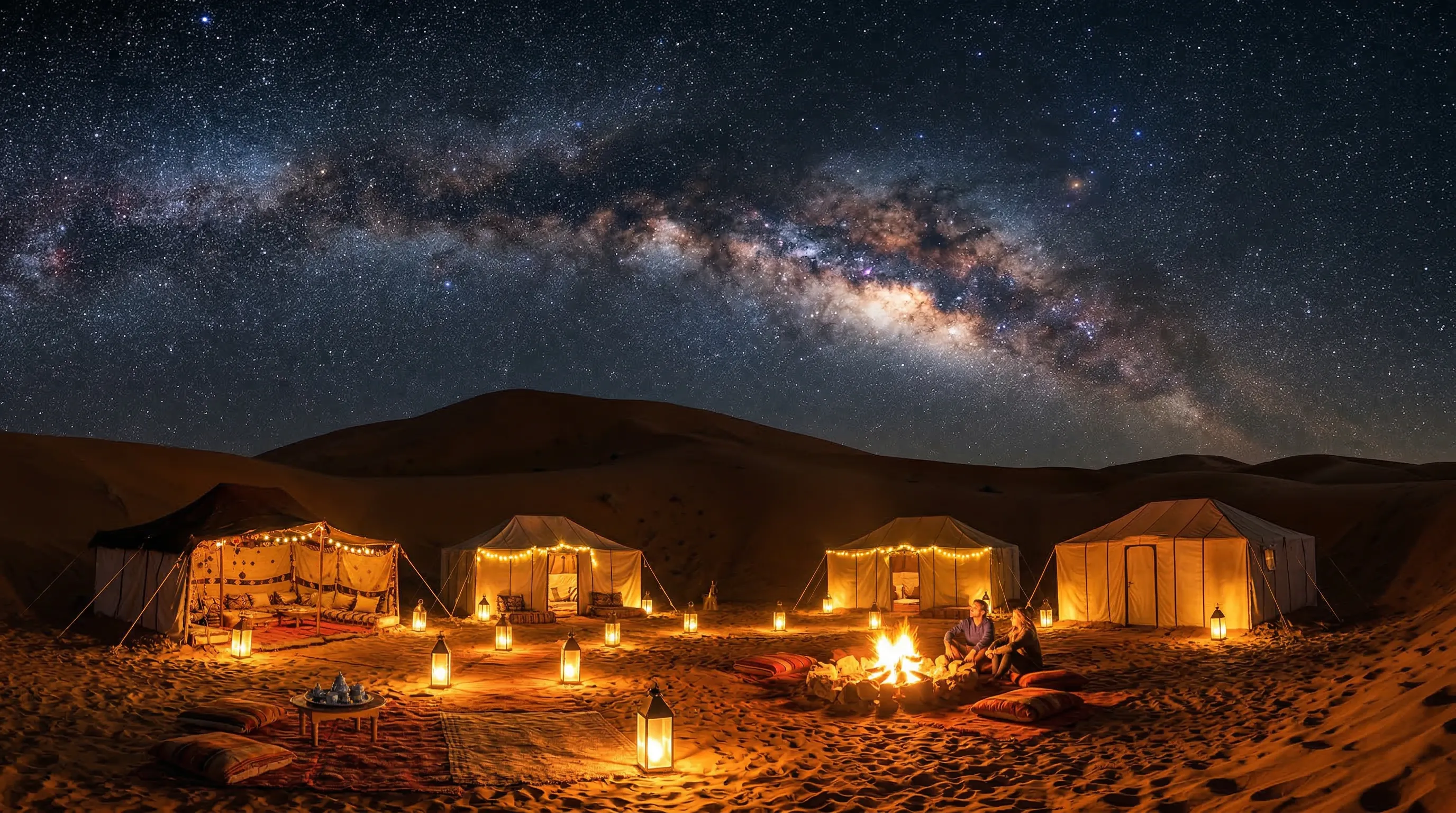
Twenty-five minutes from the medina, the Agafay stone desert rolls away in lunar ridges that glow ochre at sunset, with the snow line of the Atlas often visible behind. It is the easiest dramatic landscape near Marrakech, and luxury camps here let you shoot dusk and dawn without an overnight expedition. A 24–70mm covers the rolling hills; a 70–200mm pulls the distant peaks in tight.
Push deeper and the Ourika Valley and Imlil (both under two hours) give you terraced fields, walnut groves and flat-roofed Berber villages against a 4,000-metre backdrop — spring brings blossom, winter brings snow. West on the coast, Essaouira (three hours) offers blue fishing boats, ramparts pounded by Atlantic spray and gulls wheeling over the port — a complete change of palette in a single day.
Photographing people: how to do it well and respectfully
The frames that stay with people are usually the human ones — a coppersmith mid-strike, a trader pouring tea, a musician on the square. The etiquette is simple but worth saying plainly:
- Always ask before a close-range portrait. A nod toward the camera and eye contact asks the question; a refusal is final, with no haggling or pressure.
- Spend a moment with a craftsman's work first — ask how it is made, buy something small. Willingness to be photographed usually follows naturally once the exchange feels human rather than extractive.
- Medium-distance street work (70–135mm) is widely accepted around the souks. Shoving a wide-angle into someone's face is not.
- Turn the screen around and show people the frame you just made. The reaction is nearly always warm and often opens a longer chat.
- On Jemaa el-Fna the performers — snake charmers, henna artists, water sellers — work for tips, so a posed photo costs a little. It is fair; settle on 10–20 MAD before you shoot.
Our private guides can set up workshop visits with artisans who have agreed to photography in advance — the difference between a relaxed, consenting subject and a snatched shot is enormous. See our private guide services and photography-focused tours.
Frequently asked
Where is the most photogenic spot in Marrakech?
Jemaa el-Fna at dusk is the shot people remember — the smoke from the food stalls catching the last light while the Koutoubia minaret turns gold behind it, framed from a café terrace on the square's south side. For colour and pattern, nothing beats the Bahia Palace ceilings and the Ben Youssef Medersa courtyard. Just outside the walls, the Agafay stone desert at sunset gives you a dune-like landscape twenty-five minutes from the medina.
When is the light best for photographing Marrakech?
October to November and March to April give the cleanest, most directional light, with the summer haze gone and skies that go deep blue over the pink walls. Inside the medina, shoot the first two hours after sunrise when the lanes are empty and light rakes between the buildings. For Agafay and the Atlas foothills, late afternoon is the moment the earth glows ochre. Summer middays are harsh — retreat to a shaded riad courtyard or a tiled interior until four.
Can I photograph people in Marrakech without causing offence?
Always ask first, especially for close portraits. A nod toward your camera and a questioning look usually does it, and you respect a no without pushing. In the souks, traders and craftsmen are often happy once you've shown genuine interest in their work or bought something small. On Jemaa el-Fna, the henna artists, water sellers and snake charmers expect a few dirhams for a photo — agree 10–20 MAD up front and there's no friction.
What camera gear suits a Marrakech and Atlas trip?
A 24–70mm or 24–105mm covers most of the medina, palaces and street work. A wide-angle (16–24mm) opens up tiled courtyards and the Agafay sky. A 70–200mm lets you compress the Atlas ridgelines and shoot dune detail or candid souk moments from a respectful distance. A polarising filter earns its place in the mountains and at Lake Lalla Takerkoust. Pack a small head torch for pre-dawn climbs on a desert overnight.
Can I photograph inside the mosques in Marrakech?
Non-Muslims cannot enter active mosques in Morocco, so the Koutoubia and the Ben Youssef Mosque are exterior subjects only — though the minaret against an evening sky is one of the city's signature frames. The exception nationally is the Hassan II Mosque in Casablanca, which runs guided tours with photography in set areas. In Marrakech, the carved doors, the Ben Youssef Medersa and the zellige of the Bahia give you all the religious-architecture detail you could want.
Where can I photograph Marrakech's artisans at work?
The dyers' souk (Souk Sebbaghine) with its hanging skeins of dyed wool is the classic colour shot, best in late morning. Coppersmiths hammer away in the Haddadine quarter, and the leather tanneries in the Bab Debbagh district give you the vat-and-dye image without travelling to Fès. Weavers and zellige cutters work in workshops your guide can arrange in advance — an artisan who has agreed to the visit is relaxed and gives far better frames than a snatched shot.
Photography itineraries
We plan around the light, not the tour-bus timetable.
Dawn entry to the palaces, dusk on the square, workshop access in the souks and a sunset run out to Agafay — tell us the frames you want and we build the day around them.
Request an itinerary