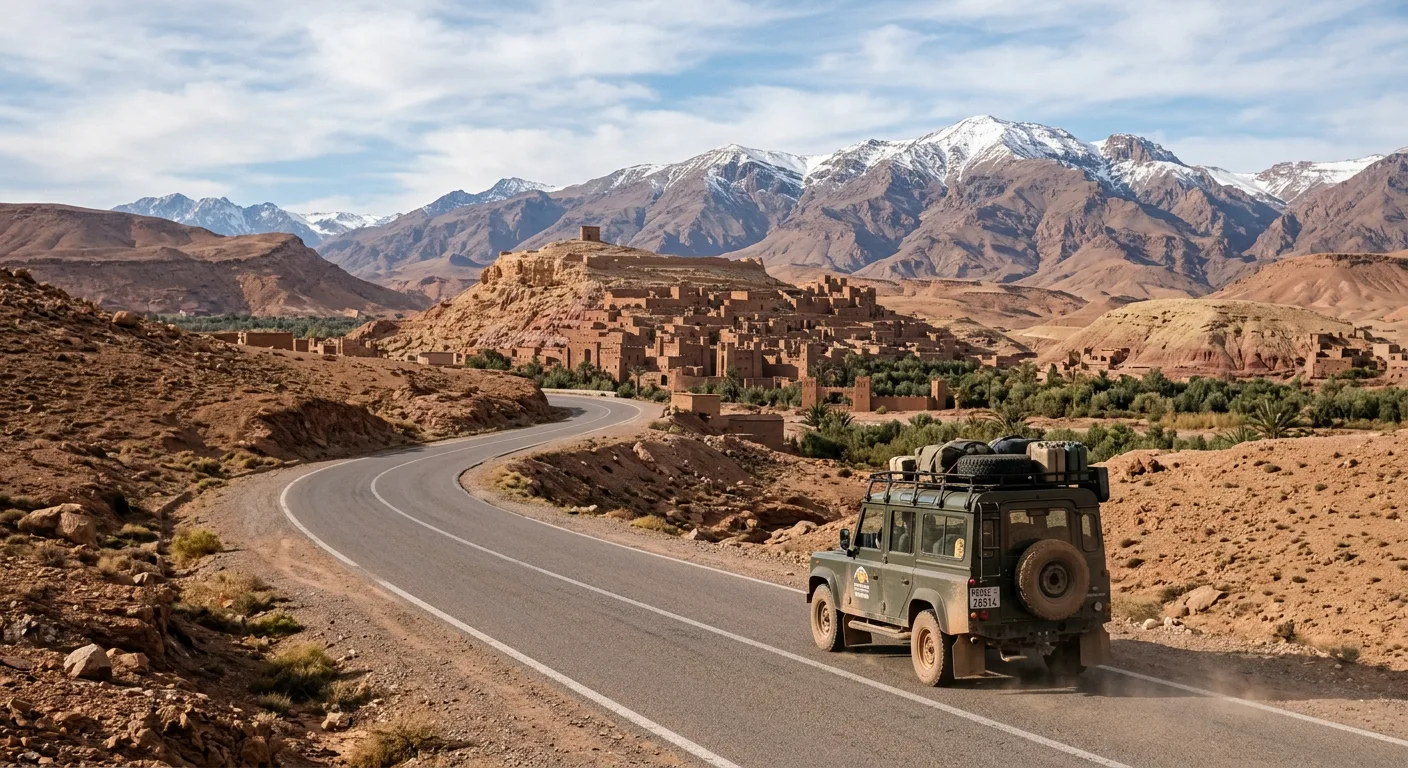
Point a car south or east out of Marrakech and Morocco opens up gloriously — the scenery turns over every hour, the Atlas passes are unforgettable, and pulling in at a roadside souk on impulse is a genuine pleasure. It is also a place where the driving never lets you switch off. So here, straight, is what we tell guests when they ask whether they should pick up the keys themselves.
What are the roads really like?
The toll motorways — the autoroutes — linking Marrakech to Casablanca, Rabat, Fès and Tangier are genuinely good: smooth surface, clear signage, well looked after. Leave them and the story gets patchier. The national routes (the N roads) running south and east are sealed and mostly sound, but narrow enough that two lorries meeting head-on leaves barely a handspan between mirrors. Provincial roads (the R prefix) can break up fast after rain. And the pistes — the unpaved tracks into the mountains and the pre-Saharan valleys — need a high-clearance 4x4; we would never send a standard hire car down one.
How do the checkpoints work?
Checkpoints (barrages) are simply part of driving here, not something gone wrong. An officer steps out with a baton and you slow to a stop. Keep your passport, your licence (home licence or International Driving Permit), and the rental contract within reach in the glovebox. They may clock your speed on radar and, now and then, breathalyse — and Morocco runs a zero-tolerance line on alcohol, with the limit set at 0.0 g/L. Stay polite, stay patient, speak clearly. If you're fined, it's paid in dirhams on the spot, and you can ask for a receipt: un reçu, s'il vous plaît.
Can you park inside the medinas?
The old medinas of Marrakech, Fès, Meknès, and most other historic cities are car-free. You will park in a supervised car park outside the walls — gardiens charge 10–20 MAD per day — and walk through the gates. In Fès el-Bali this is non-negotiable: the alleyways are too narrow even for a motorbike in places. In Marrakech you will see motorcycles and donkeys sharing a lane that a Fiat 500 could not enter. Your accommodation will send someone to meet you at the nearest landmark; riads routinely manage luggage handoffs at the car park.
What does car hire actually cost in Morocco?
A small manual (Dacia Sandero category) runs approximately US$25–40 per day from international agencies (Avis, Hertz, Europcar) at Marrakech or Casablanca airports. Local agencies advertise lower rates but their insurance terms and breakdown cover are often inadequate — read the small print carefully. Full collision damage waiver (CDW) and theft protection are worth paying for. Fuel is roughly US$1.20 per litre for petrol (Diesel is slightly cheaper); the country is well covered by petrol stations on main routes.
Why do most of our guests choose a private driver?
We are not unbiased — we arrange private driver-guides for a living. But the reasons our guests give us, after choosing to self-drive and then switching, are consistent: the mountain passes are more nerve-wracking than they expected, parking at every stop added hours of stress, the language barrier at a checkpoint was uncomfortable, and they spent their holiday focused on the road rather than the landscape. A private driver removes every one of those frictions. On a 7–10 day trip the cost difference is modest — a driver-guide costs roughly US$150–220 per day all-in, which across a group of four works out to less than US$60 per person per day. You gain a local expert, a fixer, a translator, and someone who knows which viewpoint to stop at on the Tizi n'Tichka. See our guide service for details.
Practical rules if you do self-drive
- Never drive after dark outside of cities — livestock and unlit mopeds are serious hazards.
- Download offline maps (Maps.me or Google Maps offline) before leaving your hotel — data signal disappears in the mountains and desert.
- Keep a physical copy of your rental contract, insurance, and passport photo page in the car.
- Fill the tank whenever you drop below half — petrol stations become sparse east of Ouarzazate and between Erfoud and Merzouga.
- Stick to paved roads unless you have a 4x4 and a local contact at the destination.
- At a checkpoint: engine off, window down, hands visible on the wheel. Slow and calm.
Frequently asked
Is it safe to drive in Morocco as a foreigner?
You can absolutely drive here, but the roads ask more of you than Western Europe does. In Marrakech and other cities the rules bend in practice, pedestrians and mopeds emerge without warning, and once you climb into the Atlas there are no crash barriers between you and the drop. The visitors who come through unscathed are the ones who slow right down, give themselves room, and never drive after dark.
What documents do I need to rent a car in Morocco?
For most nationalities, your home driving licence does the job — no International Driving Permit needed. Bring your passport, a credit card in your own name, and be at least 21 (sometimes 23 for the bigger vehicles). The rental contract and the insurance certificate need to stay in the car with you, not back at the riad.
Do police in Morocco stop tourists frequently?
Often, yes. Once you're out of Marrakech on the intercity roads you'll meet checkpoints — an officer stepping out with a baton. Slow down smoothly, drop the window, and have your passport and rental contract to hand. A quick look and they usually wave tourists on. Keep it calm and unhurried, and speak slowly and clearly; it goes a long way.
What is the speed limit in Morocco?
In towns it's 40–60 km/h, on open roads 100 km/h, and on the autoroutes 120 km/h. Fixed cameras are everywhere and officers run radar at the checkpoints. Fines are settled there and then in cash dirhams, so keep some on you. The signs themselves follow the familiar European shapes and symbols.
Is it better to hire a driver than self-drive in Morocco?
For most people coming for the first time — yes, and without much hesitation. Hand the wheel to a private driver-guide and the friction simply disappears: no wrestling for medina parking, no white-knuckle mountain passes, no language tangle at a checkpoint, no dead navigation signal in the hills. You also gain a local who knows the country in a way no app does. Spread over a week to ten days, the extra cost is small against the whole trip.
Can I drive between cities at night in Morocco?
We'd really rather you didn't. Unlit mopeds, livestock wandering onto the tarmac, speed bumps that appear from nowhere and plain tiredness all stack up to make night driving the single biggest hazard for visitors. Aim to reach your bed before sunset, and treat that as a hard rule on the mountain and desert legs.
Skip the road stress
Let us put a driver-guide behind the wheel.
Our private driver-guides are licensed, English-speaking, and intimately familiar with every route in this guide. We can pair a driver with a separate local guide at each destination for even deeper immersion.