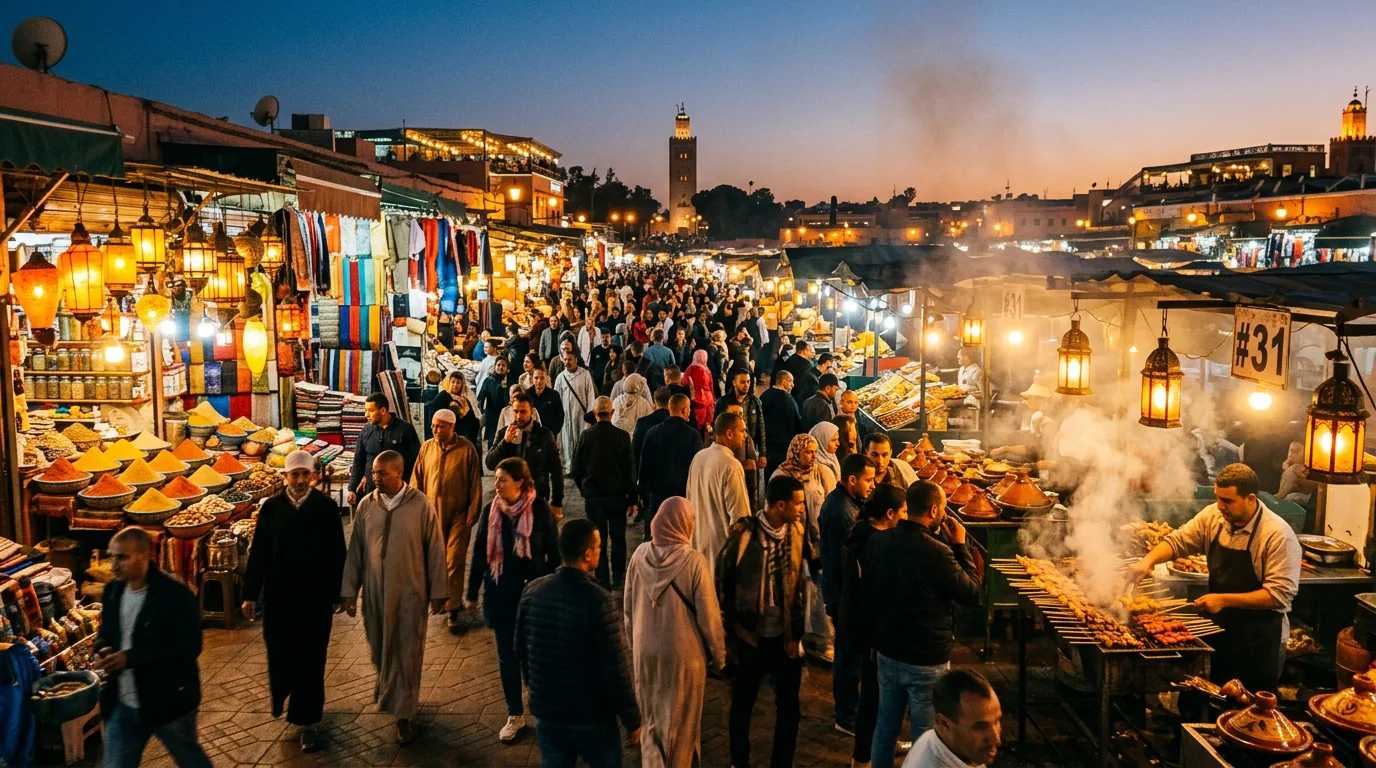
Yes — for the first day or two, Marrakech can absolutely feel overwhelming, and we would be lying to tell you otherwise. The old medina is loud, dense, hot and full of friendly-but-relentless selling, and the souks are a genuine maze. But here is the honest part most reviews leave out: the intensity is almost entirely sensory and commercial, not threatening, and it fades remarkably fast. We run trips here every week, and the pattern is the same nearly every time — guests arrive a little wide-eyed, find their feet within 48 hours, and leave in love with the exact thing that overwhelmed them on arrival. This is how to get to that point quickly, and gently.
What actually overwhelms people in Marrakech
It helps to name it. The overwhelm in Marrakech is almost always some combination of five very specific things, and once you can see them coming, they stop being overwhelming and start being — well, the experience:
- The sensory load. Spice and mint and grilled meat, calls from stallholders, hammering from the metalworkers' souk, colour everywhere, and a sense that something is happening down every alley. It is wonderful and it is a lot.
- The selling. Persistent, good-humoured, near-constant in the tourist souks. Being "called in" to every stall is tiring before you learn it is simply the local sales style, not pressure aimed at you personally.
- The medina maze. Unsigned lanes that loop and dead-end. You will get lost. Everyone does.
- The motorbikes. Scooters thread the same narrow lanes you walk, faster than you expect, with a quick beep for warning. It looks like chaos for a day, then becomes second nature.
- The heat. In late spring and summer the midday sun flattens ambitious plans and makes everything feel harder than it is.
None of these are dangers. They are textures. The visitors who struggle are usually the ones who expected a calm, signposted, European-style city centre and got something far older and wilder instead. Arrive expecting the wildness and you are already most of the way to enjoying it.
Is the hassle as bad as people say?
It is real, but it is usually overstated — and it is worth being honest about both halves of that sentence. The most common forms are shopkeepers calling you into stalls, unofficial "guides" who tell you the lane ahead is closed or that there is a festival on "today only" before steering you to a shop for commission, and people around Jemaa el-Fna expecting payment for any photo you take of them. It can be wearing, especially when you are tired.
What it almost never is: aggressive or dangerous. A calm, smiling "la, shukran" (no, thank you) while you keep walking with the air of someone who knows where they are going solves the overwhelming majority of it. Do not stop to argue, do not feel rude — declining is completely normal here. And notice that the hassle drops away sharply the moment you leave the main tourist arteries: ten minutes into a residential lane, you are just another person walking home. For the full method on the commercial side, our guide to haggling in the souks turns the negotiation from a stress into a game.
How to handle the medina without losing your mind
The medina is the source of most first-day overwhelm and most last-day love. A few practical moves change the whole experience:
- Download an offline map before you arrive (Maps.me or Google Maps offline) and drop a pin on your riad. You will still get lost; you just will not stay lost.
- Use Jemaa el-Fna as your reset point. The lanes generally funnel back toward the great central square. If you are disoriented, head for it and start again.
- Walk the medina early. At 8–9am it is calm, cool, softly lit and almost empty — the same lanes that feel like a scrum at noon feel like a film set.
- Book a licensed guide for your first souk walk. Two or three hours with someone who knows the layout teaches you the geography and the rhythm, and the low-level negotiation simply stops happening while you are with them. After that you can explore solo with confidence.
- Keep your bag zipped and in front of you in tight lanes and around the square at night — ordinary city-sense, nothing more.
For taxis, petits taxis, calèches and getting between the medina and the new town, our guide to getting around Marrakech covers the practicalities.
The 48-hour rule: it gets easier fast
This is the single most reassuring thing we can tell you, and it is true for almost everyone: the overwhelm has a shelf life of about two days. By the end of day one you have learned the "no, thank you" reflex. By day two you recognise a few landmarks, you have stopped flinching at the motorbikes, and the souks have shifted from an assault to a delight. The medina you found bewildering on arrival becomes the place you are sad to leave. If you only have one night, you may leave on the steep part of that curve; with three days you get to enjoy the top of it. Our three-day Marrakech plan is built around exactly this arc.
Build in calm: where to escape the intensity
You do not have to push through the intensity all day. Marrakech is generous with off switches, and using them is the difference between a draining trip and a magical one:
- Your riad. The whole point of a riad — a courtyard house behind a thick studded door — is that the street noise simply stops the moment you step inside. A cool tiled courtyard and a rooftop are the perfect antidote to a dusty souk morning. See our pick of the best riads in Marrakech.
- Gueliz and Hivernage. The French-built new town and the hotel district are the calm counterweight to the medina: wide pavements, modern cafés, no souk pressure, easy taxis. Twenty minutes there resets you completely.
- The gardens. Le Jardin Secret in the medina, the Majorelle and the Menara are pockets of stillness, birdsong and shade in the middle of the noise.
- A hammam. An hour in a steam bath is the ultimate Marrakech reset — cleansing, slow and a world away from the lanes outside.
- Leave the city for a day. An Atlas Mountains day trip or a run to the coast at Essaouira — calm, breezy and walkable — resets the whole nervous system in a single day, and makes you fall for Marrakech all over again when you return.
Is Marrakech a good first trip for nervous or first-time travellers?
Yes — with the right on-ramp. Marrakech can feel intimidating in the abstract and turns out gentle in practice for most people, because tourism is the city's core industry: English is widely spoken in the trade, the hospitality is genuine and warm, and serious crime against visitors is uncommon. Plenty of first-time and solo travellers do brilliantly here. What makes the difference is a soft landing: a private airport transfer so you are not navigating on arrival, a riad near a main gate so you are not deep in the maze on night one, and a guided first day to build your confidence and your mental map. Get those three things right and the overwhelm barely gets a foothold. We arrange all of it as a matter of course.
The honest verdict
Marrakech is overwhelming the way a great piece of music is overwhelming the first time you hear it — too much to take in at once, and then, very quickly, the thing you cannot stop returning to. It is not a calm city, and it is not trying to be. Come with a little patience for the theatre of it, do less than you planned, build in shade and silence, and give it 48 hours. Almost everyone who does ends up counting Marrakech among the most alive, most hospitable and most unforgettable places they have ever been.
Frequently asked
Is Marrakech overwhelming?
For the first day or two, yes — Marrakech can feel overwhelming, especially inside the old medina. It is loud, dense, hot and full of friendly-but-persistent selling, and the souks are a genuine maze. But the intensity is almost entirely sensory and commercial, not threatening, and it fades fast. Most visitors find their footing within 48 hours and end up loving the very thing that overwhelmed them at first. The trick is to lower your expectations of "getting it all done", build in rooftop and riad downtime, and treat the chaos as the experience rather than a problem to solve.
Is the hassle in Marrakech as bad as people say?
It is real but usually overstated. The most common forms are shopkeepers calling you into stalls, unofficial "guides" offering directions that lead to a shop, and people asking for money for photos around Jemaa el-Fna. It is persistent and can be tiring, but it is rarely aggressive and almost never dangerous. A calm, smiling "la, shukran" (no, thank you) and walking on solves the vast majority of it. It also eases noticeably the further you get from the main square and the tourist souks.
Will I get lost in the Marrakech medina?
Almost certainly, at least once — and that is normal. The medina is a deliberately irregular tangle of unsigned lanes, and even regulars take wrong turns. It is not dangerous, just disorienting. Download an offline map (Maps.me or Google Maps offline) before you arrive, drop a pin on your riad, and note that the lanes generally funnel back toward Jemaa el-Fna, the giant central square that works as your reset point. Getting lost for twenty minutes is part of the experience, not a failure.
How do I avoid feeling overwhelmed in Marrakech?
Slow down and do less. Pick two or three things a day, not ten. Be out early when the medina is calm and beautiful, retreat to your riad or a rooftop for the hot, busy middle of the day, then come back out in the golden evening. Stay in a riad rather than a big hotel — the quiet courtyard behind a thick door is the antidote to the street. And book a licensed guide for your first souk walk so you learn the layout and the rhythm without the constant low-level negotiation.
Is Marrakech a good first trip for nervous or first-time travellers?
Yes, with the right setup. Marrakech rewards a gentle on-ramp: a private airport transfer so you do not arrive disoriented, a riad near a main gate so you are not deep in the maze on night one, and a guided first day to build confidence. Tourism is the city's core industry, English is widely spoken in the trade, and serious crime against visitors is uncommon. Many first-time and solo travellers do brilliantly here. If the souks feel like too much, Marrakech also has calm, modern districts — Gueliz and Hivernage — and easy escapes like Essaouira and the Atlas a short drive away.
Where in Marrakech is calmer if the medina is too much?
Gueliz (the French-built new town) and Hivernage are the calm counterweights to the medina: wide pavements, modern cafés and restaurants, no souk pressure and easy taxis. The Palmeraie, on the city's edge, is quieter still — resort-style and green, though you will rely on transport to reach the sights. Within the medina itself, the gardens (Le Jardin Secret, Majorelle, the Menara) and your own riad courtyard are pockets of stillness. Stepping out of the city entirely — Essaouira on the coast or the Ourika Valley in the Atlas — resets the nervous system in a single day.
Is Marrakech safe despite feeling chaotic?
Broadly yes. The chaos is sensory, not violent — noise, crowds, motorbikes in the lanes and energetic selling. Serious crime against tourists is uncommon, and the medina, Gueliz and Hivernage are genuinely safe to walk. Apply normal city-sense: keep your bag zipped and in front of you in tight lanes and around Jemaa el-Fna at night, agree taxi fares before you ride, and trust your instincts. For a fuller picture, see our honest safety guide to Morocco.
Soft landing
Let us take the overwhelm out of day one.
Airport pickup, a riad in the right part of the medina, a licensed guide for your first souk walk and an itinerary paced around the heat and the rhythm of the city — tell us how you like to travel and we will build the gentle on-ramp so the only thing you have to navigate is the wonder of it.
Request an itinerary