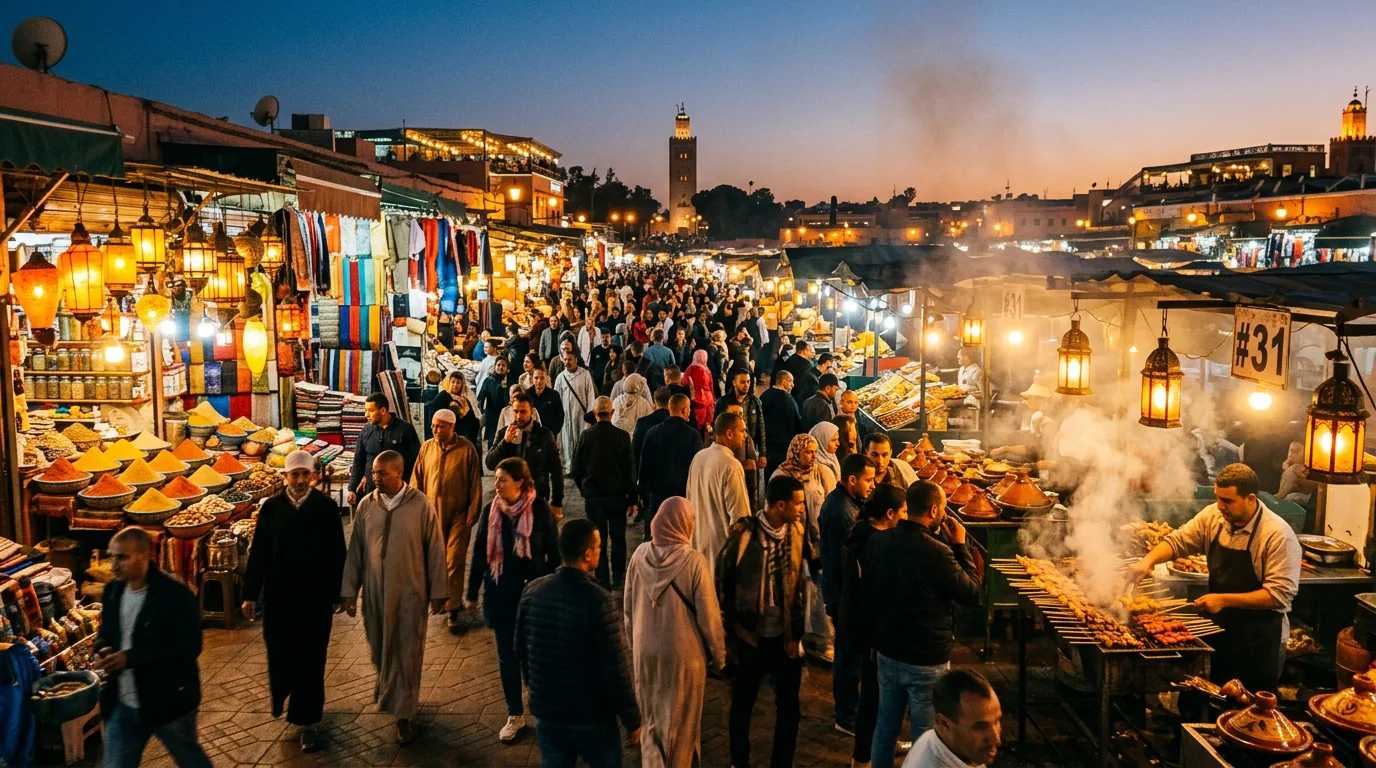
Marrakech is glorious sensory overload — a thousand-year-old medina, the cobalt of the Majorelle garden, the ritual of the hammam, candlelit rooftop dinners, and a square that reinvents itself every evening into one of the world's great open-air theatres. This is our insider map to where your hours are best spent, from the souks and the palaces to the day trips that fan out into the Atlas and the desert.
In this guide
- 01What are the top sights in Marrakech?
- 02What is there to do in Jemaa el-Fnaa?
- 03Which neighbourhoods should you explore in Marrakech?
- 04What are the best day trips from Marrakech?
- 05Where should you eat and drink in Marrakech?
- 06What is the hammam and spa experience like in Marrakech?
- 07Frequently asked
What are the top sights in Marrakech?
Marrakech is a city to get lost in, but a handful of landmarks reward a deliberate visit. The 12th-century Koutoubia Mosque — its 77-metre minaret the template for towers in Seville and Rabat — is the city's compass point; you cannot enter as a non-Muslim, but its silhouette at dusk, floodlit above the palm-fringed gardens, is the image you will keep. Jardin Majorelle, the cobalt-blue garden rescued and restored by Yves Saint Laurent, is the most photographed corner of the city, with its bamboo grove, cactus collection, Berber Museum and the Saint Laurent memorial. Go at the 8am-ish opening to walk it before the tour coaches arrive. A few minutes away in the medina, the Bahia Palace — a 19th-century grand vizier's residence of some 150 rooms set around painted courtyards and citrus gardens — is one of the finest palace interiors you can actually walk through.
The Medersa Ben Youssef, a Quranic college founded in the 14th century and enlarged under the Saadians, holds the most breathtaking carved-cedar and stucco interior in Marrakech: a still courtyard pool, a gallery of tiny student cells above, and zellige tilework worth lingering over even if historic architecture is not usually your thing. The Saadian Tombs, sealed up for centuries and only rediscovered in 1917, shelter the marble graves of the dynasty behind the Kasbah Mosque — small, intimate and gorgeously decorated. And the ruined El Badi Palace nearby, stripped of its riches long ago, is now a vast, sun-baked courtyard where storks nest on every rampart — the perfect counterpoint to Bahia's polish.
- Koutoubia Mosque — the city's landmark minaret; gardens and dusk views (interior closed to non-Muslims).
- Jardin Majorelle and the YSL Museum — arrive at opening before the tour groups.
- Bahia Palace — around 150 painted rooms and courtyards; the finest accessible palace interior.
- Medersa Ben Youssef — the most extraordinary carved-cedar interior in the medina.
- Saadian Tombs — 16th-century royal mausoleum behind the Kasbah Mosque; small but exquisite.
- El Badi Palace — sprawling ruined Saadian palace; nesting storks on every wall.
- Le Jardin Secret — a restored riad garden on the Mouassine lane, a calm pause mid-medina.
What is there to do in Jemaa el-Fnaa?
Jemaa el-Fnaa — the great square at the heart of the medina — is one of the world's iconic public spaces and is inscribed by UNESCO as a Masterpiece of Intangible Cultural Heritage. By day it ticks over with orange-juice carts, henna artists, water-sellers in fringed hats and the odd snake charmer. As the light drops it transforms completely: rows of food stalls are wheeled out and assembled in minutes, smoke billows off the grills, and circles form around storytellers, Gnaoua drummers and acrobats. It builds to a peak around 9 to 10pm. The smartest move is to claim a café-terrace table on the square's edge — Café de France, Le Grand Balcon, Kosybar nearby — and watch the whole spectacle unfold over a mint tea.
A little square-craft goes a long way: agree a price out loud before a henna artist takes your hand or a stallholder seats you, keep your bag in front of you in the crush, and if you do not want to pay for a photo, admire the snake charmers and monkey handlers from a few steps back. The souks unspool north of the square — spices, lamps, leather, slippers and textiles, each in its own cluster — and are best tackled in the morning, before the heat and the crowds thicken.
Which neighbourhoods should you explore in Marrakech?
The medina is far from uniform. Mouassine, north-west of Jemaa el-Fnaa, has the densest run of boutique riads, design-led concept stores (33 Rue Majorelle, Max & Jan) and good independent kitchens, plus the lovely Mouassine fountain and Le Jardin Secret. Bab Doukkala, by contrast, is quieter and residential — washing strung across the lanes, kids playing football — and gives you the medina as a place people live rather than a stage set. The mellah, the old Jewish quarter beside the Bahia Palace, reads differently again: taller balconied houses, a covered spice-and-fabric market, and the working Lazama (Slat al-Azama) synagogue tucked behind a blue courtyard.
Beyond the ramparts, Gueliz is the French-built ville nouvelle where modern Marrakech shops, dines and works — Avenue Mohammed V, contemporary galleries, the Marché Central and pavement cafés. Neighbouring Hivernage is the city's smart hotel-and-nightlife belt, leafy and low-rise. Spending an evening in Gueliz or Hivernage is the quickest way to understand that Marrakech is a real, contemporary city and not only the medina of the postcards.
What are the best day trips from Marrakech?
Few cities are this well placed for escapes. The High Atlas begins just 90 minutes south: Imlil, the gateway village for Jbel Toubkal, makes a superb full day of Berber village walks, a mule-track hike and a tagine lunch at a mountain guesthouse. The Ourika Valley, only 45 minutes out, is the gentlest mountain half-day — a riverside walk to the Setti Fatma waterfalls through Berber hamlets. For desert scenery without the long Sahara haul, the Agafay Desert is a 45-minute drive into a moonscape of rocky hills, ideal for a sunset camel ride, a quad circuit or dinner at a luxury tented camp with the Atlas on the horizon.
Going further, Aït Ben Haddou — the UNESCO-listed earthen kasbah seen in Gladiator, Game of Thrones and countless other films — is a long full day over the spectacular Tizi n'Tichka pass (around 4 hours each way), best with a private driver who will stop for the viewpoints and the argan co-ops. And the Atlantic port of Essaouira is the classic coastal day trip, roughly 2.5 to 3 hours west: ramparts, a working fishing harbour, grilled sardines and sea breeze. Closer to home, the Palmeraie palm groves on the city's northern edge offer a short camel ride and a glimpse of how Marrakech dissolves into desert.
- Imlil and the High Atlas — full day; 90 min each way; book a licensed guide.
- Ourika Valley — half day; Setti Fatma waterfalls, Berber villages, riverside tagine.
- Agafay Desert — 45 min; rocky 'desert' for sunset camel rides and tented-camp dinners.
- Aït Ben Haddou — long full day over the Tizi n'Tichka; UNESCO film-set kasbah.
- Essaouira — 2.5–3 hrs; the classic Atlantic coast day trip from Marrakech.
- Palmeraie camel ride — 2 hours from the medina; short, easy and atmospheric.
Where should you eat and drink in Marrakech?
The city has several dining registers running at once. There are the see-and-be-seen rooftops — Nomad and Le Jardin near Rahba Lakdima, La Terrasse des Épices — where contemporary Moroccan plates come with a medina-rooftop view; book a sunset table. There are the riad dars that serve set menus by reservation, where dinner unfolds slowly over a courtyard, Dar Moha and Al Fassia (the latter in Gueliz, famously run by women) among the names locals trust. And Café des Épices, on the spice-stall square of Rahba Lakdima, remains the perfect mid-morning mint-tea stop. In Gueliz and Hivernage you will find the city's international restaurants, wine lists and later nights.
For something genuinely local, dive into the lanes around Bab Doukkala or the Mellah at lunchtime for grilled lamb brochettes, harira soup and fresh khobz — what Marrakchi families actually eat, at a fraction of tourist-facing prices. And do brave a Jemaa el-Fnaa food stall at least once: the numbered, city-registered stalls are the lively heart of the square, and the grilled sardines, snail broth (babbouche) and warm msemen pancakes are the dependable orders. Marrakech is largely a tea-and-juice city; alcohol is served mostly in hotels, rooftop bars and Gueliz restaurants rather than in the medina proper.
What is the hammam and spa experience like in Marrakech?
The hammam — a steam-room soak followed by a vigorous scrub with a kessa mitt and black olive-oil soap (savon beldi) — is one of Morocco's great rituals and a near-perfect antidote to a day on your feet in the souks. Neighbourhood hammams such as Hammam Mouassine or Hammam Dar el-Bacha are the authentic, communal version: a small entry fee, separate hours for men and women, and a bring-your-own-kit ethic (flip-flops, a change of underwear, a towel). At the other end, spa hammams like Les Bains de Marrakech, Heritage Spa and La Sultana deliver the same gommage-and-massage sequence in a polished, English-speaking setting for around US$40–120.
If your riad has its own hammam, booking a private slot is the easiest route and lets you control the timing. A full-body gommage runs about 45 minutes and lifts an astonishing amount of skin; most people add an argan-oil massage afterwards, which is genuinely restorative. Hivernage and the road out toward the Palmeraie hold several of the city's larger destination spas if you want to make a half-day of it.
Frequently asked
How many days do you need in Marrakech?
Two nights covers the headline sights — Jardin Majorelle, Medersa Ben Youssef, the Bahia Palace, the Saadian Tombs and Jemaa el-Fnaa after dark — plus a half-day in the souks. Three nights is the comfortable standard: add a hammam, a day trip to Imlil, the Ourika Valley or the Agafay Desert, and one long, aimless medina wander. Four or five nights let you slow down, do the neighbourhoods justice and fit a longer excursion to Essaouira or Aït Ben Haddou.
What is Marrakech most famous for?
Jemaa el-Fnaa and its nightly spectacle, the Koutoubia minaret, Jardin Majorelle and the YSL Museum, the maze of medina souks, the palaces (Bahia, El Badi) and Saadian Tombs, the hammam ritual and a remarkable density of beautiful riads. It is also the launchpad for the High Atlas, the Agafay and Sahara deserts, and the coast at Essaouira.
Is Marrakech safe for tourists?
Yes. Violent crime against visitors is rare. The everyday friction is petty scams, persistent touts and faux-guides around Jemaa el-Fnaa, and the odd taxi trying to overcharge — all easily handled. Use agreed-price or metered taxis, settle prices before you commit, wave off unsolicited 'guides', and keep a hand on your bag in crowds. The medina is comfortable to walk by day, and busy and well-lit around the square into the evening.
What is the best time of year to visit Marrakech?
March to May and September to November are ideal — warm days (around 22–30°C), cool evenings and comfortable sightseeing. July and August are fierce, regularly above 38°C, so plan early starts and shaded afternoons or escape to Essaouira's sea breeze. December to February are mild and bright by day with genuinely cold nights. Ramadan shifts the daily rhythm but gives the medina a special after-dark energy.
Do you need to book Jardin Majorelle in advance?
You can buy tickets at the gate, but in peak season (spring and autumn) the garden often sells its timed slots out by mid-morning, so booking online ahead is strongly advised, particularly on weekends and holidays. The adjacent Yves Saint Laurent Museum is a separate ticket. Arrive at opening for the calmest visit before the coaches.
Planning a trip?
Let a Marrakech atelier handle the details.
Tell us your dates and style and we'll send a written itinerary and a transparent quote within 24 hours.
Request an itineraryKeep reading
Planning
The Best Time to Visit Morocco
For a Marrakech city break, spring (March–May) and autumn (September–November) hit the sweet spot — sun-warmed days in the medina, cool enough rooftops at dusk, and perfect conditions for Agafay, the Ourika valley and an Atlas or desert day trip.
Itineraries
Morocco Itinerary: 7 Days
A week is plenty to pair our home city of Marrakech with the Sahara, or to trace the imperial cities of the north. Here are two proven 7-day Morocco itineraries, both designed to start or finish in Marrakech — and how to choose between them.
Planning
Trekking the Atlas Mountains: Toubkal, Imlil & Beyond
Step out of the Marrakech medina and within ninety minutes you are standing beneath Jbel Toubkal — at 4,167 metres, the highest peak in North Africa. The High Atlas is the city's natural backyard: a single-day valley walk from Imlil, an Ourika afternoon, a village-to-village traverse or a full summit push are all reachable from a Marrakech base with the right season, a licensed guide and sensible preparation.
Planning
Morocco Honeymoon Guide
Marrakech is one of the world's most atmospheric honeymoon bases: private riad suites with plunge pools, candlelit desert camps an hour away in Agafay, rose-petal hammams in centuries-old palaces and a coast at Essaouira within easy reach. Here is how to build an unforgettable romantic trip around the Red City.