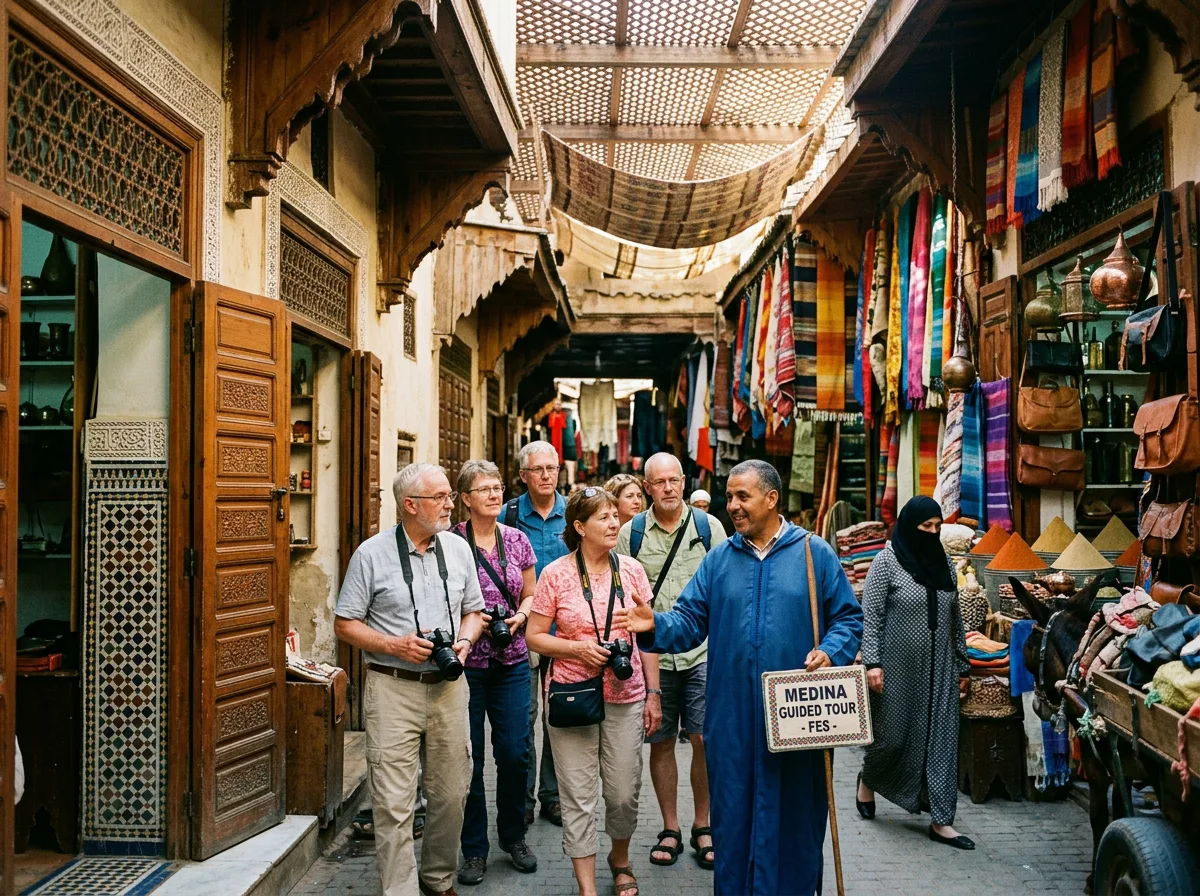
Here is the honest answer. A great many women travel Marrakech solo every year and have a wonderful, safe trip — while also meeting persistent attention and touting in the medina and souks that is tiring but very rarely dangerous. Serious crime against visitors is uncommon in the parts of the city you will spend your time. The difference between a wearing visit and a thoroughly rewarding one is simply knowing what to expect and carrying a handful of practical, respectful habits. This is a guide to exactly that — no sugar-coating, and no fear-mongering.
A note on tone
We have tried to write this the way we would brief a friend: reassuring where reassurance is honest, and frank about the bits that wear people down. The attention in the souks is a feature of a busy tourist medina and the commerce that runs it — it is not a comment on Moroccan people, the overwhelming majority of whom are warm, helpful and entirely uninterested in selling you anything. We do not publish crime statistics, emergency phone numbers or prices here, because those change and are easy to get wrong; for anything official, check current government travel advice and your accommodation before you travel.
So — is Marrakech safe for solo women?
Broadly, yes. In terms of violent crime, the medina, Gueliz and Hivernage — the areas visitors actually move through — are generally safe, and Marrakech is thoroughly set up for international travellers. What is real, and worth preparing for, is verbal attention and persistent selling in the souks and around the headline sights. It can feel relentless on day one. By day two or three, most people have found their rhythm and their phrase for declining, and the city opens up.
Keep two truths side by side and you will read Marrakech correctly: the hassle is mostly about persistence and commerce, not danger; and your own preparation — modest-ish dress, a confident walk, arranged transport after dark — measurably smooths the experience. If you would like the wider national picture, our measured take on whether Morocco is safe sets the scene, and our dedicated guide for women travellers goes deeper still.
What is the medina and Jemaa el-Fna hassle actually like — and how do I handle it?
In the souks north of Jemaa el-Fna, expect to be addressed often: shopkeepers calling you in, men offering directions or attaching themselves as informal ‘guides’, the occasional comment. It is harassment in the sense that it is unsolicited and tiring, but it is rarely threatening, and it tends to evaporate the moment you make it clear, calmly, that you are not a customer. The handful of patterns worth recognising:
- The faux guide. Someone walks alongside, points things out, then expects payment — or steers you to a shop that pays them a cut. A polite ‘no thank you’ and continuing on your way is all that is required; you owe nothing to help you did not ask for.
- ‘This way is closed.’ A classic opener — that the square, the tannery or your route is shut, conveniently requiring a detour past particular stalls. Treat it as a sales line, not information. Trust your map or step into a café to check.
- The hard sell in the souk. Persistent, theatrical, and entirely normal here. You are allowed to browse, smile and leave empty-handed. If you do want to buy, our souk haggling guide shows how the back-and-forth is meant to work.
The single most useful habit is a default response you can give without thinking: a friendly but final ‘la, shukran’ (no, thank you), said once, eyes ahead, feet still moving. Do not stop to argue, and do not feel you owe a conversation. If the medina’s intensity is your main worry, our honest piece on whether Marrakech is overwhelming is worth a read.
What should I wear?
Aim for comfortable and modest-ish — respectful, not restrictive. Covering shoulders and knees in the medina, the souks and on village day trips reads as cultural awareness and, in practice, noticeably reduces unwanted attention. Loose, breathable clothing — linen trousers or a long skirt with a light top — handles the heat and the dust better than tight fits anyway.
A lightweight scarf is the single most versatile thing to pack: a shoulder cover in the souks, a wrap near a mosque, sun protection on an Agafay or Atlas day, a dust barrier on a piste. You do not need to cover your hair in the streets, and in modern Gueliz and Hivernage plenty of Moroccan women dress in contemporary western styles. By the riad pool and on the Essaouira beach, normal swimwear is fine; at a traditional public hammam, men and women bathe separately and most people keep underwear or swim briefs on. Our what-to-pack guide has the full list.
Getting around safely — taxis, riads and walking at night
The little petits taxis are your friend for skipping a long walk or an after-dark stretch. Ask for the meter (‘compteur’) or agree the fare before you set off, since meters are not always switched on for tourists — this is the most common low-level taxi friction, and a calm question up front settles it. Cars cannot enter the narrow medina lanes, so you will be dropped at the nearest gate or square and walk the last few minutes; keep your riad’s closest landmark handy. Our full guide to getting around Marrakech covers taxis, walking and transfers in detail.
After dark, Jemaa el-Fna and the main arteries stay busy and are comfortable to walk; the quiet residential derbs are best avoided alone simply because they are unlit and a maze. For arrivals, a pre-arranged airport pickup is the calmest possible start — no arrivals-hall scrum, no fare negotiation, and a driver who can get you to your riad’s gate.
Where should I stay?
For a solo traveller, a riad with strong recent reviews is hard to beat: the small scale, the courtyard, the shared breakfast and staff who learn your name make for a soft landing and a natural source of local advice. Look specifically for places that mention solo guests, offer an airport pickup (worth it given the medina’s unmarked lanes), and have a secure entrance. The riad team is also your best ally for arranging a trusted taxi, a licensed guide or a hammam.
For the trade-offs between the medina, Gueliz and Hivernage, see where to stay in Marrakech, and for specific properties, our pick of the best riads in the medina.
Photography, consent and scams to know
Landscapes, architecture and street scenes are a joy to photograph. People are different: always ask before photographing someone — especially market vendors, artisans and women — and accept a no gracefully. Some performers and stallholders, particularly around Jemaa el-Fna, will expect a small tip if you photograph them or their animals; agree it first, or simply put the camera away. It is courtesy, and it heads off an awkward demand afterwards.
Beyond the faux-guide and ‘it’s closed’ openers, the everyday things to keep an eye on are the unmetered taxi, the ‘free’ gift or sprig of mint pressed into your hand that then expects payment, and over-eager ‘help’ at an ATM or cashpoint. None of it is sinister; it is opportunism, and a polite, unbothered decline handles almost all of it. For the money side, using money in Marrakech and the practical things to know before you visit cover the rest.
When a private guide or guided day trip removes the friction
We will be honest about our own role here: hiring a guide or a driver is a comfort upgrade, not a safety requirement. Many women explore Marrakech perfectly happily on their own. But if the constant souk attention is the part you are dreading, a half-day private guided walk through the medina genuinely removes most of it — a licensed guide threads the lanes without the faux-guide approaches, explains what you are seeing, and acts as a natural buffer through the busiest stretches. You can hand the whole first day to a private medina & souks walk and find your own feet afterwards.
For day trips out of the city — the High Atlas and Ourika valley, or the Atlantic at Essaouira — a private driver-guide means no early-morning logistics and a door you can be picked up from. Marrakech also has a growing community of licensed female guides; if you would prefer one, just ask and we will arrange it. Browse everything we run on the private tours page, or simply tell us your plans.
Cultural context and getting help
It helps to hold the right frame. Marrakech is a busy, commercial tourist medina in a Muslim-majority country with a relaxed but real sense of modesty. The persistence you meet in the souks is the commerce talking — the same instinct that makes the city such a vivid place to wander. The vast majority of your interactions, from the riad staff to the café owner to the person who points you the right way for nothing at all, will be ordinary and kind.
For practical help, your riad is the first port of call — staff can arrange a trusted taxi, a guide or a doctor, and are used to looking after solo guests. Keep a phone photo of your passport, save your riad’s location and nearest landmark offline, and note your country’s consular contacts and the local emergency numbers from an official source before you travel (we deliberately do not print numbers here, as they can change). Travel insurance that covers medical care is, as anywhere, worth having. For first-trip nerves more broadly, our honest solo travel guide is a good companion to this one.
Frequently asked
Is Marrakech safe for solo female travellers?
On the whole, yes. A great many women travel Marrakech alone every year and come away glad they did, and serious crime against tourists is uncommon in the parts of the city visitors spend their time. What you should expect, rather than fear, is persistent commercial attention in the medina and souks — vendors, men offering directions or 'guiding', a harder sell than you may be used to. It is tiring more than threatening. Knowing it is coming, and having a calm, firm way to handle it, is what turns a wearing trip into a thoroughly rewarding one.
Is it safe to walk alone at night in Marrakech?
Jemaa el-Fna and the main medina arteries stay busy and lively well into the evening, and plenty of women walk them after dark. The deep, quiet residential derbs (the narrow side-lanes) are a different matter — poorly lit and easy to get lost in, so it is more comfortable to stick to the main routes or take a petit taxi or an arranged car back to your riad. This is sensible big-city caution rather than anything specific to Marrakech: stay where there are people and lights, and you will be fine.
What should I wear as a woman in Marrakech?
Comfortable, modest-ish, and respectful rather than restrictive. Covering shoulders and knees in the medina, the souks and on village day trips reads as cultural awareness and, in practice, noticeably softens unsolicited attention. A lightweight scarf you can drape over your shoulders is the single most useful thing to pack — it doubles as sun cover and a wrap near a mosque. You do not need to cover your hair, and in modern Gueliz and Hivernage plenty of Moroccan women wear contemporary western styles. By a riad pool or on the Essaouira beach, normal swimwear is fine.
How do I deal with persistent vendors and faux guides?
Keep it light, firm and moving. A friendly but final 'la, shukran' (no, thank you) said once, without breaking stride or getting drawn into a back-and-forth, handles the vast majority of approaches. Be wary of unsolicited 'help' with directions or anyone insisting your route is 'closed' or that a square or workshop is 'this way' — these are usually openers, not facts. You are never obliged to follow, to engage, or to feel rude. Most exchanges are perfectly ordinary commerce; you just need a default that lets you decline and walk on.
Are petit taxis safe for solo women?
Yes, and they are the easy way to skip a long walk or an after-dark stretch. The petits taxis are the small city cabs; ask the driver to use the meter ('compteur', svp) or agree the fare before you set off, since meters are not always switched on for tourists. Have your riad's nearest gate or a known landmark to hand — cars cannot enter the narrow medina lanes, so you will be dropped at the closest square or gate and walk the last few minutes. Keeping small notes makes paying simpler.
Does hiring a female guide or a private driver actually help?
It removes most of the day-to-day friction, honestly. A licensed guide walks you through the souks without the faux-guide approaches, and a pre-booked driver means no haggling at the airport or after dark. Marrakech also has a growing community of licensed female guides, who can offer a different read on daily life and access to spaces such as a women's hammam or a family kitchen. It is not a safety necessity — many women happily explore independently — but it is a genuine comfort-and-ease upgrade, especially on your first day.
Travelling solo — and want the friction taken out
Tell us your dates and we will shape an easy, confident Marrakech around you.
Airport pickup, a vetted riad, a licensed guide for the medina — a female guide if you prefer — and day trips with an English-speaking driver. Independent where you want it, supported where it helps.
Request an itinerary